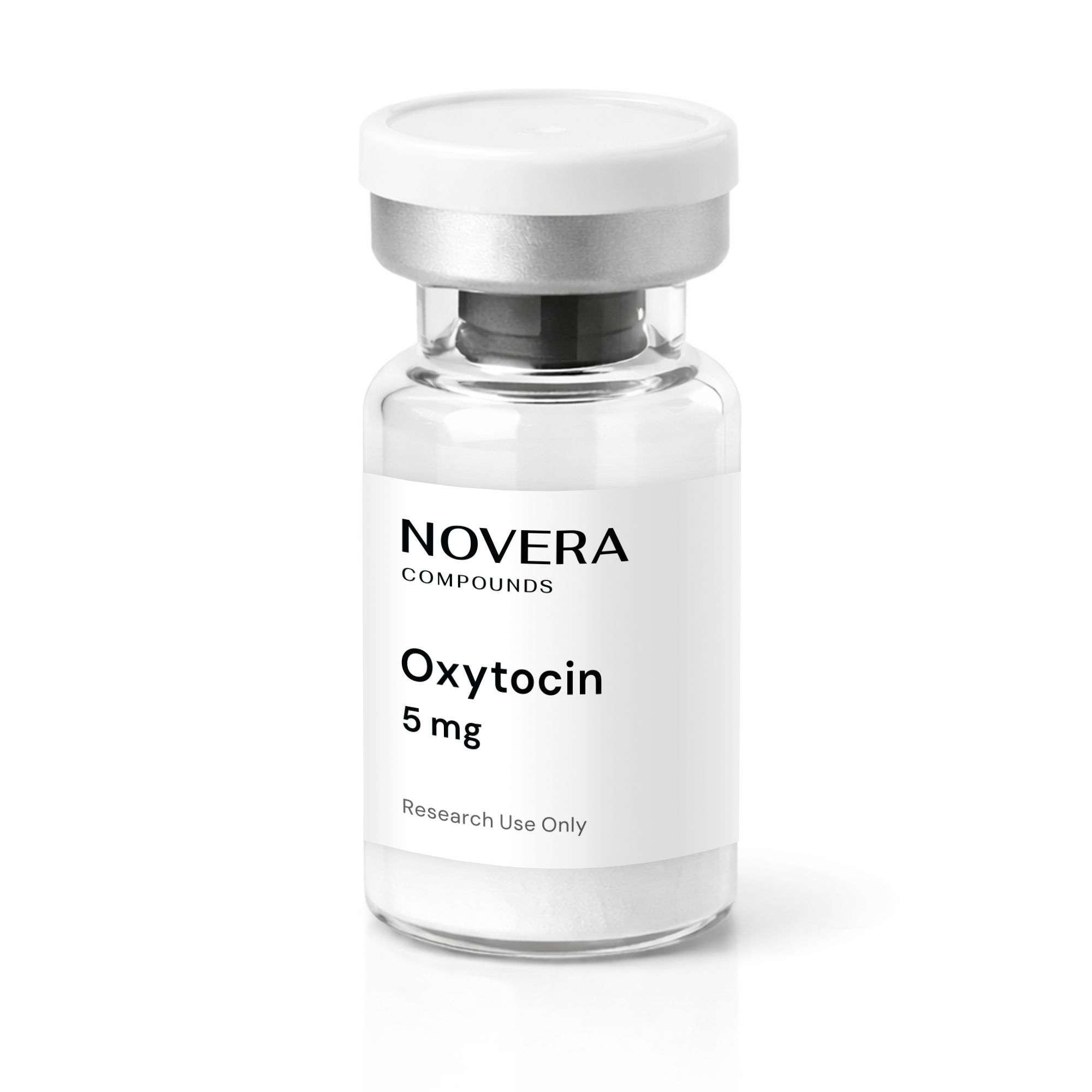
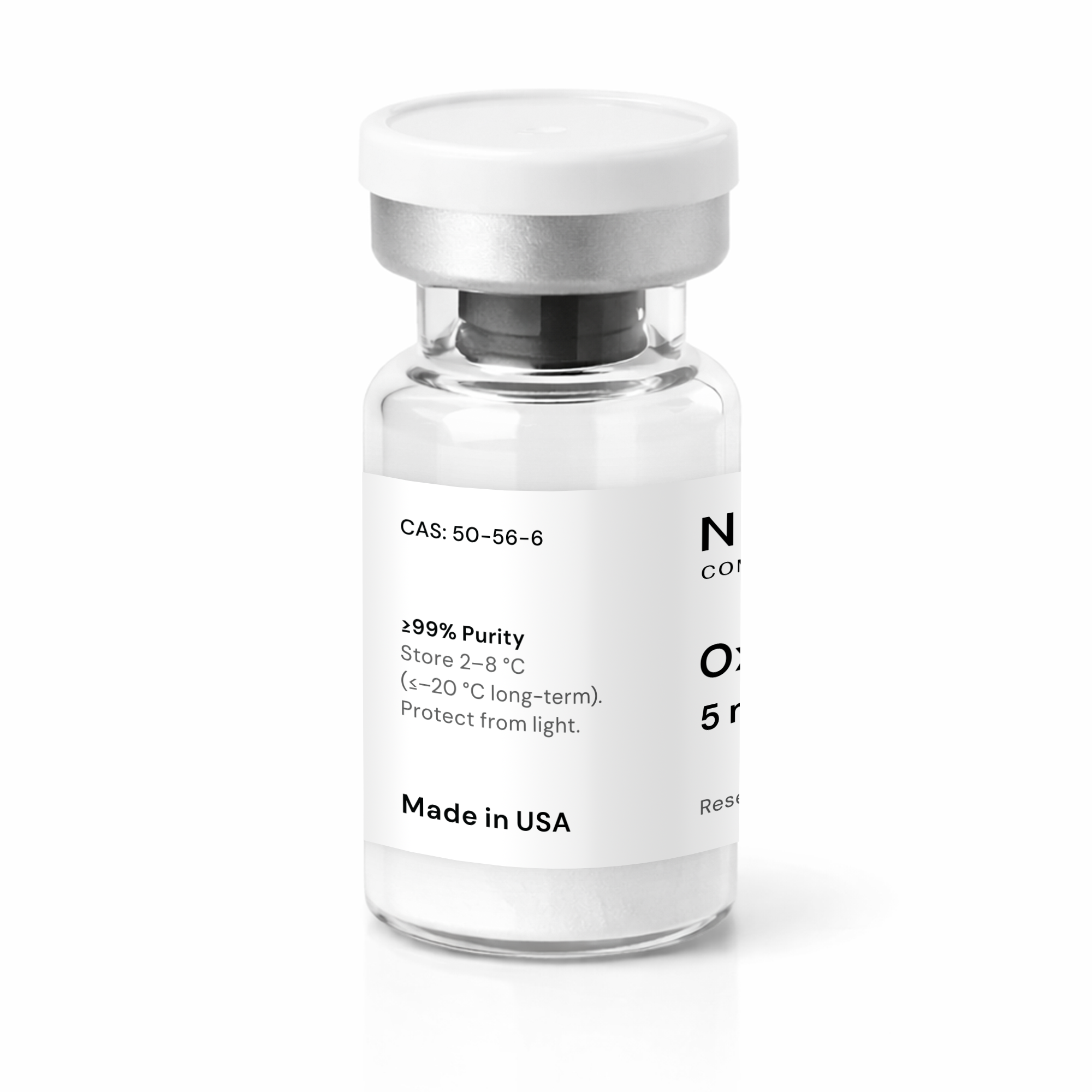
Oxytocin (5mg)
All products are 100% genuine and sourced from trusted manufacturers, with authenticity that can be verified for complete peace of mind.
Order exactly what you need with no minimum quantity required, whether it’s a single unit or a larger order.
Your order is guaranteed to arrive safely, with full shipment tracking and dedicated support to ensure a smooth delivery experience.
Your payments are protected with industry-standard encryption and trusted payment providers, ensuring every transaction is safe, private, and secure.
 99% PURITY GUARANTEE
 99% PURITY GUARANTEE
Each peptide batch is tested and verified to meet or exceed 98–99% purity (HPLC). Full analytical reports are available in the Certificate of Analysis section.
 Preparation & Handling Notice
The product is delivered in powdered (lyophilized) form and must be properly reconstituted prior to research use.
 RESEARCH USE ONLY
This product is intended for research use only. It is not for human or veterinary use, not for diagnostic or therapeutic purposes, and should only be handled by qualified professionals.
Strength: 5 mg
CAS: 50-56-6
Chemical Formula: C₄₃H₆₆N₁₂O₁₂S₂
Molecular weight: 1007.2 g/mol
Peptide Sequence: Cys-Tyr-Ile-Gln-Asn-Cys-Pro-Leu-Gly-NH2
Synonyms: Pitocin, Endopituitrina
Storage: Store 2–8 °C (≤–20 °C long-term). RT exposure during transport acceptable. Protect from light.
Shelf life: 24 months from the manufacturing date.
Ovagen is a synthetic tripeptide bioregulator (Glu Asp Leu; EDL) classified as an organ specific peptide with primary experimental use in liver and gastrointestinal models. Research suggests that it may influence chromatin organization, gene expression, protein synthesis markers, antioxidant defenses, fibrotic remodeling, and viral protease interactions in preclinical hepatic and gastrointestinal studies.
-
Cold chain shipping available for temperature-sensitive products.
-
Orders are processed within 1–2 business days.
-
Delivery timelines vary by destination and shipping method — view our Shipping Policy for region-specific estimates.
-
Tracking information will be provided once shipped.
-
No order minimum applies.
-
If your shipment is delayed, lost, or arrives damaged, you're covered under our Refund & Replacement Policy.
We accept Visa, Mastercard, and American Express. Apple Pay and Google Pay are available upon request via your account manager.
All transactions are processed through a secure, PCI DSS–compliant system to ensure your data is fully protected.
Why Choose NOVERA COMPOUNDS Peptides?
Novera Research delivers high-quality research peptides developed under strict manufacturing and quality-control standards. Each product is carefully synthesized, tested, and handled to ensure consistency, reliability, and transparency for advanced research applications.
- High-purity, research-grade peptide synthesis
- Analytical testing to verify quality and composition
- Consistent batch-to-batch performance
- Batch identification on every vial for traceability
- Stored and shipped under controlled conditions
 High-purity, research-grade peptide synthesis

Why Choose Medica Depot
Shop hundreds of medical products with no minimums and free shipping on large orders.
 400+ products
 No order minimums
 Free shipping
 Loyalty rewards
 Trusted since 2007
 Account manager
 Verified LOT numbers
INFORMATION
What is Oxytocin (5 mg)?
Oxytocin (5 mg) is a cyclic 9-amino-acid peptide that functions as both a hormone and a neuropeptide. The body produces it in the hypothalamus and releases it through the posterior pituitary, where it acts in peripheral tissues and within neuroendocrine signaling networks.
Researchers often classify oxytocin within the sexual health and hormonal peptide category because it plays a key role in reproductive processes. It’s also examined in models of social behavior, emotional processing, and stress responses.
In laboratory settings, synthetic oxytocin serves as a reference standard for studying oxytocin receptor (OXTR) signaling, smooth-muscle activity, and peptide-driven changes in physiology and behavior in controlled in vitro and non-clinical in vivo research.
Product Specifications
- Synonyms: Pitocin; Endopituitrina
- Peptide Sequence: Cys–Tyr–Ile–Gln–Asn–Cys–Pro–Leu–Gly–NH₂
- Chemical Formula: C₄₃H₆₆N₁₂O₁₂S₂
- Molecular Weight: 1007.2 g/mol
- CAS Number: 50-56-6
- Purity: Research-grade synthetic peptide, typically ≥98–99% by HPLC; identity and purity confirmed by HPLC and mass spectrometry, with batch results listed in a COA
- Packaging Format: 5 mg lyophilized (freeze-dried) oxytocin in a sealed vial—ideal for small-volume stock solutions and pilot studies
- Storage Conditions: Store at −20 °C, protect from light and moisture, and avoid repeated freeze–thaw cycles
- Intended Use: For laboratory research use only; not for human or veterinary use
Key Characteristics of Oxytocin (5 mg)
- Compact cyclic peptide: A disulfide bond between two cysteines forms a stable ring structure that supports strong binding to OXTR.
- Clear signaling pathway profile: Oxytocin activates OXTR (a GPCR), commonly triggering Gq/11-linked signaling, including phospholipase C activation and intracellular calcium release in various models.
- Broad research relevance: Endogenous oxytocin supports uterine contraction and milk ejection, and contributes to pathways involved in social bonding and stress reactivity.
- Useful across systems biology: Researchers use oxytocin to explore links between receptor signaling and endpoints in neural, reproductive, cardiovascular, metabolic, and inflammation-related models.
How Oxytocin (5 mg) Supports Research
Oxytocin (5 mg) provides researchers with a well-characterized peptide for studying OXTR biology and downstream signaling under controlled conditions. In cell and tissue systems, researchers use oxytocin to evaluate ligand–receptor interactions, second-messenger activity, and signaling-linked changes in reproductive, vascular, and neural models.
In behavioral and neuroendocrine research, oxytocin helps investigators examine correlations between oxytocin signaling and attachment, social cognition, anxiety-like behavior, and stress adaptation—linking molecular readouts with system-level outcomes without implying therapeutic use.
Research Applications & Usage Information
- Receptor and Signaling Studies:
- Use oxytocin as a standard agonist for OXTR pharmacology, including binding assays, selectivity checks versus vasopressin receptors, and studies of receptor desensitization/internalization.
- Measure second-messenger responses, including phospholipase C activation, inositol phosphate signaling, calcium flux, and related kinase/transcription-factor pathways.
- Reproductive and Smooth-Muscle Physiology:
- Apply oxytocin to uterine and mammary tissue models to assess contractility, receptor sensitivity, and modulation by other hormones or test compounds.
- Use vascular and smooth-muscle systems to examine tone regulation, receptor density changes, and pathway cross-talk.
- Social Behavior, Stress, and Cognition: Use animal models and translational research paradigms to examine relationships among oxytocin signaling, social bonding, anxiety-like behavior, stress buffering, and cognitive measures.
- Inflammation, Wound Healing, and Cardiometabolic Models: Incorporate oxytocin into studies tracking cytokine profiles, wound-repair markers, blood pressure signaling, and cardiometabolic risk indicators under defined experimental conditions.
- Metabolic Homeostasis and Energy Balance: Use obesity and dysglycemia models to evaluate how oxytocin influences food intake, adiposity-related endpoints, and insulin-associated measures in non-clinical research and early human studies.
Note: Investigators must define all experimental parameters (e.g., concentration, exposure time, route, formulation) based on study goals and applicable standards. However, no dosing or clinical recommendations are provided or implied.
Handling and Storage Recommendations
- Store lyophilized oxytocin at −20 °C in the original vial, tightly closed, and protected from light and moisture.
- Let the sealed vial reach room temperature before opening to reduce condensation.
- Store aliquots refrigerated or frozen per internal stability limits; discard if appearance changes or storage limits are exceeded.
- Use standard PPE and dispose of materials in accordance with institutional and regulatory waste procedures.
Research Use Only Notice
This product is intended for laboratory research use only and is not approved for human or veterinary use. It is not intended for diagnostic, therapeutic, or clinical applications. Any reference to biological activity or potential effects is based solely on preclinical or in‑vitro findings and should not be interpreted as validated clinical outcomes. Researchers are responsible for ensuring proper handling, storage, and disposal in accordance with institutional, federal, and international guidelines.
References
- Bosch OJ, Young LJ. Oxytocin and social relationships: From attachment to bond disruption. Current Topics in Behavioral Neurosciences. 2017;35:97-117. doi:10.1007/7854_2017_10
- Gimpl G, Fahrenholz F. The oxytocin receptor system: structure, function, and regulation. Physiological Reviews. 2001;81(2):629-683. doi:10.1152/physrev.2001.81.2.629
- Marsh N, Marsh AA, Lee MR, Hurlemann R. Oxytocin and the neurobiology of prosocial behavior. The Neuroscientist. 2020;27(6):604-619. doi:10.1177/1073858420960111
- 1-(19-Amino-7-(2-Amino-2-Oxoethyl)-10-(3-Amino-3-Oxopropyl)-13-Butan-2-Yl-16-((4-Hydroxyphenyl)Methyl)-6,9,12,15,18-Pentaoxo-1,2-Dithia-5,8,11,14,17-Pentazacycloicosane-4-Carbonyl)-N-(1-((2-Amino-2-Oxoethyl)Amino)-4-Methyl-1-Oxopentan-2-Yl)Pyrrolidine-2-Carboxamide. PubChem. https://pubchem.ncbi.nlm.nih.gov/compound/Cys-Tyr-Ile-Gln-Asn-Cys-Pro-Leu-Gly-NH2
- Donaldson ZR, Young LJ. Oxytocin, vasopressin, and the neurogenetics of sociality. Science. 2008;322(5903):900-904. doi:10.1126/science.1158668
What is Oxytocin (5 mg)?
Oxytocin (5 mg) is a cyclic 9-amino-acid peptide that functions as both a hormone and a neuropeptide. The body produces it in the hypothalamus and releases it through the posterior pituitary, where it acts in peripheral tissues and within neuroendocrine signaling networks.
Researchers often classify oxytocin within the sexual health and hormonal peptide category because it plays a key role in reproductive processes. It’s also examined in models of social behavior, emotional processing, and stress responses.
In laboratory settings, synthetic oxytocin serves as a reference standard for studying oxytocin receptor (OXTR) signaling, smooth-muscle activity, and peptide-driven changes in physiology and behavior in controlled in vitro and non-clinical in vivo research.
Product Specifications
- Synonyms: Pitocin; Endopituitrina
- Peptide Sequence: Cys–Tyr–Ile–Gln–Asn–Cys–Pro–Leu–Gly–NH₂
- Chemical Formula: C₄₃H₆₆N₁₂O₁₂S₂
- Molecular Weight: 1007.2 g/mol
- CAS Number: 50-56-6
- Purity: Research-grade synthetic peptide, typically ≥98–99% by HPLC; identity and purity confirmed by HPLC and mass spectrometry, with batch results listed in a COA
- Packaging Format: 5 mg lyophilized (freeze-dried) oxytocin in a sealed vial—ideal for small-volume stock solutions and pilot studies
- Storage Conditions: Store at −20 °C, protect from light and moisture, and avoid repeated freeze–thaw cycles
- Intended Use: For laboratory research use only; not for human or veterinary use
Key Characteristics of Oxytocin (5 mg)
- Compact cyclic peptide: A disulfide bond between two cysteines forms a stable ring structure that supports strong binding to OXTR.
- Clear signaling pathway profile: Oxytocin activates OXTR (a GPCR), commonly triggering Gq/11-linked signaling, including phospholipase C activation and intracellular calcium release in various models.
- Broad research relevance: Endogenous oxytocin supports uterine contraction and milk ejection, and contributes to pathways involved in social bonding and stress reactivity.
- Useful across systems biology: Researchers use oxytocin to explore links between receptor signaling and endpoints in neural, reproductive, cardiovascular, metabolic, and inflammation-related models.
How Oxytocin (5 mg) Supports Research
Oxytocin (5 mg) provides researchers with a well-characterized peptide for studying OXTR biology and downstream signaling under controlled conditions. In cell and tissue systems, researchers use oxytocin to evaluate ligand–receptor interactions, second-messenger activity, and signaling-linked changes in reproductive, vascular, and neural models.
In behavioral and neuroendocrine research, oxytocin helps investigators examine correlations between oxytocin signaling and attachment, social cognition, anxiety-like behavior, and stress adaptation—linking molecular readouts with system-level outcomes without implying therapeutic use.
Research Applications & Usage Information
- Receptor and Signaling Studies:
- Use oxytocin as a standard agonist for OXTR pharmacology, including binding assays, selectivity checks versus vasopressin receptors, and studies of receptor desensitization/internalization.
- Measure second-messenger responses, including phospholipase C activation, inositol phosphate signaling, calcium flux, and related kinase/transcription-factor pathways.
- Reproductive and Smooth-Muscle Physiology:
- Apply oxytocin to uterine and mammary tissue models to assess contractility, receptor sensitivity, and modulation by other hormones or test compounds.
- Use vascular and smooth-muscle systems to examine tone regulation, receptor density changes, and pathway cross-talk.
- Social Behavior, Stress, and Cognition: Use animal models and translational research paradigms to examine relationships among oxytocin signaling, social bonding, anxiety-like behavior, stress buffering, and cognitive measures.
- Inflammation, Wound Healing, and Cardiometabolic Models: Incorporate oxytocin into studies tracking cytokine profiles, wound-repair markers, blood pressure signaling, and cardiometabolic risk indicators under defined experimental conditions.
- Metabolic Homeostasis and Energy Balance: Use obesity and dysglycemia models to evaluate how oxytocin influences food intake, adiposity-related endpoints, and insulin-associated measures in non-clinical research and early human studies.
Note: Investigators must define all experimental parameters (e.g., concentration, exposure time, route, formulation) based on study goals and applicable standards. However, no dosing or clinical recommendations are provided or implied.
Handling and Storage Recommendations
- Store lyophilized oxytocin at −20 °C in the original vial, tightly closed, and protected from light and moisture.
- Let the sealed vial reach room temperature before opening to reduce condensation.
- Store aliquots refrigerated or frozen per internal stability limits; discard if appearance changes or storage limits are exceeded.
- Use standard PPE and dispose of materials in accordance with institutional and regulatory waste procedures.
Research Use Only Notice
This product is intended for laboratory research use only and is not approved for human or veterinary use. It is not intended for diagnostic, therapeutic, or clinical applications. Any reference to biological activity or potential effects is based solely on preclinical or in‑vitro findings and should not be interpreted as validated clinical outcomes. Researchers are responsible for ensuring proper handling, storage, and disposal in accordance with institutional, federal, and international guidelines.
References
- Bosch OJ, Young LJ. Oxytocin and social relationships: From attachment to bond disruption. Current Topics in Behavioral Neurosciences. 2017;35:97-117. doi:10.1007/7854_2017_10
- Gimpl G, Fahrenholz F. The oxytocin receptor system: structure, function, and regulation. Physiological Reviews. 2001;81(2):629-683. doi:10.1152/physrev.2001.81.2.629
- Marsh N, Marsh AA, Lee MR, Hurlemann R. Oxytocin and the neurobiology of prosocial behavior. The Neuroscientist. 2020;27(6):604-619. doi:10.1177/1073858420960111
- 1-(19-Amino-7-(2-Amino-2-Oxoethyl)-10-(3-Amino-3-Oxopropyl)-13-Butan-2-Yl-16-((4-Hydroxyphenyl)Methyl)-6,9,12,15,18-Pentaoxo-1,2-Dithia-5,8,11,14,17-Pentazacycloicosane-4-Carbonyl)-N-(1-((2-Amino-2-Oxoethyl)Amino)-4-Methyl-1-Oxopentan-2-Yl)Pyrrolidine-2-Carboxamide. PubChem. https://pubchem.ncbi.nlm.nih.gov/compound/Cys-Tyr-Ile-Gln-Asn-Cys-Pro-Leu-Gly-NH2
- Donaldson ZR, Young LJ. Oxytocin, vasopressin, and the neurogenetics of sociality. Science. 2008;322(5903):900-904. doi:10.1126/science.1158668
Related products