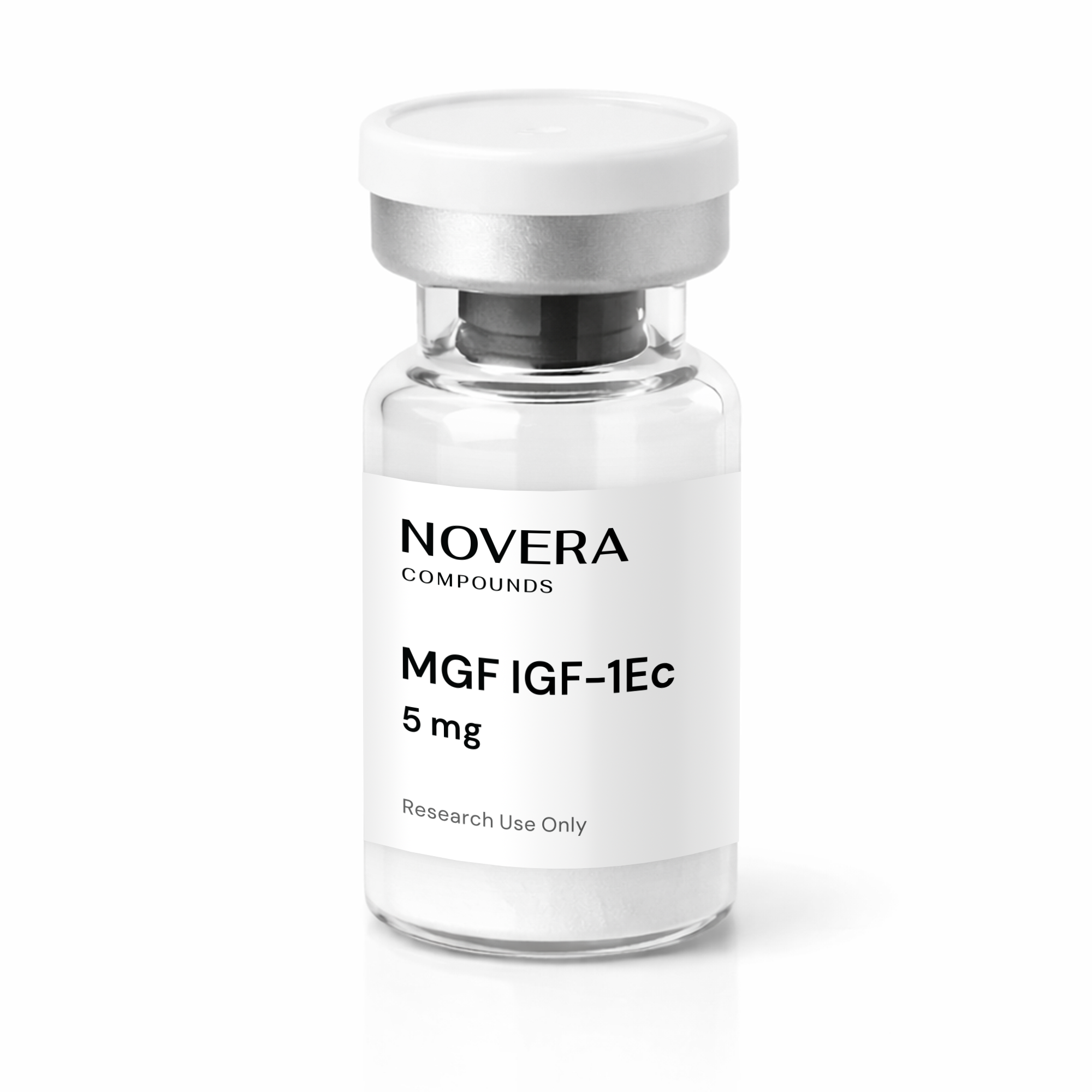
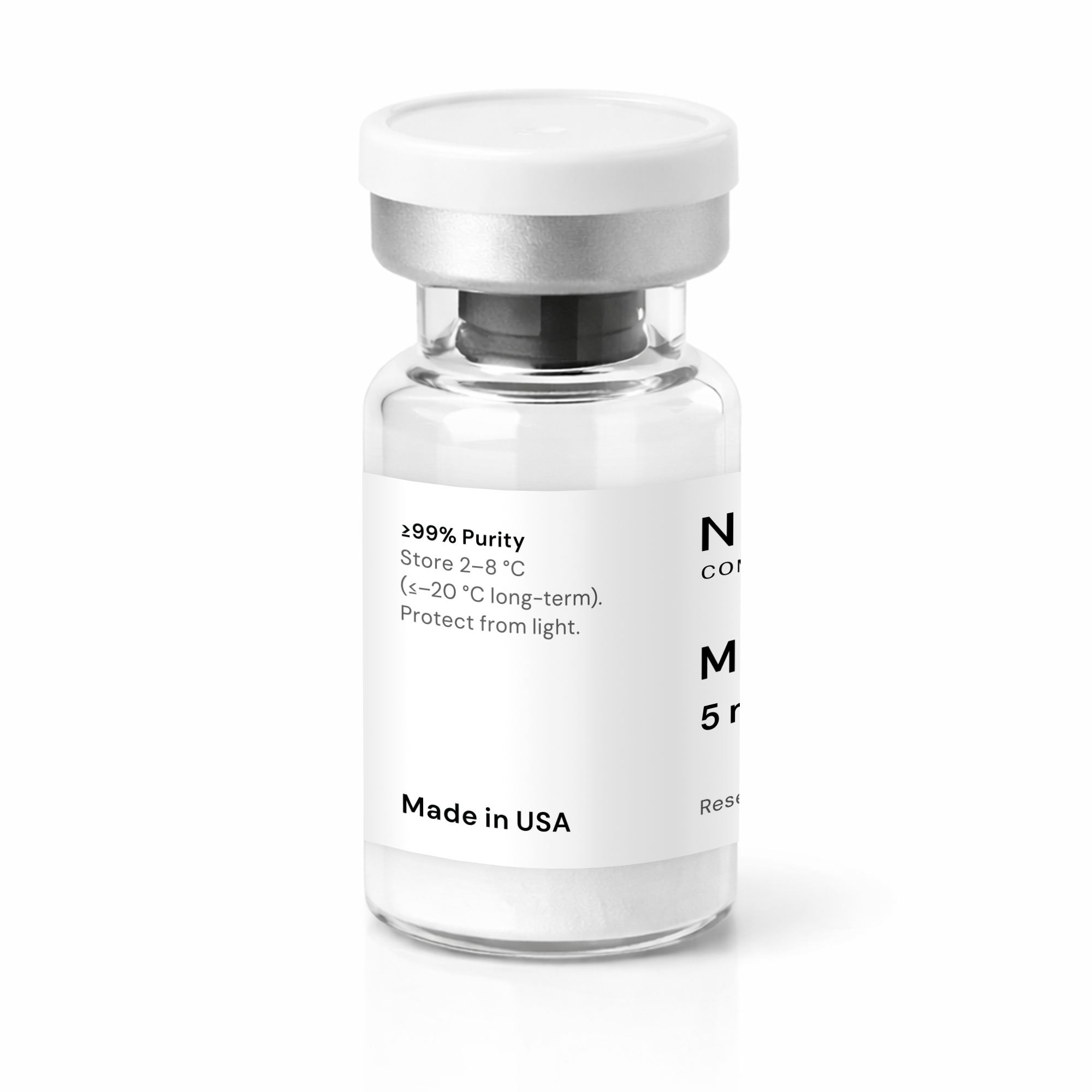
MGF IGF-1Ec (5mg)
All products are 100% genuine and sourced from trusted manufacturers, with authenticity that can be verified for complete peace of mind.
Order exactly what you need with no minimum quantity required, whether it’s a single unit or a larger order.
Your order is guaranteed to arrive safely, with full shipment tracking and dedicated support to ensure a smooth delivery experience.
Your payments are protected with industry-standard encryption and trusted payment providers, ensuring every transaction is safe, private, and secure.
 99% PURITY GUARANTEE
 99% PURITY GUARANTEE
Each peptide batch is tested and verified to meet or exceed 98–99% purity (HPLC). Full analytical reports are available in the Certificate of Analysis section.
 Preparation & Handling Notice
The product is delivered in powdered (lyophilized) form and must be properly reconstituted prior to research use.
 RESEARCH USE ONLY
This product is intended for research use only. It is not for human or veterinary use, not for diagnostic or therapeutic purposes, and should only be handled by qualified professionals.
Strength: IGF-1Ec
CAS: N/A
Chemical Formula: C₁₂₄H₂₀₄N₄₂O₄₁S₁
Molecular weight: 2971.99 g/mol
Peptide Sequence: Tyr-GIn-Pro-Pro-Ser-Thr-Asn-Lys-Asn-Thr-Lys-Ser-GIn-Arg-Arg-Lys-Gly-Ser-Thr-Phe-Glu-Glu-Arg-Lys-Cys
Synonyms: Mechano Growth Factor C-terminal
Storage: Store 2–8 °C (≤–20 °C long-term). RT exposure during transport acceptable. Protect from light.
Shelf life: 24 months from the manufacturing date.
MGF IGF 1Ec (5mg) is a synthetic C terminal E domain peptide derived from the mechano growth factor (IGF 1Ec) splice variant and is used in muscle biology research to investigate mechano responsive IGF 1 isoform signaling. Research indicates that IGF 1Ec/MGF is upregulated in skeletal muscle following mechanical overload or injury and that synthetic MGF E domain peptides can modulate satellite cell proliferation, myogenic signaling, and tissue repair–related gene expression in preclinical models, complementing but functionally differing from mature IGF 1.
-
Cold chain shipping available for temperature-sensitive products.
-
Orders are processed within 1–2 business days.
-
Delivery timelines vary by destination and shipping method — view our Shipping Policy for region-specific estimates.
-
Tracking information will be provided once shipped.
-
No order minimum applies.
-
If your shipment is delayed, lost, or arrives damaged, you're covered under our Refund & Replacement Policy.
We accept Visa, Mastercard, and American Express. Apple Pay and Google Pay are available upon request via your account manager.
All transactions are processed through a secure, PCI DSS–compliant system to ensure your data is fully protected.
Why Choose NOVERA COMPOUNDS Peptides?
Novera Research delivers high-quality research peptides developed under strict manufacturing and quality-control standards. Each product is carefully synthesized, tested, and handled to ensure consistency, reliability, and transparency for advanced research applications.
- High-purity, research-grade peptide synthesis
- Analytical testing to verify quality and composition
- Consistent batch-to-batch performance
- Batch identification on every vial for traceability
- Stored and shipped under controlled conditions
 High-purity, research-grade peptide synthesis

Why Choose Medica Depot
Shop hundreds of medical products with no minimums and free shipping on large orders.
 400+ products
 No order minimums
 Free shipping
 Loyalty rewards
 Trusted since 2007
 Account manager
 Verified LOT numbers
INFORMATION
What is MGF IGF‑1Ec (5mg)?
MGF IGF‑1Ec (5mg) is a synthetic C‑terminal peptide fragment corresponding to the E‑domain of the mechano growth factor (MGF) isoform of insulin‑like growth factor‑1 (IGF‑1Ec). IGF‑1Ec/MGF is a splice variant of the IGF‑1 gene that is upregulated in skeletal muscle and other tissues after mechanical overload or cellular stress.
In muscle growth and performance research, MGF IGF‑1Ec (Mechano Growth Factor C‑terminal) is used to study mechano‑sensitive signaling involved in myogenic activation, proliferation, and repair pathways.
Product Specifications
- Peptide Sequence: Tyr‑Gln‑Pro‑Pro‑Ser‑Thr‑Asn‑Lys‑Asn‑Thr‑Lys‑Ser‑Gln‑Arg‑Arg‑Lys‑Gly‑Ser‑Thr‑Phe‑Glu‑Glu‑Arg‑Lys‑Cys
- Chemical Formula: C₁₂₄H₂₀₄N₄₂O₄₁S₁
- Molecular Weight: 2971.99 g/mol
- Purity: Supplied as a high‑purity research peptide (typically ≥98–99% by HPLC), with identity and purity assessed via chromatographic methods and mass spectrometry; lot‑specific values are documented in a certificate of analysis (COA).
- Packaging Format: 5 mg lyophilized (freeze‑dried) MGF IGF‑1Ec peptide in a sealed vial, suitable for reconstitution with an appropriate solvent or buffer prior to experimental use.
- Storage Conditions: Store at −20°C, protected from light and moisture; avoid repeated freeze–thaw cycles to help maintain structural integrity and experimental performance.
- Intended Use: For laboratory research use only; not for human or veterinary use.
Key Characteristics of MGF IGF‑1Ec (5mg)
- E-Domain Fragment of IGF-1Ec (MGF): Represents the C-terminal region linked to IGF-1 splicing patterns that rise after mechanical stress or tissue strain in research models.
- Muscle Cell Behavior Studies: Preclinical work uses MGF-related fragments to examine myoblast and satellite-cell activity, often focusing on early-phase responses such as proliferation and activation timing.
- Pathway Mapping: Researchers evaluate how MGF-associated signaling may connect with IGF-1 receptor–linked pathways (e.g., PI3K/Akt) and other intracellular cascades, while also exploring effects that may not fully depend on the IGF-1 receptor.
- Tool for Local vs Systemic IGF-1 Biology: Helps compare “local” splice-variant responses (IGF-1Ec/MGF) with effects typically attributed to other IGF-1 isoforms in mechanistic designs.
- Research-Grade Consistency: Supplied as a sequence-defined, lyophilized peptide with standard analytical documentation (HPLC/MS/CoA) to support reproducibility across experiments.
How MGF IGF‑1Ec (5mg) Supports Research
MGF IGF‑1Ec (5mg) supports research by providing a defined E‑domain peptide derived from the IGF‑1Ec/MGF splice variant, enabling investigators to isolate and study mechano‑responsive signaling separate from full‑length IGF‑1.
In skeletal muscle models, this peptide helps clarify how local IGF‑1 isoforms contribute to satellite‑cell activation, myogenic proliferation, and subsequent repair programs following mechanical loading or injury.
Since MGF expression is closely linked to mechanical stress and damage, synthetic MGF IGF‑1Ec peptides are also used to explore how splice‑variant–specific responses differ across tissues (muscle, heart, nervous system) and how E‑domain fragments complement or diverge from canonical IGF‑1 receptor signaling.
Research Applications & Usage Information
- Muscle Damage, Repair, and Regeneration Models: Used to track changes in regeneration markers, myogenic regulators (e.g., MyoD), and repair kinetics after overload or injury in preclinical systems.
- Satellite‑Cell Activation and Myogenic Signaling: Applied in muscle cell cultures to study activation/proliferation timing and compare responses to mature IGF-1, including analysis of PI3K/Akt, ERK, and related pathways.
- Mechano‑Sensitive Gene Expression and Splicing: Supports studies examining how mechanical inputs influence IGF-1 splicing patterns and early response gene signatures in controlled models.
- Neuro‑Muscular and Neurogenic Models: Included in experimental designs exploring neuromuscular signaling and cell-survival endpoints in defined disease or stress models.
- Cardiac and Ischemia‑Related Research: Used in preclinical cardiac research to examine remodeling, inflammation markers, and stress-response signaling—strictly as a mechanistic tool.
Note: Experimental protocols (e.g., concentrations, exposure durations, dosing schedules, and routes of administration) vary widely between studies and must be defined by qualified investigators. No specific protocol, dosing guidance, or clinical use is recommended or implied here.
Handling and Storage Recommendations
- Keep lyophilized peptide at −20°C or colder, dry, and protected from light.
- Let the sealed vial warm to room temperature to reduce condensation.
- Use a sterile solvent/buffer suitable for your assay; mix gently until dissolved.
- Divide into small, labeled portions to limit freeze–thaw cycles. Store at 2-8°C for short-term storage and at -20°C for long-term storage.
- Use standard PPE and dispose of materials per institutional waste procedures.
Research Use Only Notice
This product is intended for laboratory research use only and is not approved for human or veterinary use. It is not intended for diagnostic, therapeutic, or clinical applications. Any reference to biological activity or potential effects is based solely on preclinical or in‑vitro findings and should not be interpreted as validated clinical outcomes. Researchers are responsible for ensuring proper handling, storage, and disposal in accordance with institutional, federal, and international guidelines.
References
- Zabłocka B, Goldspink PH, Goldspink G, Górecki DC. Mechano-Growth Factor: an important cog or a loose screw in the repair machinery? Frontiers in Endocrinology. 2012;3:131. doi:10.3389/fendo.2012.00131
- Velloso CP, Harridge SDR. Insulin‐like growth factor‐I E peptides: implications for ageing skeletal muscle. Scandinavian Journal of Medicine and Science in Sports. 2009;20(1):20-27. doi:10.1111/j.1600-0838.2009.00997.x
- Yang SY, Goldspink G. Different roles of the IGF‐I Ec peptide (MGF) and mature IGF‐I in myoblast proliferation and differentiation. FEBS Letters. 2002;522(1-3):156-160. doi:10.1016/s0014-5793(02)02918-6
- Philippou A, Barton ER. Optimizing IGF-I for skeletal muscle therapeutics. Growth Hormone & IGF Research. 2014;24(5):157-163. doi:10.1016/j.ghir.2014.06.003
- Sun KT, Cheung KK, Au SWN, Yeung SS, Yeung EW. Overexpression of Mechano-Growth factor modulates inflammatory cytokine expression and macrophage resolution in skeletal muscle injury. Frontiers in Physiology. 2018;9:999. doi:10.3389/fphys.2018.00999
What is MGF IGF‑1Ec (5mg)?
MGF IGF‑1Ec (5mg) is a synthetic C‑terminal peptide fragment corresponding to the E‑domain of the mechano growth factor (MGF) isoform of insulin‑like growth factor‑1 (IGF‑1Ec). IGF‑1Ec/MGF is a splice variant of the IGF‑1 gene that is upregulated in skeletal muscle and other tissues after mechanical overload or cellular stress.
In muscle growth and performance research, MGF IGF‑1Ec (Mechano Growth Factor C‑terminal) is used to study mechano‑sensitive signaling involved in myogenic activation, proliferation, and repair pathways.
Product Specifications
- Peptide Sequence: Tyr‑Gln‑Pro‑Pro‑Ser‑Thr‑Asn‑Lys‑Asn‑Thr‑Lys‑Ser‑Gln‑Arg‑Arg‑Lys‑Gly‑Ser‑Thr‑Phe‑Glu‑Glu‑Arg‑Lys‑Cys
- Chemical Formula: C₁₂₄H₂₀₄N₄₂O₄₁S₁
- Molecular Weight: 2971.99 g/mol
- Purity: Supplied as a high‑purity research peptide (typically ≥98–99% by HPLC), with identity and purity assessed via chromatographic methods and mass spectrometry; lot‑specific values are documented in a certificate of analysis (COA).
- Packaging Format: 5 mg lyophilized (freeze‑dried) MGF IGF‑1Ec peptide in a sealed vial, suitable for reconstitution with an appropriate solvent or buffer prior to experimental use.
- Storage Conditions: Store at −20°C, protected from light and moisture; avoid repeated freeze–thaw cycles to help maintain structural integrity and experimental performance.
- Intended Use: For laboratory research use only; not for human or veterinary use.
Key Characteristics of MGF IGF‑1Ec (5mg)
- E-Domain Fragment of IGF-1Ec (MGF): Represents the C-terminal region linked to IGF-1 splicing patterns that rise after mechanical stress or tissue strain in research models.
- Muscle Cell Behavior Studies: Preclinical work uses MGF-related fragments to examine myoblast and satellite-cell activity, often focusing on early-phase responses such as proliferation and activation timing.
- Pathway Mapping: Researchers evaluate how MGF-associated signaling may connect with IGF-1 receptor–linked pathways (e.g., PI3K/Akt) and other intracellular cascades, while also exploring effects that may not fully depend on the IGF-1 receptor.
- Tool for Local vs Systemic IGF-1 Biology: Helps compare “local” splice-variant responses (IGF-1Ec/MGF) with effects typically attributed to other IGF-1 isoforms in mechanistic designs.
- Research-Grade Consistency: Supplied as a sequence-defined, lyophilized peptide with standard analytical documentation (HPLC/MS/CoA) to support reproducibility across experiments.
How MGF IGF‑1Ec (5mg) Supports Research
MGF IGF‑1Ec (5mg) supports research by providing a defined E‑domain peptide derived from the IGF‑1Ec/MGF splice variant, enabling investigators to isolate and study mechano‑responsive signaling separate from full‑length IGF‑1.
In skeletal muscle models, this peptide helps clarify how local IGF‑1 isoforms contribute to satellite‑cell activation, myogenic proliferation, and subsequent repair programs following mechanical loading or injury.
Since MGF expression is closely linked to mechanical stress and damage, synthetic MGF IGF‑1Ec peptides are also used to explore how splice‑variant–specific responses differ across tissues (muscle, heart, nervous system) and how E‑domain fragments complement or diverge from canonical IGF‑1 receptor signaling.
Research Applications & Usage Information
- Muscle Damage, Repair, and Regeneration Models: Used to track changes in regeneration markers, myogenic regulators (e.g., MyoD), and repair kinetics after overload or injury in preclinical systems.
- Satellite‑Cell Activation and Myogenic Signaling: Applied in muscle cell cultures to study activation/proliferation timing and compare responses to mature IGF-1, including analysis of PI3K/Akt, ERK, and related pathways.
- Mechano‑Sensitive Gene Expression and Splicing: Supports studies examining how mechanical inputs influence IGF-1 splicing patterns and early response gene signatures in controlled models.
- Neuro‑Muscular and Neurogenic Models: Included in experimental designs exploring neuromuscular signaling and cell-survival endpoints in defined disease or stress models.
- Cardiac and Ischemia‑Related Research: Used in preclinical cardiac research to examine remodeling, inflammation markers, and stress-response signaling—strictly as a mechanistic tool.
Note: Experimental protocols (e.g., concentrations, exposure durations, dosing schedules, and routes of administration) vary widely between studies and must be defined by qualified investigators. No specific protocol, dosing guidance, or clinical use is recommended or implied here.
Handling and Storage Recommendations
- Keep lyophilized peptide at −20°C or colder, dry, and protected from light.
- Let the sealed vial warm to room temperature to reduce condensation.
- Use a sterile solvent/buffer suitable for your assay; mix gently until dissolved.
- Divide into small, labeled portions to limit freeze–thaw cycles. Store at 2-8°C for short-term storage and at -20°C for long-term storage.
- Use standard PPE and dispose of materials per institutional waste procedures.
Research Use Only Notice
This product is intended for laboratory research use only and is not approved for human or veterinary use. It is not intended for diagnostic, therapeutic, or clinical applications. Any reference to biological activity or potential effects is based solely on preclinical or in‑vitro findings and should not be interpreted as validated clinical outcomes. Researchers are responsible for ensuring proper handling, storage, and disposal in accordance with institutional, federal, and international guidelines.
References
- Zabłocka B, Goldspink PH, Goldspink G, Górecki DC. Mechano-Growth Factor: an important cog or a loose screw in the repair machinery? Frontiers in Endocrinology. 2012;3:131. doi:10.3389/fendo.2012.00131
- Velloso CP, Harridge SDR. Insulin‐like growth factor‐I E peptides: implications for ageing skeletal muscle. Scandinavian Journal of Medicine and Science in Sports. 2009;20(1):20-27. doi:10.1111/j.1600-0838.2009.00997.x
- Yang SY, Goldspink G. Different roles of the IGF‐I Ec peptide (MGF) and mature IGF‐I in myoblast proliferation and differentiation. FEBS Letters. 2002;522(1-3):156-160. doi:10.1016/s0014-5793(02)02918-6
- Philippou A, Barton ER. Optimizing IGF-I for skeletal muscle therapeutics. Growth Hormone & IGF Research. 2014;24(5):157-163. doi:10.1016/j.ghir.2014.06.003
- Sun KT, Cheung KK, Au SWN, Yeung SS, Yeung EW. Overexpression of Mechano-Growth factor modulates inflammatory cytokine expression and macrophage resolution in skeletal muscle injury. Frontiers in Physiology. 2018;9:999. doi:10.3389/fphys.2018.00999
Related products