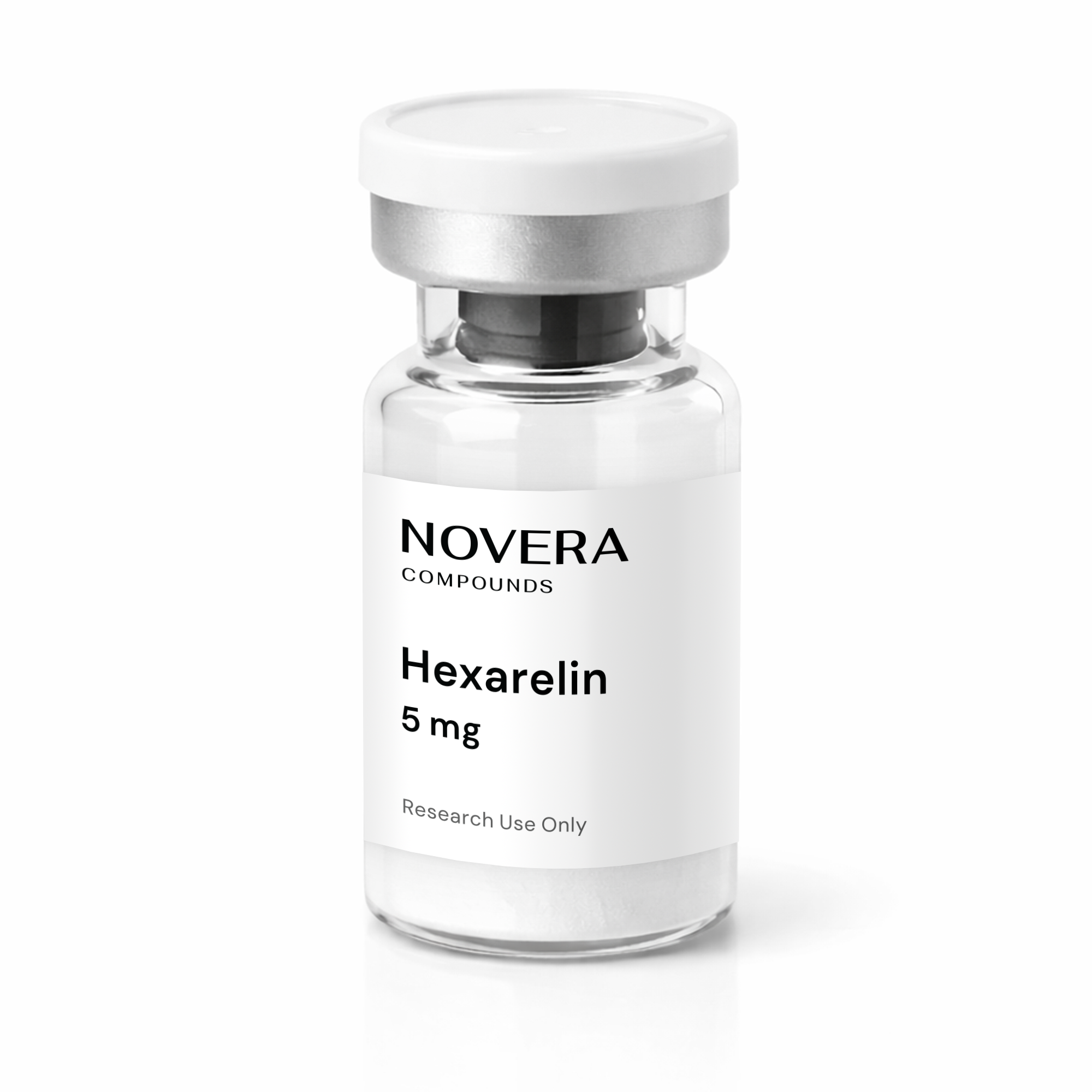
Hexarelin (5mg)
All products are 100% genuine and sourced from trusted manufacturers, with authenticity that can be verified for complete peace of mind.
Order exactly what you need with no minimum quantity required, whether it’s a single unit or a larger order.
Your order is guaranteed to arrive safely, with full shipment tracking and dedicated support to ensure a smooth delivery experience.
Your payments are protected with industry-standard encryption and trusted payment providers, ensuring every transaction is safe, private, and secure.
 99% PURITY GUARANTEE
 99% PURITY GUARANTEE
Each peptide batch is tested and verified to meet or exceed 98–99% purity (HPLC). Full analytical reports are available in the Certificate of Analysis section.
 Preparation & Handling Notice
The product is delivered in powdered (lyophilized) form and must be properly reconstituted prior to research use.
 RESEARCH USE ONLY
This product is intended for research use only. It is not for human or veterinary use, not for diagnostic or therapeutic purposes, and should only be handled by qualified professionals.
Strength: 5 mg
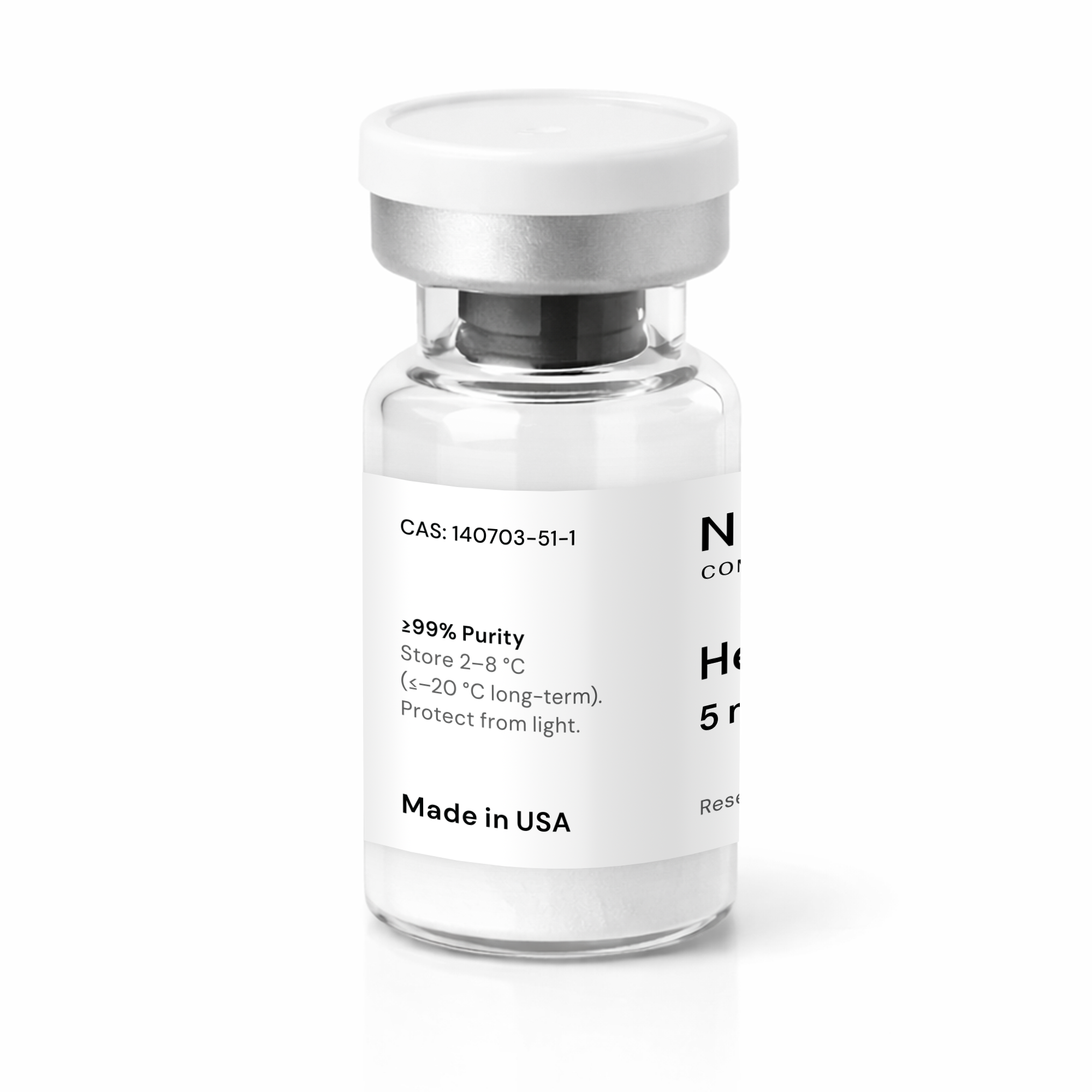
CAS: 140703-51-1
Chemical Formula: C₄₇H₅₈N₁₂O₆
Molecular weight: 887.059 g/mol
Peptide Sequence: His-2MeDTrp-Ala-Trp-DPhe-Lys-NH2
Synonyms: Examorelin
Storage: Store 2–8 °C (≤–20 °C long-term). RT exposure during transport acceptable. Protect from light.
Shelf life: 24 months from the manufacturing date.
Hexarelin is a synthetic hexapeptide and growth hormone secretagogue that binds to the GHSR 1a (ghrelin receptor). It has been studied in various preclinical and early-stage research models for its ability to stimulate growth hormone release, modulate cardiovascular and metabolic signaling, and affect stress response pathways. Hexarelin has been explored in contexts such as ischemia models, insulin resistance, and skeletal muscle atrophy, without implying any therapeutic claims.
-
Cold chain shipping available for temperature-sensitive products.
-
Orders are processed within 1–2 business days.
-
Delivery timelines vary by destination and shipping method — view our Shipping Policy for region-specific estimates.
-
Tracking information will be provided once shipped.
-
No order minimum applies.
-
If your shipment is delayed, lost, or arrives damaged, you're covered under our Refund & Replacement Policy.
We accept Visa, Mastercard, and American Express. Apple Pay and Google Pay are available upon request via your account manager.
All transactions are processed through a secure, PCI DSS–compliant system to ensure your data is fully protected.
Why Choose NOVERA COMPOUNDS Peptides?
Novera Research delivers high-quality research peptides developed under strict manufacturing and quality-control standards. Each product is carefully synthesized, tested, and handled to ensure consistency, reliability, and transparency for advanced research applications.
- High-purity, research-grade peptide synthesis
- Analytical testing to verify quality and composition
- Consistent batch-to-batch performance
- Batch identification on every vial for traceability
- Stored and shipped under controlled conditions
 High-purity, research-grade peptide synthesis

Why Choose Medica Depot
Shop hundreds of medical products with no minimums and free shipping on large orders.
 400+ products
 No order minimums
 Free shipping
 Loyalty rewards
 Trusted since 2007
 Account manager
 Verified LOT numbers
INFORMATION
What is Hexarelin (5mg)?
Hexarelin (5mg) is a synthetic growth hormone secretagogue supplied as a lyophilized (freeze-dried) peptide for laboratory research. It acts as a potent agonist of the growth hormone secretagogue receptor (GHSR-1a) and is designed to mimic ghrelin-like signaling in studies of the somatotropic (growth hormone) axis and related endocrine pathways.
As classified under muscle growth and performance peptides, researchers commonly use hexarelin to investigate growth hormone regulation, metabolic stress responses, cardiac remodeling, and peptide–receptor signaling in controlled experimental models. Notably, it is not intended for clinical use.
Product Specifications
- Peptide Sequence: His‑2MeDTrp‑Ala‑Trp‑DPhe‑Lys‑NH₂
- Chemical Formula: C₄₇H₅₈N₁₂O₆
- Molecular Weight: 887.059 g/mol
- CAS Number: 140703‑51‑1
- Purity: ≥99% (HPLC); confirmed by mass spectrometry and analytical profiling, with batch-specific CoA available
- Packaging Format: 5 mg lyophilized (freeze‑dried) peptide in a sealed vial, intended for reconstitution with an appropriate laboratory solvent or buffer prior to use.
- Storage Conditions: Store at −20°C in a dry, light-protected environment; avoid repeated freeze–thaw cycles.
- Intended Use: For laboratory research use only; not for human or veterinary use.
Key Characteristics of Hexarelin (5mg)
- GHSR-1a Agonist: Activates the growth hormone secretagogue receptor, distinct from endogenous ghrelin.
- Endocrine Pathway Tool: Supports studies of growth hormone signaling and related endocrine responses, including potential ACTH–cortisol pathway interactions in some models.
- Cardiac Research Use: Used in experimental cardiac systems to examine stress signaling linked to ischemia, fibrosis, and cell survival.
- Metabolic Model Relevance: Applied in studies of glucose handling, lipid metabolism, and insulin sensitivity under controlled conditions.
- Muscle and Cachexia Models: Used to explore muscle signaling, mitochondrial function, and protein balance in atrophy-related models.
- Verified Research Material: Supplied with analytical documentation to support identity confirmation and reproducible use.
How Hexarelin (5mg) Supports Research
Hexarelin serves as a robust research tool to model the effects of GHSR‑1a receptor activation across multiple systems. Its activity enables exploration of growth hormone dynamics, peptide-induced metabolic shifts, and cellular stress responses in both in vitro and in vivo models.
Because GHSR‑1a is expressed in diverse tissues (pituitary, hypothalamus, cardiac, and skeletal muscle), hexarelin allows researchers to dissect receptor-specific pathways under defined concentrations and timing, without relying on endogenous hormone release.
Comparative use with other secretagogues and ghrelin analogues also aids ligand characterization, pharmacologic screening, and signal transduction profiling in receptor-focused studies.
Research Applications & Usage Information
Hexarelin (5mg) is utilized across diverse preclinical models to investigate peptide-receptor interactions, hormone signaling, and physiological responses in controlled experimental systems.
Endocrine and Growth Hormone Axis Studies
- Evaluate growth hormone release patterns, feedback signaling, and interactions with GHRH pathways.
- Compare activity and receptor selectivity versus other GHS peptides or ghrelin analogues.
Cardiac and Ischemia Models
- Study signaling responses in ischemia/reperfusion and fibrosis-related
- Track cellular endpoints such as calcium signaling and apoptosis-related
Metabolic Regulation and Insulin Sensitivity
- Assess effects on glucose uptake, insulin response, lipid handling, and energy balance.
- Use in diet-induced metabolic dysfunction models to study pathway changes.
Skeletal Muscle and Cachexia Research
- Explore muscle signaling related to mitochondrial health, protein turnover, and atrophy markers.
- Apply in cachexia models (including chemotherapy-associated paradigms) to examine muscle-related endpoints.
Receptor Pharmacology and Peptide Profiling
- Use as a reference compound in receptor binding studies and downstream pathway readouts.
- Support ligand–receptor characterization across ghrelin-related compounds.
Note: This material is intended for use in non-human, non-clinical laboratory studies only. Protocols, concentrations, and exposure durations should be determined by qualified investigators.
Handling and Storage Recommendations
- Store lyophilized peptide at −20°C or colder in a sealed, light-protected vial
- Let sealed vials equilibrate to room temperature before opening to avoid condensation
- Maintain aliquots at refrigerated or frozen temperatures per internal lab policies; label clearly with prep date and concentration
- Use appropriate PPE and follow institutional biosafety protocols for handling research peptides and disposing of laboratory waste
Research Use Only Notice
This product is intended for laboratory research use only and is not approved for human or veterinary use. It is not intended for diagnostic, therapeutic, or clinical applications. Any reference to biological activity or potential effects is based solely on preclinical or in‑vitro findings and should not be interpreted as validated clinical outcomes. Researchers are responsible for ensuring proper handling, storage, and disposal in accordance with institutional, federal, and international guidelines.
References
- Mao Y, Tokudome T, Kishimoto I. The cardiovascular action of hexarelin. pmc.ncbi.nlm.nih.gov. Published online September 1, 2014. doi:10.11909/j.issn.1671-5411.2014.03.007
- Mosa R, Huang L, Wu Y, et al. Hexarelin, a growth hormone secretagogue, improves lipid metabolic aberrations in nonobese Insulin-Resistant male MKR mice. Endocrinology. 2017;158(10):3174-3187. doi:10.1210/en.2017-00168
- Ghigo E, Broglio F, Arvat E, Maccario M, Papotti M, Muccioli G. Ghrelin: more than a natural GH secretagogue and/or an orexigenic factor. Clinical Endocrinology. 2004;62(1):1-17. doi:10.1111/j.1365-2265.2004.02160.x
- Sigalos JT, Pastuszak AW. The safety and efficacy of growth hormone secretagogues. Sexual Medicine Reviews. 2017;6(1):45-53. doi:10.1016/j.sxmr.2017.02.004
- Korbonits M, Kaltsas G, Perry LA, et al. The growth hormone secretagogue hexarelin stimulates the Hypothalamo-Pituitary-Adrenal axis via arginine vasopressin. The Journal of Clinical Endocrinology & Metabolism. 1999;84(7):2489-2495. doi:10.1210/jcem.84.7.5811
- Arvat E, Maccario M, Di Vito L, et al. Endocrine Activities of Ghrelin, a Natural Growth Hormone Secretagogue (GHS), in Humans: Comparison and Interactions with Hexarelin, a Nonnatural Peptidyl GHS, and GH-Releasing Hormone1. The Journal of Clinical Endocrinology & Metabolism. 2001;86(3):1169-1174. doi:10.1210/jcem.86.3.7314
What is Hexarelin (5mg)?
Hexarelin (5mg) is a synthetic growth hormone secretagogue supplied as a lyophilized (freeze-dried) peptide for laboratory research. It acts as a potent agonist of the growth hormone secretagogue receptor (GHSR-1a) and is designed to mimic ghrelin-like signaling in studies of the somatotropic (growth hormone) axis and related endocrine pathways.
As classified under muscle growth and performance peptides, researchers commonly use hexarelin to investigate growth hormone regulation, metabolic stress responses, cardiac remodeling, and peptide–receptor signaling in controlled experimental models. Notably, it is not intended for clinical use.
Product Specifications
- Peptide Sequence: His‑2MeDTrp‑Ala‑Trp‑DPhe‑Lys‑NH₂
- Chemical Formula: C₄₇H₅₈N₁₂O₆
- Molecular Weight: 887.059 g/mol
- CAS Number: 140703‑51‑1
- Purity: ≥99% (HPLC); confirmed by mass spectrometry and analytical profiling, with batch-specific CoA available
- Packaging Format: 5 mg lyophilized (freeze‑dried) peptide in a sealed vial, intended for reconstitution with an appropriate laboratory solvent or buffer prior to use.
- Storage Conditions: Store at −20°C in a dry, light-protected environment; avoid repeated freeze–thaw cycles.
- Intended Use: For laboratory research use only; not for human or veterinary use.
Key Characteristics of Hexarelin (5mg)
- GHSR-1a Agonist: Activates the growth hormone secretagogue receptor, distinct from endogenous ghrelin.
- Endocrine Pathway Tool: Supports studies of growth hormone signaling and related endocrine responses, including potential ACTH–cortisol pathway interactions in some models.
- Cardiac Research Use: Used in experimental cardiac systems to examine stress signaling linked to ischemia, fibrosis, and cell survival.
- Metabolic Model Relevance: Applied in studies of glucose handling, lipid metabolism, and insulin sensitivity under controlled conditions.
- Muscle and Cachexia Models: Used to explore muscle signaling, mitochondrial function, and protein balance in atrophy-related models.
- Verified Research Material: Supplied with analytical documentation to support identity confirmation and reproducible use.
How Hexarelin (5mg) Supports Research
Hexarelin serves as a robust research tool to model the effects of GHSR‑1a receptor activation across multiple systems. Its activity enables exploration of growth hormone dynamics, peptide-induced metabolic shifts, and cellular stress responses in both in vitro and in vivo models.
Because GHSR‑1a is expressed in diverse tissues (pituitary, hypothalamus, cardiac, and skeletal muscle), hexarelin allows researchers to dissect receptor-specific pathways under defined concentrations and timing, without relying on endogenous hormone release.
Comparative use with other secretagogues and ghrelin analogues also aids ligand characterization, pharmacologic screening, and signal transduction profiling in receptor-focused studies.
Research Applications & Usage Information
Hexarelin (5mg) is utilized across diverse preclinical models to investigate peptide-receptor interactions, hormone signaling, and physiological responses in controlled experimental systems.
Endocrine and Growth Hormone Axis Studies
- Evaluate growth hormone release patterns, feedback signaling, and interactions with GHRH pathways.
- Compare activity and receptor selectivity versus other GHS peptides or ghrelin analogues.
Cardiac and Ischemia Models
- Study signaling responses in ischemia/reperfusion and fibrosis-related
- Track cellular endpoints such as calcium signaling and apoptosis-related
Metabolic Regulation and Insulin Sensitivity
- Assess effects on glucose uptake, insulin response, lipid handling, and energy balance.
- Use in diet-induced metabolic dysfunction models to study pathway changes.
Skeletal Muscle and Cachexia Research
- Explore muscle signaling related to mitochondrial health, protein turnover, and atrophy markers.
- Apply in cachexia models (including chemotherapy-associated paradigms) to examine muscle-related endpoints.
Receptor Pharmacology and Peptide Profiling
- Use as a reference compound in receptor binding studies and downstream pathway readouts.
- Support ligand–receptor characterization across ghrelin-related compounds.
Note: This material is intended for use in non-human, non-clinical laboratory studies only. Protocols, concentrations, and exposure durations should be determined by qualified investigators.
Handling and Storage Recommendations
- Store lyophilized peptide at −20°C or colder in a sealed, light-protected vial
- Let sealed vials equilibrate to room temperature before opening to avoid condensation
- Maintain aliquots at refrigerated or frozen temperatures per internal lab policies; label clearly with prep date and concentration
- Use appropriate PPE and follow institutional biosafety protocols for handling research peptides and disposing of laboratory waste
Research Use Only Notice
This product is intended for laboratory research use only and is not approved for human or veterinary use. It is not intended for diagnostic, therapeutic, or clinical applications. Any reference to biological activity or potential effects is based solely on preclinical or in‑vitro findings and should not be interpreted as validated clinical outcomes. Researchers are responsible for ensuring proper handling, storage, and disposal in accordance with institutional, federal, and international guidelines.
References
- Mao Y, Tokudome T, Kishimoto I. The cardiovascular action of hexarelin. pmc.ncbi.nlm.nih.gov. Published online September 1, 2014. doi:10.11909/j.issn.1671-5411.2014.03.007
- Mosa R, Huang L, Wu Y, et al. Hexarelin, a growth hormone secretagogue, improves lipid metabolic aberrations in nonobese Insulin-Resistant male MKR mice. Endocrinology. 2017;158(10):3174-3187. doi:10.1210/en.2017-00168
- Ghigo E, Broglio F, Arvat E, Maccario M, Papotti M, Muccioli G. Ghrelin: more than a natural GH secretagogue and/or an orexigenic factor. Clinical Endocrinology. 2004;62(1):1-17. doi:10.1111/j.1365-2265.2004.02160.x
- Sigalos JT, Pastuszak AW. The safety and efficacy of growth hormone secretagogues. Sexual Medicine Reviews. 2017;6(1):45-53. doi:10.1016/j.sxmr.2017.02.004
- Korbonits M, Kaltsas G, Perry LA, et al. The growth hormone secretagogue hexarelin stimulates the Hypothalamo-Pituitary-Adrenal axis via arginine vasopressin. The Journal of Clinical Endocrinology & Metabolism. 1999;84(7):2489-2495. doi:10.1210/jcem.84.7.5811
- Arvat E, Maccario M, Di Vito L, et al. Endocrine Activities of Ghrelin, a Natural Growth Hormone Secretagogue (GHS), in Humans: Comparison and Interactions with Hexarelin, a Nonnatural Peptidyl GHS, and GH-Releasing Hormone1. The Journal of Clinical Endocrinology & Metabolism. 2001;86(3):1169-1174. doi:10.1210/jcem.86.3.7314
Related products