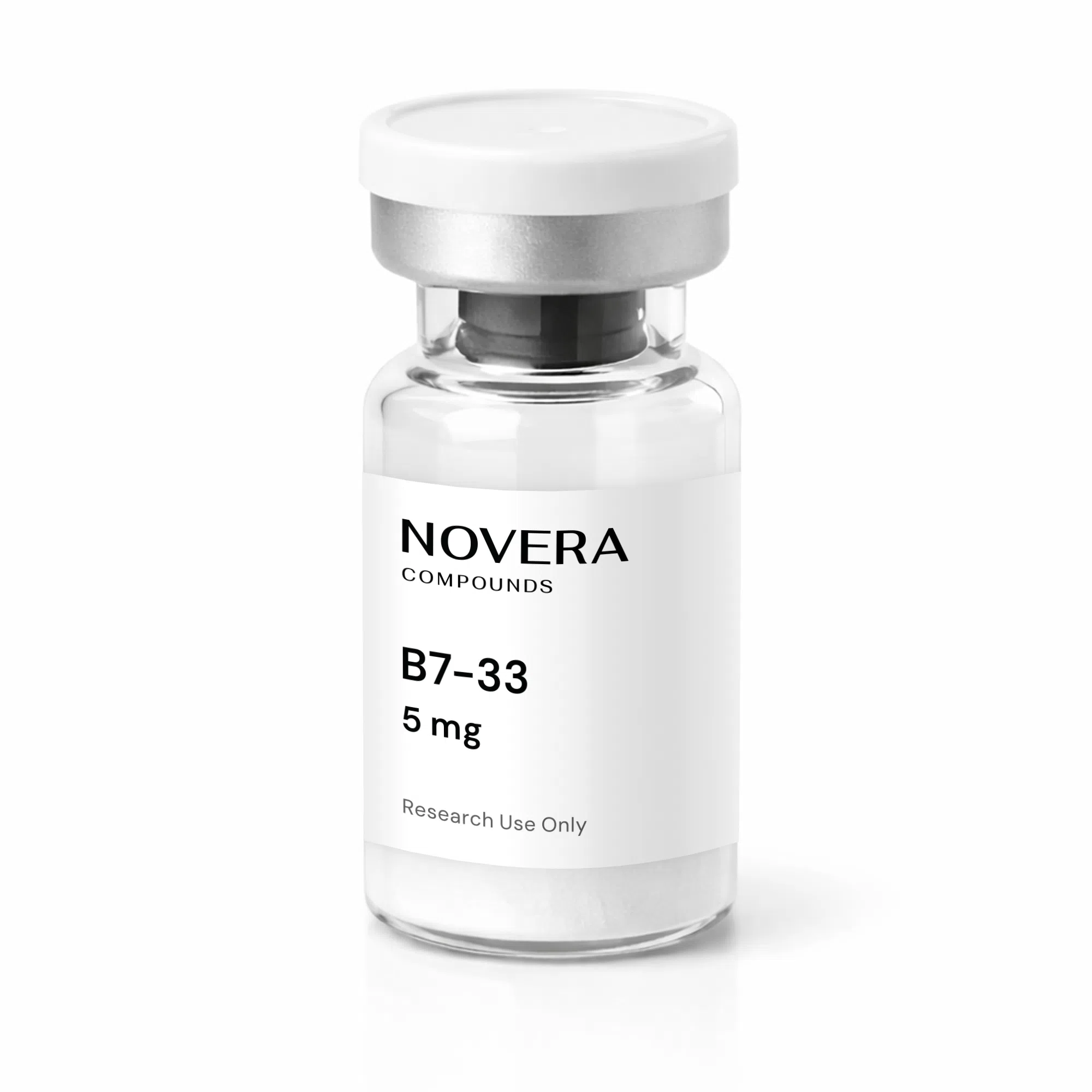
B7-33
Strength: 5 mg
CAS: 1818415-56-3
Chemical Formula: C₁₃₁H₂₂₉N₄₁O₃₆S
Molecular weight: 2986.54 g/mol
Peptide Sequence: Val-Ile-Lys-Leu-Ser-Gly-Arg-Glu-Leu-Val-Arg-Ala-Gln-Ile-Ala-Ile-Ser-Gly-Met-Ser-Thr-Trp-Ser-Lys-Arg-Ser-Leu-NH₂
Storage: Store 2–8 °C (≤–20 °C long-term). RT exposure during transport acceptable. Protect from light.
Shelf life: 24 months from the manufacturing date.
B7-33 (5 mg) is a synthetic research peptide. It is used in laboratory and preclinical studies to explore peptide mediated cellular signaling and tissue level responses in controlled models, and is supplied as a high purity, lyophilized powder for research use only.


Why Choose Medica Depot
Shop hundreds of medical products with no minimums and free shipping on large orders.
 400+ products
 No order minimums
 Free shipping
 Loyalty rewards
 Trusted since 2007
 Account manager
 Verified LOT numbers
INFORMATION
What is B7-33?
B7-33 is a synthetic research peptide studied in laboratory settings for its role in cellular signaling and tissue-related research models, helping to understand how cells communicate, respond to stress, and maintain structural integrity. In preclinical work, B7‑33 has been evaluated in cell and tissue models where stress responses, matrix remodeling, or injury‑related signaling are of interest, without implying any established therapeutic effect.
In research contexts, B7-33 is used to study peptide–cell interactions and downstream responses under controlled experimental conditions. Its defined amino acid sequence and stable formulation make it suitable for in vitro and preclinical studies that require reproducibility and consistency.
B7-33 is supplied strictly as a research reagent and is not intended for therapeutic, diagnostic, or clinical use.
Product Specifications
- Peptide Name: B7-33
- Category: Peptides
- Subcategory: Healing & Regenerative Peptides
- CAS Number: 1818415-56-3
- Molecular Formula: C₁₃₁H₂₂₉N₄₁O₃₆S
- Molecular Weight:2986.54 g/mol
- Peptide Sequence:
Val–Ile–Lys–Leu–Ser–Gly–Arg–Glu–Leu–Val–Arg–Ala–Gln–Ile–Ala–Ile–Ser–Gly–Met–Ser–Thr–Trp–Ser–Lys–Arg–Ser–Leu–NH₂ - Purity: ≥ 95% (HPLC-verified)
- Packaging Format: Lyophilized powder, 5 mg vial
- Storage Conditions: Store at 2–8 °C (≤ –20 °C for long-term storage). Protect from light.
- Intended Use: For laboratory research use only
Key Characteristics of B7-33
- Supplied as a high-purity, lyophilized peptide suitable for laboratory handling
- Defined amino acid sequence supports reproducible experimental outcomes
- Commonly used in cellular and tissue-focused research models where peptide‑mediated signaling and structural responses are under investigation
- Stable under recommended storage conditions
- Verified using standard analytical methods such as HPLC and mass spectrometry
- Compatible with routine peptide handling and reconstitution protocols
How B7-33 Supports Research
In laboratory research, B7-33 is used as a tool peptide to explore how peptide-based signals influence cellular behavior. Researchers employ B7‑33 to observe how peptide‑based signals influence cellular communication, signaling dynamics, and structural responses in controlled experimental systems, comparing responses across different cell types or tissue models.
Its role in research is exploratory, focused on understanding biological mechanisms rather than producing therapeutic effects. B7-33 allows researchers to examine peptide interactions within broader signaling environments and compare responses across different experimental conditions.
Research Applications & Usage Information
B7-33 is generally used in laboratory research for:
- Studies of cellular signaling pathways, focusing on how peptide exposure influences intracellular signaling cascades.
- Tissue‑related and regenerative research models where structural integrity, stress responses, or matrix remodeling are endpoints.
- Investigations of peptide–protein interactions using in vitro binding or cell‑based assay systems.
- Exploratory studies of cellular response and adaptation to exogenous peptides under controlled conditions.
- Comparative peptide research in preclinical systems, using B7‑33 alongside other peptides to contrast signaling or structural effects.
All applications are limited to in vitro and preclinical research environments.
Handling and Storage Recommendations
- Store unopened vials at 2–8°C; ≤–20°C is recommended for long-term storage.
- Protect from light and moisture.
- After reconstitution, store solutions at 2–8°C and use within laboratory-defined timeframes.
- Avoid repeated freeze-thaw cycles.
- Use sterile handling techniques and label all prepared solutions clearly.
- All handling and storage are performed within laboratory research environments; B7‑33 is not intended for human or veterinary administration.
Research Use Only Notice
This product is intended for laboratory research use only and is not approved for human or veterinary use. It is not intended for diagnostic, therapeutic, or clinical applications. Any reference to biological activity or potential effects is based solely on preclinical or in-vitro findings and should not be interpreted as validated clinical outcomes. Researchers are responsible for ensuring proper handling, storage, and disposal in accordance with institutional, federal, and international guidelines.
References
- Devarakonda T, Mauro AG, Guzman G, et al. B7-33, a Functionally Selective Relaxin Receptor 1 Agonist, Attenuates Myocardial Infarction-Related Adverse Cardiac Remodeling in Mice. J Am Heart Assoc. 2020;9(8):e015748. doi:10.1161/JAHA.119.015748
- de Hoog VC, Bovens SM, de Jager SC, et al. BLT1 antagonist LSN2792613 reduces infarct size in a mouse model of myocardial ischaemia-reperfusion injury. Cardiovasc Res. 2015;108(3):367-376. doi:10.1093/cvr/cvv224
- Takatori O, Usui S, Okajima M, et al. Sodium 4-Phenylbutyrate Attenuates Myocardial Reperfusion Injury by Reducing the Unfolded Protein Response. J Cardiovasc Pharmacol Ther. 2017;22(3):283-292. doi:10.1177/1074248416679308
What is B7-33?
B7-33 is a synthetic research peptide studied in laboratory settings for its role in cellular signaling and tissue-related research models, helping to understand how cells communicate, respond to stress, and maintain structural integrity. In preclinical work, B7‑33 has been evaluated in cell and tissue models where stress responses, matrix remodeling, or injury‑related signaling are of interest, without implying any established therapeutic effect.
In research contexts, B7-33 is used to study peptide–cell interactions and downstream responses under controlled experimental conditions. Its defined amino acid sequence and stable formulation make it suitable for in vitro and preclinical studies that require reproducibility and consistency.
B7-33 is supplied strictly as a research reagent and is not intended for therapeutic, diagnostic, or clinical use.
Product Specifications
- Peptide Name: B7-33
- Category: Peptides
- Subcategory: Healing & Regenerative Peptides
- CAS Number: 1818415-56-3
- Molecular Formula: C₁₃₁H₂₂₉N₄₁O₃₆S
- Molecular Weight:2986.54 g/mol
- Peptide Sequence:
Val–Ile–Lys–Leu–Ser–Gly–Arg–Glu–Leu–Val–Arg–Ala–Gln–Ile–Ala–Ile–Ser–Gly–Met–Ser–Thr–Trp–Ser–Lys–Arg–Ser–Leu–NH₂ - Purity: ≥ 95% (HPLC-verified)
- Packaging Format: Lyophilized powder, 5 mg vial
- Storage Conditions: Store at 2–8 °C (≤ –20 °C for long-term storage). Protect from light.
- Intended Use: For laboratory research use only
Key Characteristics of B7-33
- Supplied as a high-purity, lyophilized peptide suitable for laboratory handling
- Defined amino acid sequence supports reproducible experimental outcomes
- Commonly used in cellular and tissue-focused research models where peptide‑mediated signaling and structural responses are under investigation
- Stable under recommended storage conditions
- Verified using standard analytical methods such as HPLC and mass spectrometry
- Compatible with routine peptide handling and reconstitution protocols
How B7-33 Supports Research
In laboratory research, B7-33 is used as a tool peptide to explore how peptide-based signals influence cellular behavior. Researchers employ B7‑33 to observe how peptide‑based signals influence cellular communication, signaling dynamics, and structural responses in controlled experimental systems, comparing responses across different cell types or tissue models.
Its role in research is exploratory, focused on understanding biological mechanisms rather than producing therapeutic effects. B7-33 allows researchers to examine peptide interactions within broader signaling environments and compare responses across different experimental conditions.
Research Applications & Usage Information
B7-33 is generally used in laboratory research for:
- Studies of cellular signaling pathways, focusing on how peptide exposure influences intracellular signaling cascades.
- Tissue‑related and regenerative research models where structural integrity, stress responses, or matrix remodeling are endpoints.
- Investigations of peptide–protein interactions using in vitro binding or cell‑based assay systems.
- Exploratory studies of cellular response and adaptation to exogenous peptides under controlled conditions.
- Comparative peptide research in preclinical systems, using B7‑33 alongside other peptides to contrast signaling or structural effects.
All applications are limited to in vitro and preclinical research environments.
Handling and Storage Recommendations
- Store unopened vials at 2–8°C; ≤–20°C is recommended for long-term storage.
- Protect from light and moisture.
- After reconstitution, store solutions at 2–8°C and use within laboratory-defined timeframes.
- Avoid repeated freeze-thaw cycles.
- Use sterile handling techniques and label all prepared solutions clearly.
- All handling and storage are performed within laboratory research environments; B7‑33 is not intended for human or veterinary administration.
Research Use Only Notice
This product is intended for laboratory research use only and is not approved for human or veterinary use. It is not intended for diagnostic, therapeutic, or clinical applications. Any reference to biological activity or potential effects is based solely on preclinical or in-vitro findings and should not be interpreted as validated clinical outcomes. Researchers are responsible for ensuring proper handling, storage, and disposal in accordance with institutional, federal, and international guidelines.
References
- Devarakonda T, Mauro AG, Guzman G, et al. B7-33, a Functionally Selective Relaxin Receptor 1 Agonist, Attenuates Myocardial Infarction-Related Adverse Cardiac Remodeling in Mice. J Am Heart Assoc. 2020;9(8):e015748. doi:10.1161/JAHA.119.015748
- de Hoog VC, Bovens SM, de Jager SC, et al. BLT1 antagonist LSN2792613 reduces infarct size in a mouse model of myocardial ischaemia-reperfusion injury. Cardiovasc Res. 2015;108(3):367-376. doi:10.1093/cvr/cvv224
- Takatori O, Usui S, Okajima M, et al. Sodium 4-Phenylbutyrate Attenuates Myocardial Reperfusion Injury by Reducing the Unfolded Protein Response. J Cardiovasc Pharmacol Ther. 2017;22(3):283-292. doi:10.1177/1074248416679308
Related products