
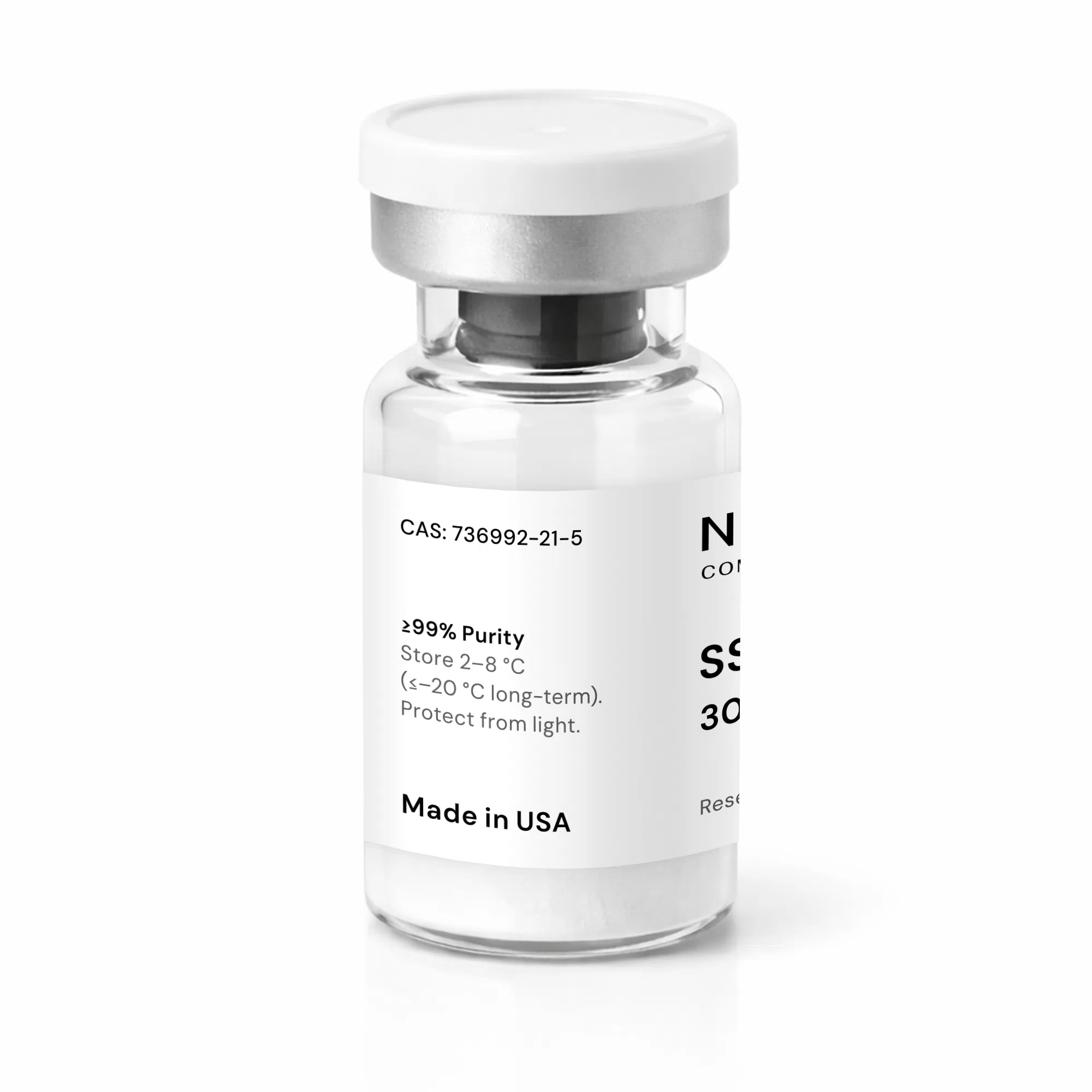
SS-31 30mg
Strength: 30 mg
CAS: 736992-21-5
Chemical Formula: C₃₂H₄₉N₉O₅
Molecular weight: 639.8 g/mol
Peptide Sequence: D-Arg-dimethyl-Tyr-Lys-Phe-NH2
Synonyms: MTP-131, Elamipretide
Storage: Store 2–8 °C (≤–20 °C long-term). RT exposure during transport acceptable. Protect from light.
Shelf life: 24 months from the manufacturing date.
SS-31 (elamipretide, MTP-131) is a synthetic mitochondria-targeted tetrapeptide (D-Arg-Dmt-Lys-Phe-NH₂) supplied as high-purity lyophilized powder for laboratory research. Research examines its interactions with cardiolipin in isolated mitochondria and cell models of bioenergetic stress.


Why Choose Medica Depot
Shop hundreds of medical products with no minimums and free shipping on large orders.
 400+ products
 No order minimums
 Free shipping
 Loyalty rewards
 Trusted since 2007
 Account manager
 Verified LOT numbers
INFORMATION
What is SS-31 (30 mg)?
SS-31 (30 mg), also known as elamipretide or MTP-131, is a synthetic mitochondria-targeted tetrapeptide (D-Arg-Dmt-Lys-Phe-NH₂) studied in laboratory and preclinical settings for its interactions with mitochondrial membranes.
Product Specifications
- CAS Number: 736992-21-5
- Synonyms: MTP-131, Elamipretide
- Peptide Sequence: D-Arg-dimethyl-Tyr-Lys-Phe-NH₂
- Molecular Formula: C₃₂H₄₉N₉O₅
- Molecular Weight: 639.8 g/moll
- Purity: ≥98% (verified by HPLC and mass spectrometry), lot-specific COA
- Storage Conditions: Store 2–8 °C (≤–20 °C long term). Protect from light.
- Intended Use: For Laboratory Research Use Only
Key Characteristics of SS-31 (30 mg)
- Mitochondrial Membrane Targeting: SS-31 is designed to accumulate in mitochondrial membranes, where it binds to cardiolipin, a lipid that plays a key role in mitochondrial function and energy production.
- Cardiolipin Affinity and Membrane Support: By binding to cardiolipin, SS-31 supports membrane integrity and respiratory-chain organization, particularly under stressed conditions.
- Associations with ROS Dynamics: SS-31 has been studied for its associations with reactive oxygen species (ROS) dynamics, helping to track mitochondrial oxidative stress and energy production.
- Examined in Cellular Models of Mitochondrial Stress: SS-31 has been used in models of mitochondrial dysfunction, including those focused on bioenergetic challenges and cellular stress.
How SS-31 (30 mg) Supports Research
SS-31 (30 mg) is used as a targeted probe to study mitochondrial function, especially in experiments focused on mitochondrial bioenergetics and membrane stability. Researchers use SS-31 to examine:
- Respiratory performance and energy output
- Supercomplex integrity and membrane stability
- Mitochondrial responses in ischemia, inflammation, and aging models
SS-31 is widely used in research to assess mitochondrial responses, particularly in models where oxidative stress and impaired function are key areas of interest.
Research Applications & Usage Information
- Mitochondrial Bioenergetics and Cardiolipin Biology: Used in isolated mitochondria, cell cultures, and tissue preparations to study how SS-31 affects cardiolipin binding, respiratory-chain organization, and ATP production under stress conditions.
- Ischemia–Reperfusion and Organ Protection: Applied in kidney and heart research to assess SS-31’s ability to preserve mitochondrial structure, support ATP recovery, and reduce damage during ischemic stress, offering insights into organ protection.
- Mitochondrial Pathway Mapping: Used in proteomic and mitochondrial assays to explore effects on ATP production, ROS signaling, and membrane potential under bioenergetic stress.
- Cellular Models of Mitochondrial Stress: Included in studies examining mitochondrial responses in various stress models, tracking changes in mitochondrial function, structure, and signaling.
All applications are limited to controlled in vitro and preclinical research environments.
Handling and Storage Recommendations
- Store 2–8 °C (≤–20 °C long term). Protect from light.
- Keep the vial tightly sealed when not in use.
- Avoid prolonged exposure to light, heat, or moisture.
- Allow the vial to equilibrate before opening to minimize condensation.
- After reconstitution, store solutions at 2–8 °C according to laboratory protocol.
- Avoid repeated freeze–thaw cycles to maintain peptide integrity.
- Discard any solutions showing visible changes (e.g., precipitation or discoloration) or exceeding validated stability windows.
Research Use Only Notice
This product is intended for laboratory research use only and is not approved for human or veterinary use. It is not intended for diagnostic, therapeutic, or clinical applications. Any reference to biological activity or potential effects is based solely on preclinical or in vitro findings and should not be interpreted as validated clinical outcomes. Researchers are responsible for ensuring proper handling, storage, and disposal in accordance with institutional, federal, and international guidelines.
References
- PubChem CID 11764719. National Center for Biotechnology Information. https://pubchem.ncbi.nlm.nih.gov/compound/Elamipretide
- Elamipretide: Uses, interactions, mechanism of action. DrugBank. https://go.drugbank.com/drugs/DB11981
- Birk AV, Liu S, Soong Y, et al. The mitochondrial-targeted compound SS-31 re-energizes ischemic mitochondria by interacting with cardiolipin. J Am Soc Nephrol. 2013;24(8):1250-1261. doi:10.1681/ASN.2012121216
- Tse BC, Dvoriantchikova G, Tao W, et al. Mitochondrial targeted therapy with elamipretide (MTP-131) as an adjunct to tumor necrosis factor inhibition for traumatic optic neuropathy in the acute setting. Exp Eye Res. 2020;199:108178. doi:10.1016/j.exer.2020.108178
- Brown DA, Hale SL, Baines CP, et al. Reduction of early reperfusion injury with the mitochondria-targeting peptide bendavia. J Cardiovasc Pharmacol Ther. 2014;19(1):121-132. doi:10.1177/1074248413508003
- Li M, Kong D, Meng L, Wang Z, Bai Z, Wu G. Discovery of novel SS-31 (d-Arg-dimethylTyr-Lys-Phe-NH2) derivatives as potent agents to ameliorate inflammation and increase mitochondrial ATP synthesis. RSC Adv. 2024;14(41):29789-29799. Published 2024 Sep 18. doi:10.1039/d4ra05517a
What is SS-31 (30 mg)?
SS-31 (30 mg), also known as elamipretide or MTP-131, is a synthetic mitochondria-targeted tetrapeptide (D-Arg-Dmt-Lys-Phe-NH₂) studied in laboratory and preclinical settings for its interactions with mitochondrial membranes.
Product Specifications
- CAS Number: 736992-21-5
- Synonyms: MTP-131, Elamipretide
- Peptide Sequence: D-Arg-dimethyl-Tyr-Lys-Phe-NH₂
- Molecular Formula: C₃₂H₄₉N₉O₅
- Molecular Weight: 639.8 g/moll
- Purity: ≥98% (verified by HPLC and mass spectrometry), lot-specific COA
- Storage Conditions: Store 2–8 °C (≤–20 °C long term). Protect from light.
- Intended Use: For Laboratory Research Use Only
Key Characteristics of SS-31 (30 mg)
- Mitochondrial Membrane Targeting: SS-31 is designed to accumulate in mitochondrial membranes, where it binds to cardiolipin, a lipid that plays a key role in mitochondrial function and energy production.
- Cardiolipin Affinity and Membrane Support: By binding to cardiolipin, SS-31 supports membrane integrity and respiratory-chain organization, particularly under stressed conditions.
- Associations with ROS Dynamics: SS-31 has been studied for its associations with reactive oxygen species (ROS) dynamics, helping to track mitochondrial oxidative stress and energy production.
- Examined in Cellular Models of Mitochondrial Stress: SS-31 has been used in models of mitochondrial dysfunction, including those focused on bioenergetic challenges and cellular stress.
How SS-31 (30 mg) Supports Research
SS-31 (30 mg) is used as a targeted probe to study mitochondrial function, especially in experiments focused on mitochondrial bioenergetics and membrane stability. Researchers use SS-31 to examine:
- Respiratory performance and energy output
- Supercomplex integrity and membrane stability
- Mitochondrial responses in ischemia, inflammation, and aging models
SS-31 is widely used in research to assess mitochondrial responses, particularly in models where oxidative stress and impaired function are key areas of interest.
Research Applications & Usage Information
- Mitochondrial Bioenergetics and Cardiolipin Biology: Used in isolated mitochondria, cell cultures, and tissue preparations to study how SS-31 affects cardiolipin binding, respiratory-chain organization, and ATP production under stress conditions.
- Ischemia–Reperfusion and Organ Protection: Applied in kidney and heart research to assess SS-31’s ability to preserve mitochondrial structure, support ATP recovery, and reduce damage during ischemic stress, offering insights into organ protection.
- Mitochondrial Pathway Mapping: Used in proteomic and mitochondrial assays to explore effects on ATP production, ROS signaling, and membrane potential under bioenergetic stress.
- Cellular Models of Mitochondrial Stress: Included in studies examining mitochondrial responses in various stress models, tracking changes in mitochondrial function, structure, and signaling.
All applications are limited to controlled in vitro and preclinical research environments.
Handling and Storage Recommendations
- Store 2–8 °C (≤–20 °C long term). Protect from light.
- Keep the vial tightly sealed when not in use.
- Avoid prolonged exposure to light, heat, or moisture.
- Allow the vial to equilibrate before opening to minimize condensation.
- After reconstitution, store solutions at 2–8 °C according to laboratory protocol.
- Avoid repeated freeze–thaw cycles to maintain peptide integrity.
- Discard any solutions showing visible changes (e.g., precipitation or discoloration) or exceeding validated stability windows.
Research Use Only Notice
This product is intended for laboratory research use only and is not approved for human or veterinary use. It is not intended for diagnostic, therapeutic, or clinical applications. Any reference to biological activity or potential effects is based solely on preclinical or in vitro findings and should not be interpreted as validated clinical outcomes. Researchers are responsible for ensuring proper handling, storage, and disposal in accordance with institutional, federal, and international guidelines.
References
- PubChem CID 11764719. National Center for Biotechnology Information. https://pubchem.ncbi.nlm.nih.gov/compound/Elamipretide
- Elamipretide: Uses, interactions, mechanism of action. DrugBank. https://go.drugbank.com/drugs/DB11981
- Birk AV, Liu S, Soong Y, et al. The mitochondrial-targeted compound SS-31 re-energizes ischemic mitochondria by interacting with cardiolipin. J Am Soc Nephrol. 2013;24(8):1250-1261. doi:10.1681/ASN.2012121216
- Tse BC, Dvoriantchikova G, Tao W, et al. Mitochondrial targeted therapy with elamipretide (MTP-131) as an adjunct to tumor necrosis factor inhibition for traumatic optic neuropathy in the acute setting. Exp Eye Res. 2020;199:108178. doi:10.1016/j.exer.2020.108178
- Brown DA, Hale SL, Baines CP, et al. Reduction of early reperfusion injury with the mitochondria-targeting peptide bendavia. J Cardiovasc Pharmacol Ther. 2014;19(1):121-132. doi:10.1177/1074248413508003
- Li M, Kong D, Meng L, Wang Z, Bai Z, Wu G. Discovery of novel SS-31 (d-Arg-dimethylTyr-Lys-Phe-NH2) derivatives as potent agents to ameliorate inflammation and increase mitochondrial ATP synthesis. RSC Adv. 2024;14(41):29789-29799. Published 2024 Sep 18. doi:10.1039/d4ra05517a
Related products