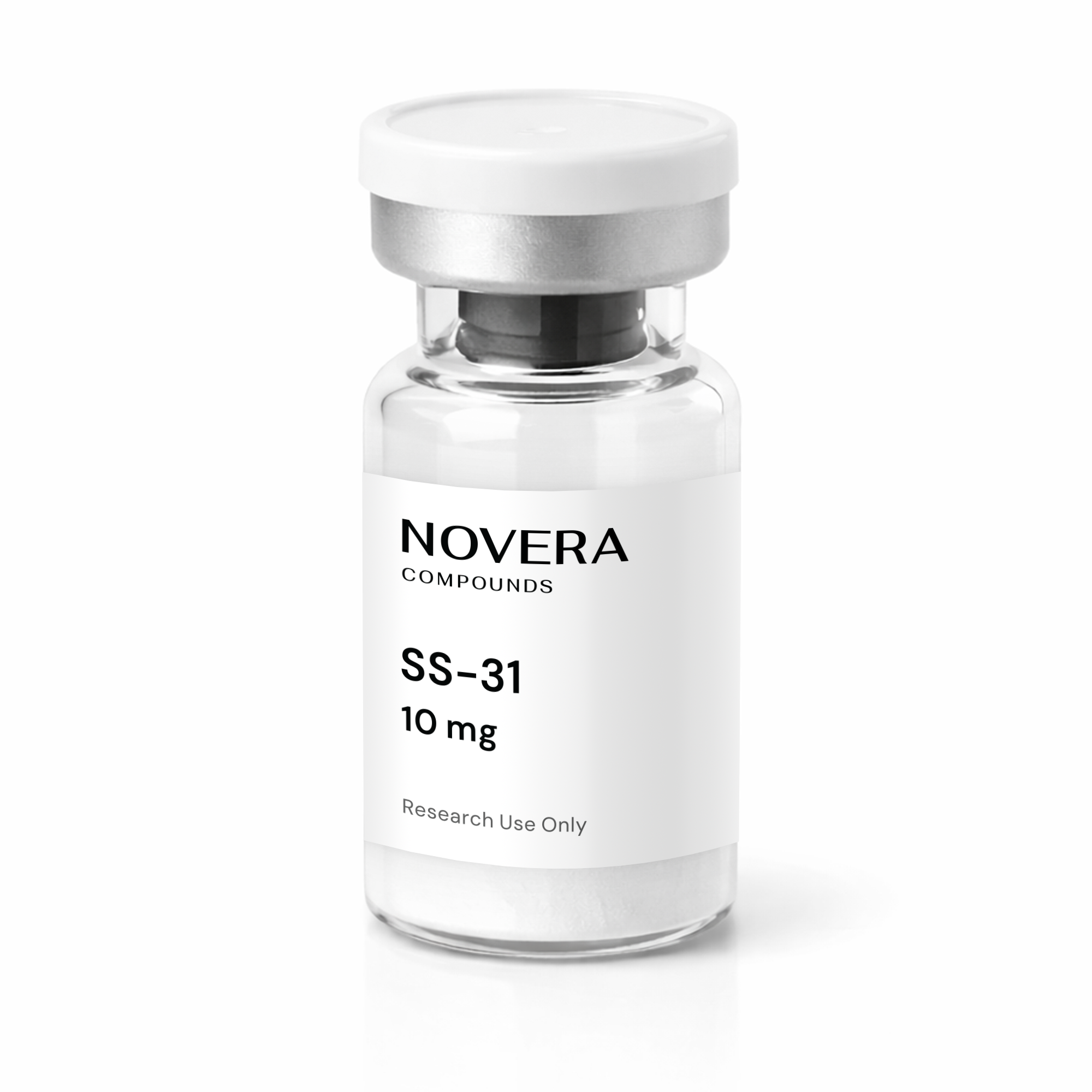
SS-31 (10 mg)
All products are 100% genuine and sourced from trusted manufacturers, with authenticity that can be verified for complete peace of mind.
Order exactly what you need with no minimum quantity required, whether it’s a single unit or a larger order.
Your order is guaranteed to arrive safely, with full shipment tracking and dedicated support to ensure a smooth delivery experience.
Your payments are protected with industry-standard encryption and trusted payment providers, ensuring every transaction is safe, private, and secure.
 99% PURITY GUARANTEE
 99% PURITY GUARANTEE
Each peptide batch is tested and verified to meet or exceed 98–99% purity (HPLC). Full analytical reports are available in the Certificate of Analysis section.


 Preparation & Handling Notice
The product is delivered in powdered (lyophilized) form and must be properly reconstituted prior to research use.
 RESEARCH USE ONLY
This product is intended for research use only. It is not for human or veterinary use, not for diagnostic or therapeutic purposes, and should only be handled by qualified professionals.
Strength: 10 mg
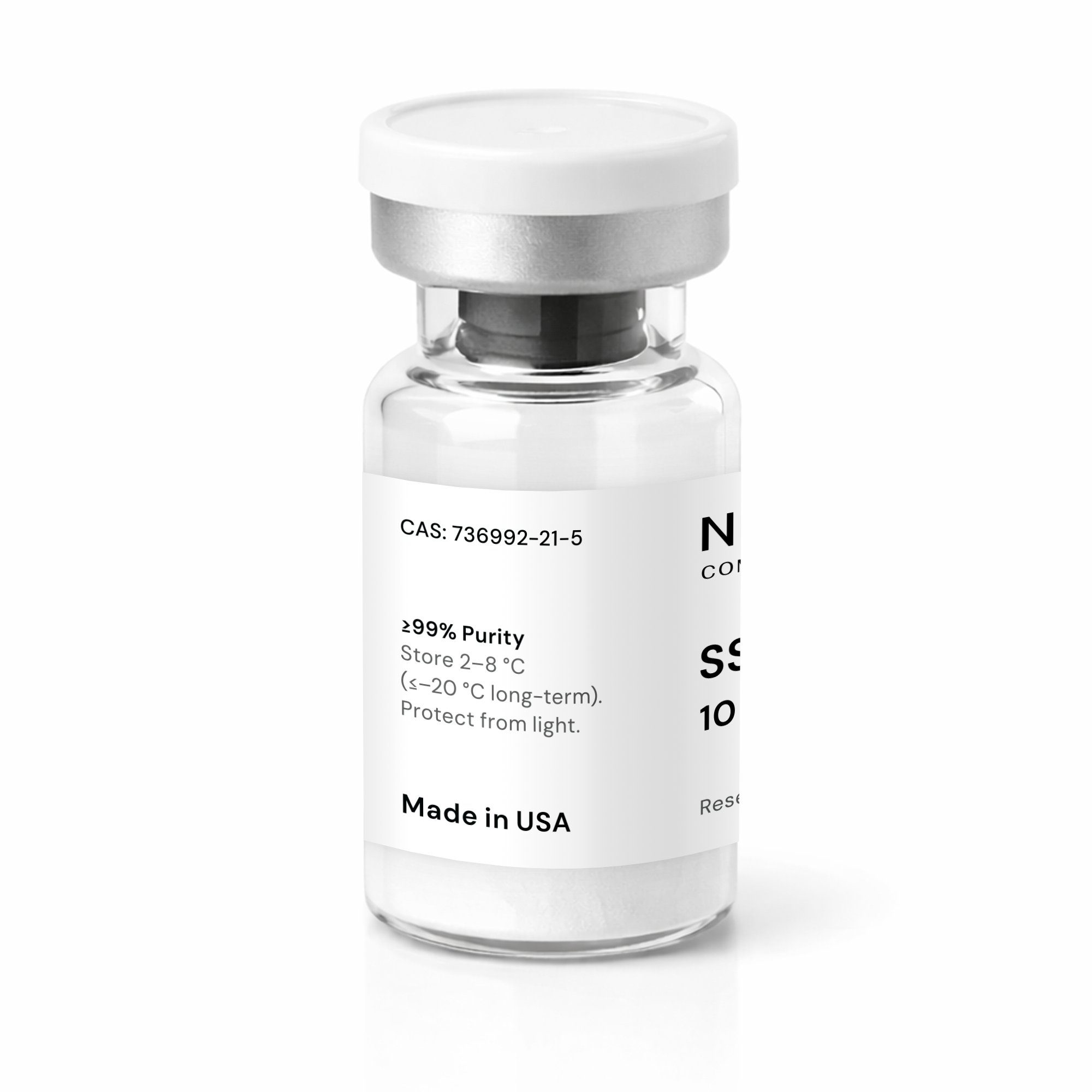
CAS: 736992-21-5
Chemical Formula: C₃₂H₄₉N₉O₅
Molecular weight: 639.8 g/mol
Peptide Sequence: D-Arg-dimethyl-Tyr-Lys-Phe-NH2
Synonyms: MTP-131, Elamipretide
Storage: Store 2–8 °C (≤–20 °C long-term). RT exposure during transport acceptable. Protect from light.
Shelf life: 24 months from the manufacturing date.
SS-31 (elamipretide, MTP-131) is a synthetic mitochondria-targeted tetrapeptide (D-Arg-Dmt-Lys-Phe-NH₂) supplied as high-purity lyophilized powder for laboratory research. Research examines its interactions with cardiolipin in isolated mitochondria and cell models of bioenergetic stress.
-
Cold chain shipping available for temperature-sensitive products.
-
Orders are processed within 1–2 business days.
-
Delivery timelines vary by destination and shipping method — view our Shipping Policy for region-specific estimates.
-
Tracking information will be provided once shipped.
-
No order minimum applies.
-
If your shipment is delayed, lost, or arrives damaged, you're covered under our Refund & Replacement Policy.
We accept Visa, Mastercard, and American Express. Apple Pay and Google Pay are available upon request via your account manager.
All transactions are processed through a secure, PCI DSS–compliant system to ensure your data is fully protected.
Why Choose NOVERA COMPOUNDS Peptides?
Novera Research delivers high-quality research peptides developed under strict manufacturing and quality-control standards. Each product is carefully synthesized, tested, and handled to ensure consistency, reliability, and transparency for advanced research applications.
- High-purity, research-grade peptide synthesis
- Analytical testing to verify quality and composition
- Consistent batch-to-batch performance
- Batch identification on every vial for traceability
- Stored and shipped under controlled conditions
 High-purity, research-grade peptide synthesis

Why Choose Medica Depot
Shop hundreds of medical products with no minimums and free shipping on large orders.
 400+ products
 No order minimums
 Free shipping
 Loyalty rewards
 Trusted since 2007
 Account manager
 Verified LOT numbers
INFORMATION
What is SS-31 (10 mg)?
SS-31 (10 mg), also known as elamipretide or MTP-131 (Bendavia), is a synthetic mitochondria-targeting tetrapeptide with the sequence D-Arg-dimethylTyr-Lys-Phe-NH₂. Research examines its interactions with cardiolipin in mitochondrial membranes and its effects on bioenergetics in isolated mitochondria and cell models.
Product Specifications
- CAS Number: 736992-21-5
- Synonyms: MTP-131, Elamipretide
- Peptide Sequence: D-Arg-dimethyl-Tyr-Lys-Phe-NH₂
- Molecular Formula: C₃₂H₄₉N₉O₅
- Molecular Weight:8 g/mol
- Purity: ≥98% (verified by HPLC and mass spectrometry), lot-specific COA
- Storage Conditions: Store 2–8 °C (≤–20 °C long term). Protect from light.
- Intended Use: For Laboratory Research Use Only
Key Characteristics of SS-31 (10 mg)
- Mitochondrial Membrane Targeting: SS-31 is designed to accumulate in mitochondrial membranes, where it binds to cardiolipin, a lipid that plays a key role in maintaining mitochondrial structure and efficient energy production.
- Cardiolipin Affinity and Membrane Support: SS-31 binds cardiolipin, supporting membrane integrity and helping maintain respiratory-chain organization under stress.
- Oxidative Stress and Energy Readouts: SS-31 has been examined for its associations with reducing mitochondrial ROS, supporting ATP production, and maintaining mitochondrial membrane potential in stressed mitochondria.
- Examined in Cellular Models of Mitochondrial Stress: SS-31 is studied in models of mitochondrial dysfunction, including aging and oxidative stress.
How SS-31 (10 mg) Supports Research
SS-31 (10 mg) is used to study mitochondrial function and how the peptide interacts with cardiolipin to influence mitochondrial performance under stress. It is commonly used in experiments that track:
- Respiratory performance and energy output
- Supercomplex integrity and membrane stability
- Mitochondrial swelling and stress responses in ischemia, inflammation, and aging models
Research Applications & Usage Information
- Mitochondrial Bioenergetics and Cardiolipin Biology: Used in isolated mitochondria, cell cultures, and tissue preparations to study how SS-31 affects cardiolipin binding, respiratory-chain organization, and ATP production under both normal and stress conditions.
- Ischemia–Reperfusion and Organ-Protection Models: Applied in kidney and heart research to examine SS-31’s ability to preserve mitochondrial structure, support ATP recovery, and reduce damage during ischemic stress, offering insights into organ protection strategies.
- Examined in Cellular Models of Barth Syndrome for Mitochondrial Parameters: Used in preclinical studies of Barth syndrome, a genetic disorder associated with mitochondrial dysfunction, to track mitochondrial integrity, functional parameters, and associated biomarkers.
- Mitochondrial Pathway Mapping: Used in proteomic and mitochondrial assays to explore effects on ATP production, ROS signaling, and membrane potential under bioenergetic stress.
Study parameters (e.g., concentration, timing, route, frequency, and controls) should be determined by qualified researchers under applicable ethical and regulatory oversight. No dosing or clinical recommendations are provided or implied.
Handling and Storage Recommendations
- Store the sealed vial at −20 °C or below, protected from light and moisture.
- Allow the vial to reach room temperature before opening to reduce condensation.
- Handle using standard lab PPE and good laboratory practices for bioactive peptides.
- If preparing solutions, follow your lab’s validated procedures for solvent choice, labeling, stability controls, and disposal.
- Discard solutions if they exhibit visible changes (e.g., precipitation or discoloration) or exceed the validated storage period.
Research Use Only Notice
This product is intended for laboratory research use only and is not approved for human or veterinary use. It is not intended for diagnostic, therapeutic, or clinical applications. Any reference to biological activity or potential effects is based solely on preclinical or in‑vitro findings and should not be interpreted as validated clinical outcomes. Researchers are responsible for ensuring proper handling, storage, and disposal in accordance with institutional, federal, and international guidelines.
References
- PubChem CID 11764719. National Center for Biotechnology Information. https://pubchem.ncbi.nlm.nih.gov/compound/Elamipretide
- Elamipretide: Uses, interactions, mechanism of action. DrugBank. https://go.drugbank.com/drugs/DB11981
- Birk AV, Liu S, Soong Y, et al. The mitochondrial-targeted compound SS-31 re-energizes ischemic mitochondria by interacting with cardiolipin. J Am Soc Nephrol. 2013;24(8):1250-1261. doi:10.1681/ASN.2012121216
- Tse BC, Dvoriantchikova G, Tao W, et al. Mitochondrial targeted therapy with elamipretide (MTP-131) as an adjunct to tumor necrosis factor inhibition for traumatic optic neuropathy in the acute setting. Exp Eye Res. 2020;199:108178. doi:10.1016/j.exer.2020.108178
- Brown DA, Hale SL, Baines CP, et al. Reduction of early reperfusion injury with the mitochondria-targeting peptide bendavia. J Cardiovasc Pharmacol Ther. 2014;19(1):121-132. doi:10.1177/1074248413508003
- Li M, Kong D, Meng L, Wang Z, Bai Z, Wu G. Discovery of novel SS-31 (d-Arg-dimethylTyr-Lys-Phe-NH2) derivatives as potent agents to ameliorate inflammation and increase mitochondrial ATP synthesis. RSC Adv. 2024;14(41):29789-29799. Published 2024 Sep 18. doi:10.1039/d4ra05517a
What is SS-31 (10 mg)?
SS-31 (10 mg), also known as elamipretide or MTP-131 (Bendavia), is a synthetic mitochondria-targeting tetrapeptide with the sequence D-Arg-dimethylTyr-Lys-Phe-NH₂. Research examines its interactions with cardiolipin in mitochondrial membranes and its effects on bioenergetics in isolated mitochondria and cell models.
Product Specifications
- CAS Number: 736992-21-5
- Synonyms: MTP-131, Elamipretide
- Peptide Sequence: D-Arg-dimethyl-Tyr-Lys-Phe-NH₂
- Molecular Formula: C₃₂H₄₉N₉O₅
- Molecular Weight:8 g/mol
- Purity: ≥98% (verified by HPLC and mass spectrometry), lot-specific COA
- Storage Conditions: Store 2–8 °C (≤–20 °C long term). Protect from light.
- Intended Use: For Laboratory Research Use Only
Key Characteristics of SS-31 (10 mg)
- Mitochondrial Membrane Targeting: SS-31 is designed to accumulate in mitochondrial membranes, where it binds to cardiolipin, a lipid that plays a key role in maintaining mitochondrial structure and efficient energy production.
- Cardiolipin Affinity and Membrane Support: SS-31 binds cardiolipin, supporting membrane integrity and helping maintain respiratory-chain organization under stress.
- Oxidative Stress and Energy Readouts: SS-31 has been examined for its associations with reducing mitochondrial ROS, supporting ATP production, and maintaining mitochondrial membrane potential in stressed mitochondria.
- Examined in Cellular Models of Mitochondrial Stress: SS-31 is studied in models of mitochondrial dysfunction, including aging and oxidative stress.
How SS-31 (10 mg) Supports Research
SS-31 (10 mg) is used to study mitochondrial function and how the peptide interacts with cardiolipin to influence mitochondrial performance under stress. It is commonly used in experiments that track:
- Respiratory performance and energy output
- Supercomplex integrity and membrane stability
- Mitochondrial swelling and stress responses in ischemia, inflammation, and aging models
Research Applications & Usage Information
- Mitochondrial Bioenergetics and Cardiolipin Biology: Used in isolated mitochondria, cell cultures, and tissue preparations to study how SS-31 affects cardiolipin binding, respiratory-chain organization, and ATP production under both normal and stress conditions.
- Ischemia–Reperfusion and Organ-Protection Models: Applied in kidney and heart research to examine SS-31’s ability to preserve mitochondrial structure, support ATP recovery, and reduce damage during ischemic stress, offering insights into organ protection strategies.
- Examined in Cellular Models of Barth Syndrome for Mitochondrial Parameters: Used in preclinical studies of Barth syndrome, a genetic disorder associated with mitochondrial dysfunction, to track mitochondrial integrity, functional parameters, and associated biomarkers.
- Mitochondrial Pathway Mapping: Used in proteomic and mitochondrial assays to explore effects on ATP production, ROS signaling, and membrane potential under bioenergetic stress.
Study parameters (e.g., concentration, timing, route, frequency, and controls) should be determined by qualified researchers under applicable ethical and regulatory oversight. No dosing or clinical recommendations are provided or implied.
Handling and Storage Recommendations
- Store the sealed vial at −20 °C or below, protected from light and moisture.
- Allow the vial to reach room temperature before opening to reduce condensation.
- Handle using standard lab PPE and good laboratory practices for bioactive peptides.
- If preparing solutions, follow your lab’s validated procedures for solvent choice, labeling, stability controls, and disposal.
- Discard solutions if they exhibit visible changes (e.g., precipitation or discoloration) or exceed the validated storage period.
Research Use Only Notice
This product is intended for laboratory research use only and is not approved for human or veterinary use. It is not intended for diagnostic, therapeutic, or clinical applications. Any reference to biological activity or potential effects is based solely on preclinical or in‑vitro findings and should not be interpreted as validated clinical outcomes. Researchers are responsible for ensuring proper handling, storage, and disposal in accordance with institutional, federal, and international guidelines.
References
- PubChem CID 11764719. National Center for Biotechnology Information. https://pubchem.ncbi.nlm.nih.gov/compound/Elamipretide
- Elamipretide: Uses, interactions, mechanism of action. DrugBank. https://go.drugbank.com/drugs/DB11981
- Birk AV, Liu S, Soong Y, et al. The mitochondrial-targeted compound SS-31 re-energizes ischemic mitochondria by interacting with cardiolipin. J Am Soc Nephrol. 2013;24(8):1250-1261. doi:10.1681/ASN.2012121216
- Tse BC, Dvoriantchikova G, Tao W, et al. Mitochondrial targeted therapy with elamipretide (MTP-131) as an adjunct to tumor necrosis factor inhibition for traumatic optic neuropathy in the acute setting. Exp Eye Res. 2020;199:108178. doi:10.1016/j.exer.2020.108178
- Brown DA, Hale SL, Baines CP, et al. Reduction of early reperfusion injury with the mitochondria-targeting peptide bendavia. J Cardiovasc Pharmacol Ther. 2014;19(1):121-132. doi:10.1177/1074248413508003
- Li M, Kong D, Meng L, Wang Z, Bai Z, Wu G. Discovery of novel SS-31 (d-Arg-dimethylTyr-Lys-Phe-NH2) derivatives as potent agents to ameliorate inflammation and increase mitochondrial ATP synthesis. RSC Adv. 2024;14(41):29789-29799. Published 2024 Sep 18. doi:10.1039/d4ra05517a
Related products