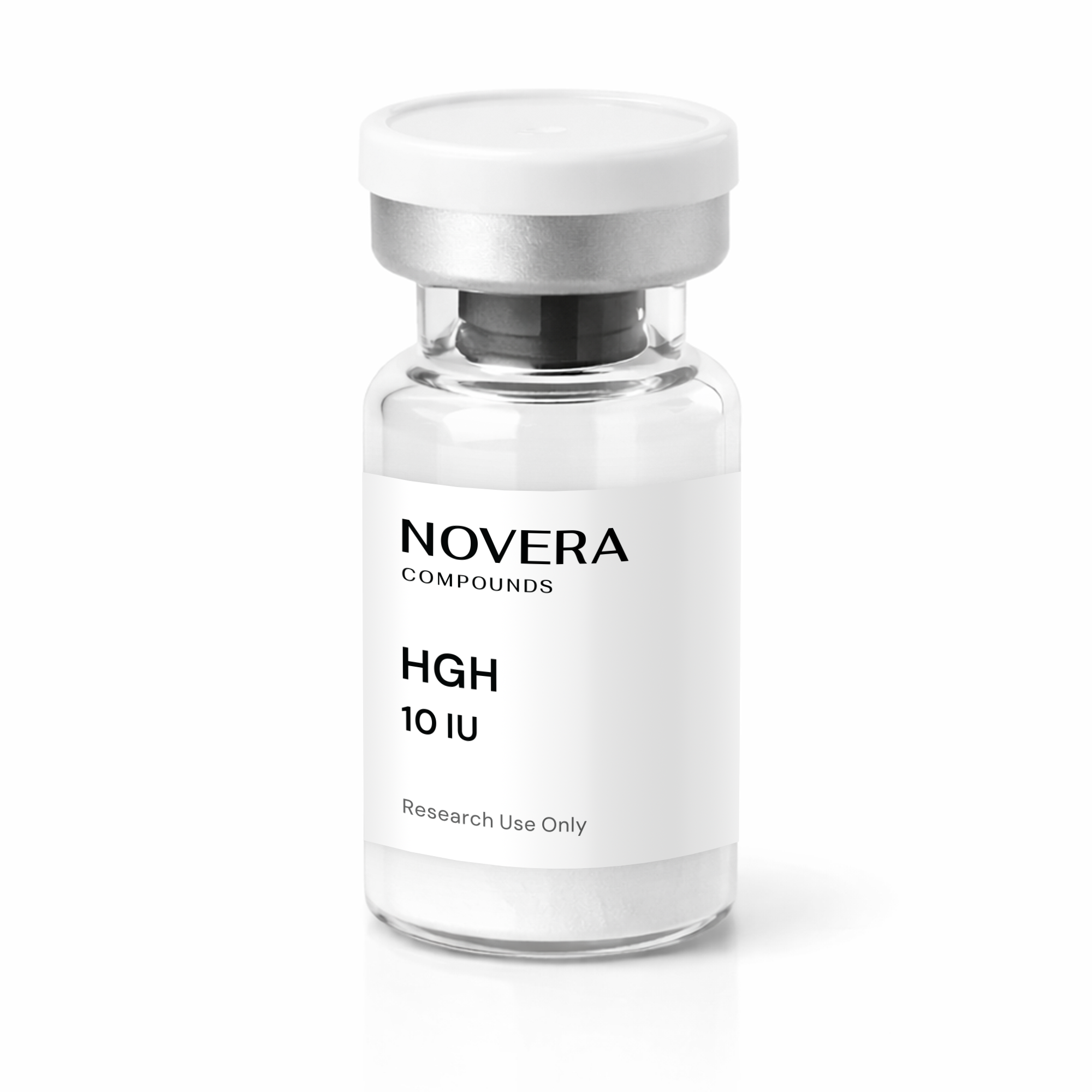
HGH (10iu)
All products are 100% genuine and sourced from trusted manufacturers, with authenticity that can be verified for complete peace of mind.
Order exactly what you need with no minimum quantity required, whether it’s a single unit or a larger order.
Your order is guaranteed to arrive safely, with full shipment tracking and dedicated support to ensure a smooth delivery experience.
Your payments are protected with industry-standard encryption and trusted payment providers, ensuring every transaction is safe, private, and secure.
 99% PURITY GUARANTEE
 99% PURITY GUARANTEE
Each peptide batch is tested and verified to meet or exceed 98–99% purity (HPLC). Full analytical reports are available in the Certificate of Analysis section.
 Preparation & Handling Notice
The product is delivered in powdered (lyophilized) form and must be properly reconstituted prior to research use.
 RESEARCH USE ONLY
This product is intended for research use only. It is not for human or veterinary use, not for diagnostic or therapeutic purposes, and should only be handled by qualified professionals.
Strength: 10iu
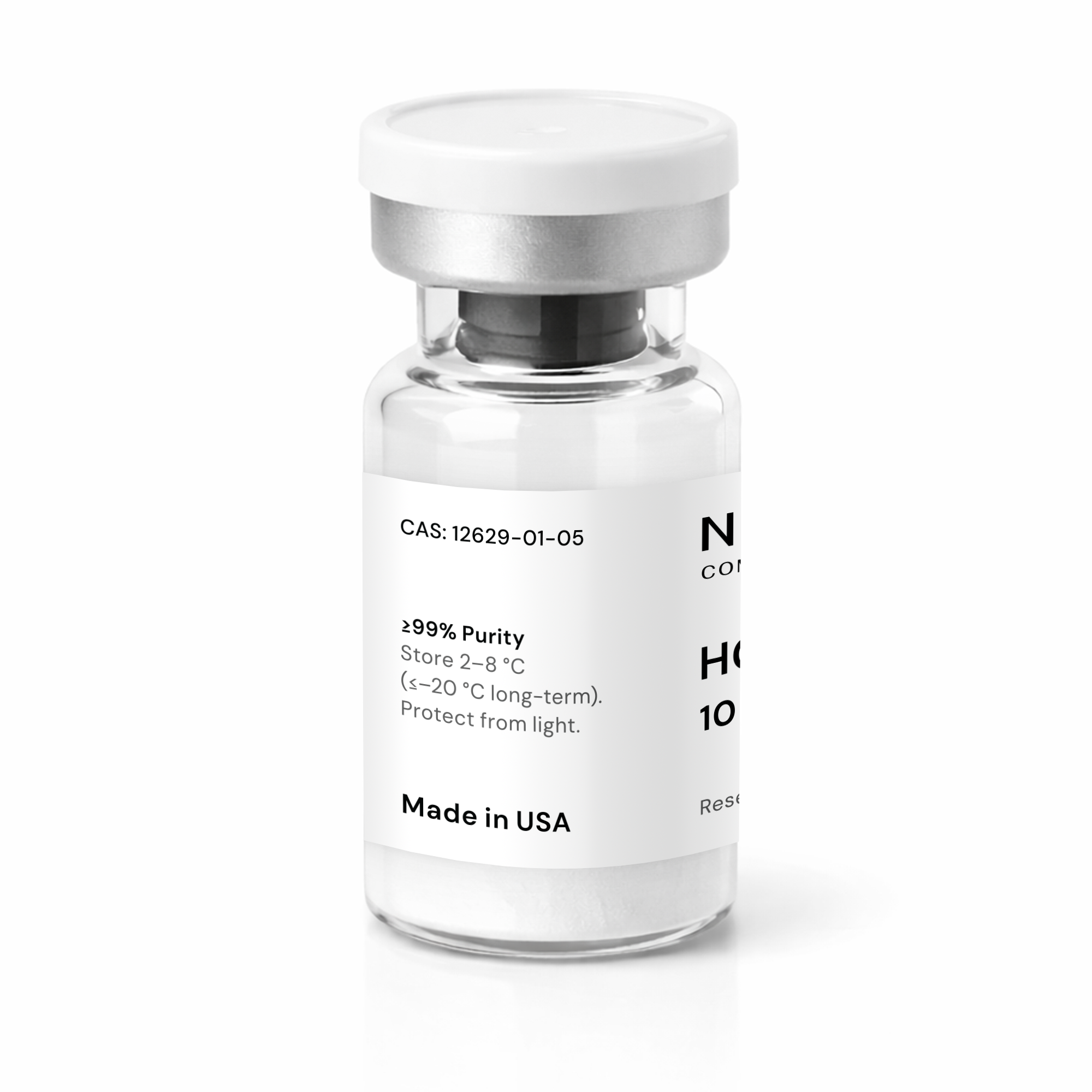
CAS: 12629-01-05
Chemical Formula: C₃₉H₆₀N₈O₁₃
Molecular weight: 848.9 g/mol
Peptide Sequence: H-Glu-Glu-Ala-Tyr-Ile-Pro-Lys-OH
Synonyms: Somatotropin (32–38) / HGH (32–38)
Storage: Store 2–8 °C (≤–20 °C long-term). RT exposure during transport acceptable. Protect from light.
Shelf life: 24 months from the manufacturing date.
HGH is a somatotropin-related peptide fragment supplied for laboratory research use. Derived from a defined region of human growth hormone, it is used in controlled experimental settings to study growth hormone–related signaling, receptor interactions, and structure–function relationships. This product is provided as a lyophilized powder for research applications only and is not intended for clinical or therapeutic use.
-
Cold chain shipping available for temperature-sensitive products.
-
Orders are processed within 1–2 business days.
-
Delivery timelines vary by destination and shipping method — view our Shipping Policy for region-specific estimates.
-
Tracking information will be provided once shipped.
-
No order minimum applies.
-
If your shipment is delayed, lost, or arrives damaged, you're covered under our Refund & Replacement Policy.
We accept Visa, Mastercard, and American Express. Apple Pay and Google Pay are available upon request via your account manager.
All transactions are processed through a secure, PCI DSS–compliant system to ensure your data is fully protected.
Why Choose NOVERA COMPOUNDS Peptides?
Novera Research delivers high-quality research peptides developed under strict manufacturing and quality-control standards. Each product is carefully synthesized, tested, and handled to ensure consistency, reliability, and transparency for advanced research applications.
- High-purity, research-grade peptide synthesis
- Analytical testing to verify quality and composition
- Consistent batch-to-batch performance
- Batch identification on every vial for traceability
- Stored and shipped under controlled conditions
 High-purity, research-grade peptide synthesis

Why Choose Medica Depot
Shop hundreds of medical products with no minimums and free shipping on large orders.
 400+ products
 No order minimums
 Free shipping
 Loyalty rewards
 Trusted since 2007
 Account manager
 Verified LOT numbers
INFORMATION
What is HGH (10 IU)?
Human growth hormone (HGH), also known as somatotropin, is a naturally occurring peptide hormone produced by the anterior pituitary gland and plays a role in regulating growth, metabolism, and cellular signaling.
In research settings, peptide fragments derived from growth hormone are used to investigate structure–function relationships, receptor-binding regions, and localized biological activity within the broader hormone molecule. Studying shorter fragments allows researchers to isolate specific amino acid sequences and evaluate how individual regions contribute to receptor interaction, intracellular signaling, or protein stability. This targeted approach supports mechanistic research without relying on the complete hormone structure.
Product Specifications
- Category: Peptides
- Subcategory: Muscle Growth & Performance Peptides
- Peptide Sequence: H-Glu-Glu-Ala-Tyr-Ile-Pro-Lys-OH
- Synonym: Somatotropin (32–38) / HGH (32–38)
- Molecular Formula: C₃₉H₆₀N₈O₁₃
- Molecular weight: 848.9 g/mol
- Purity: ≥95% (verified by HPLC and mass spectrometry)
- Packaging Format: 10 IU lyophilized powder in a sealed research-grade vial
- Storage Conditions: Store at −20 °C; protect from light and moisture
- Intended Use: For Laboratory Research Use Only
Key Characteristics of HGH (10 IU)
- Synthetic peptide fragment corresponding to a defined region of the somatotropin molecule.
- Designed for controlled laboratory investigation of growth hormone–related mechanisms.
- Enables targeted evaluation of specific amino acid sequences within the HGH structure.
- Lyophilized formulation enhances long-term stability and handling consistency.
- Analytical verification typically performed using HPLC and mass spectrometry.
- Suitable for biochemical, receptor-binding, and molecular modeling research.
How HGH (10 IU) Supports Research
HGH-related peptide fragments are used in laboratory research to better understand how growth hormone interacts with its receptor and activates intracellular signaling pathways. By isolating a short region of the full hormone, researchers can study how specific residues influence receptor recognition, protein folding, and downstream molecular responses.
This fragment-based approach is particularly useful in structure–activity research, where investigators compare full-length growth hormone with truncated or modified sequences. Typical experimental applications include mapping putative receptor-contact motifs, testing fragment binding in ligand–receptor or peptide–protein interaction assays, and using the fragment as a control or comparison sequence in structure–activity studies.
Any observed biological activity of this fragment is highly model-dependent and is not equivalent to the full spectrum of actions associated with intact human growth hormone. Such studies contribute to broader knowledge of endocrine regulation, protein–protein interactions, and signal transduction mechanisms in controlled experimental systems. All findings remain investigational and confined to laboratory models.
Research Applications & Usage Information
HGH (10 IU) peptide fragment is commonly incorporated into research involving:
- Growth hormone receptor interaction studies
- Structure–activity and structure–function analysis
- Protein-binding and affinity assays
- Endocrine signaling pathway modeling
- Comparative analysis of somatotropin fragments vs. full-length hormone
- Biochemical characterization and molecular modeling experiments
All applications are conducted in controlled laboratory or preclinical research environments.
Handling and Storage Recommendations
- Store unopened vials at −20°C; short‑term storage at 2–8°C is acceptable.
- Protect from light, excessive heat, and humidity.
- After reconstitution, store at 2–8°C and use within protocol‑defined laboratory timeframes.
- Avoid repeated freeze–thaw cycles to preserve peptide integrity.
- Follow institutional laboratory safety and handling procedures.
Proper storage and careful handling help maintain peptide integrity and ensure reliable experimental outcomes.
Research Use Only Notice
This product is intended for laboratory research use only and is not approved for human or veterinary use. It is not intended for diagnostic, therapeutic, or clinical applications. Any reference to biological activity or potential effects is based solely on preclinical or in vitro findings and should not be interpreted as validated clinical outcomes. Researchers are responsible for ensuring proper handling, storage, and disposal in accordance with institutional, federal, and international guidelines.
References
- National Center for Biotechnology Information. PubChem compound summary for CID 126658, Somatotropin (32‑38). PubChem. Available at: https://pubchem.ncbi.nlm.nih.gov/compound/126658
- Sami AJ. Structure-function relation of somatotropin with reference to molecular modeling. Curr Protein Pept Sci. 2007;8(3):283-292. doi:10.2174/138920307780831820
- Fernández-Garza LE, Guillen-Silva F, Sotelo-Ibarra MA, Domínguez-Mendoza AE, Barrera-Barrera SA, Barrera-Saldaña HA. Growth hormone and aging: a clinical review. Frontiers in Aging. 2025;6:1549453. doi:10.3389/fragi.2025.1549453
- Somatropin for growth hormone deficiency. In: CADTH Canadian Drug Expert Committee Reports. Ottawa, ON: Canadian Agency for Drugs and Technologies in Health; 2023. https://www.ncbi.nlm.nih.gov/books/NBK596750/
What is HGH (10 IU)?
Human growth hormone (HGH), also known as somatotropin, is a naturally occurring peptide hormone produced by the anterior pituitary gland and plays a role in regulating growth, metabolism, and cellular signaling.
In research settings, peptide fragments derived from growth hormone are used to investigate structure–function relationships, receptor-binding regions, and localized biological activity within the broader hormone molecule. Studying shorter fragments allows researchers to isolate specific amino acid sequences and evaluate how individual regions contribute to receptor interaction, intracellular signaling, or protein stability. This targeted approach supports mechanistic research without relying on the complete hormone structure.
Product Specifications
- Category: Peptides
- Subcategory: Muscle Growth & Performance Peptides
- Peptide Sequence: H-Glu-Glu-Ala-Tyr-Ile-Pro-Lys-OH
- Synonym: Somatotropin (32–38) / HGH (32–38)
- Molecular Formula: C₃₉H₆₀N₈O₁₃
- Molecular weight: 848.9 g/mol
- Purity: ≥95% (verified by HPLC and mass spectrometry)
- Packaging Format: 10 IU lyophilized powder in a sealed research-grade vial
- Storage Conditions: Store at −20 °C; protect from light and moisture
- Intended Use: For Laboratory Research Use Only
Key Characteristics of HGH (10 IU)
- Synthetic peptide fragment corresponding to a defined region of the somatotropin molecule.
- Designed for controlled laboratory investigation of growth hormone–related mechanisms.
- Enables targeted evaluation of specific amino acid sequences within the HGH structure.
- Lyophilized formulation enhances long-term stability and handling consistency.
- Analytical verification typically performed using HPLC and mass spectrometry.
- Suitable for biochemical, receptor-binding, and molecular modeling research.
How HGH (10 IU) Supports Research
HGH-related peptide fragments are used in laboratory research to better understand how growth hormone interacts with its receptor and activates intracellular signaling pathways. By isolating a short region of the full hormone, researchers can study how specific residues influence receptor recognition, protein folding, and downstream molecular responses.
This fragment-based approach is particularly useful in structure–activity research, where investigators compare full-length growth hormone with truncated or modified sequences. Typical experimental applications include mapping putative receptor-contact motifs, testing fragment binding in ligand–receptor or peptide–protein interaction assays, and using the fragment as a control or comparison sequence in structure–activity studies.
Any observed biological activity of this fragment is highly model-dependent and is not equivalent to the full spectrum of actions associated with intact human growth hormone. Such studies contribute to broader knowledge of endocrine regulation, protein–protein interactions, and signal transduction mechanisms in controlled experimental systems. All findings remain investigational and confined to laboratory models.
Research Applications & Usage Information
HGH (10 IU) peptide fragment is commonly incorporated into research involving:
- Growth hormone receptor interaction studies
- Structure–activity and structure–function analysis
- Protein-binding and affinity assays
- Endocrine signaling pathway modeling
- Comparative analysis of somatotropin fragments vs. full-length hormone
- Biochemical characterization and molecular modeling experiments
All applications are conducted in controlled laboratory or preclinical research environments.
Handling and Storage Recommendations
- Store unopened vials at −20°C; short‑term storage at 2–8°C is acceptable.
- Protect from light, excessive heat, and humidity.
- After reconstitution, store at 2–8°C and use within protocol‑defined laboratory timeframes.
- Avoid repeated freeze–thaw cycles to preserve peptide integrity.
- Follow institutional laboratory safety and handling procedures.
Proper storage and careful handling help maintain peptide integrity and ensure reliable experimental outcomes.
Research Use Only Notice
This product is intended for laboratory research use only and is not approved for human or veterinary use. It is not intended for diagnostic, therapeutic, or clinical applications. Any reference to biological activity or potential effects is based solely on preclinical or in vitro findings and should not be interpreted as validated clinical outcomes. Researchers are responsible for ensuring proper handling, storage, and disposal in accordance with institutional, federal, and international guidelines.
References
- National Center for Biotechnology Information. PubChem compound summary for CID 126658, Somatotropin (32‑38). PubChem. Available at: https://pubchem.ncbi.nlm.nih.gov/compound/126658
- Sami AJ. Structure-function relation of somatotropin with reference to molecular modeling. Curr Protein Pept Sci. 2007;8(3):283-292. doi:10.2174/138920307780831820
- Fernández-Garza LE, Guillen-Silva F, Sotelo-Ibarra MA, Domínguez-Mendoza AE, Barrera-Barrera SA, Barrera-Saldaña HA. Growth hormone and aging: a clinical review. Frontiers in Aging. 2025;6:1549453. doi:10.3389/fragi.2025.1549453
- Somatropin for growth hormone deficiency. In: CADTH Canadian Drug Expert Committee Reports. Ottawa, ON: Canadian Agency for Drugs and Technologies in Health; 2023. https://www.ncbi.nlm.nih.gov/books/NBK596750/
Related products