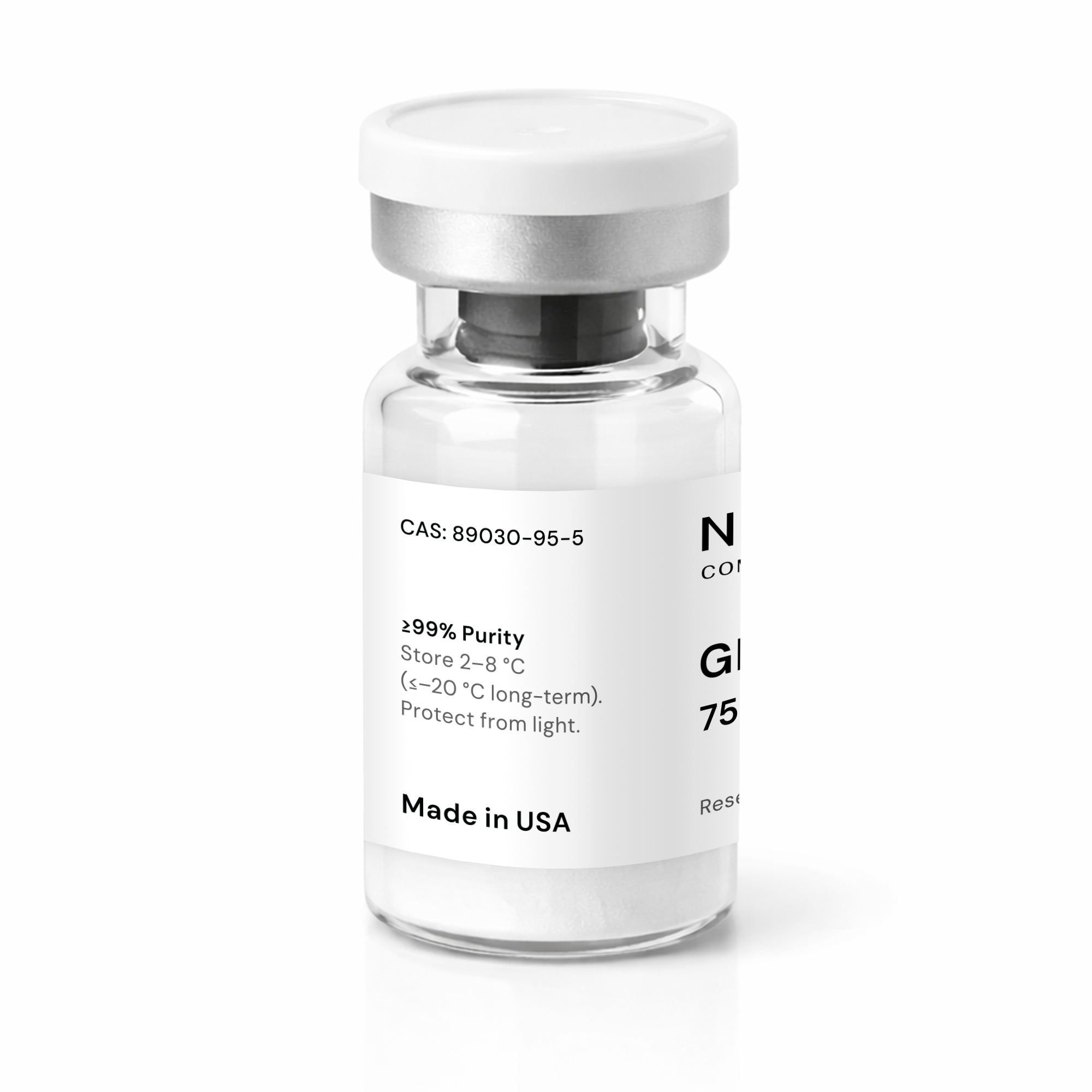
GHK-CU (75 mg)
All products are 100% genuine and sourced from trusted manufacturers, with authenticity that can be verified for complete peace of mind.
Order exactly what you need with no minimum quantity required, whether it’s a single unit or a larger order.
Your order is guaranteed to arrive safely, with full shipment tracking and dedicated support to ensure a smooth delivery experience.
Your payments are protected with industry-standard encryption and trusted payment providers, ensuring every transaction is safe, private, and secure.
 99% PURITY GUARANTEE
 99% PURITY GUARANTEE
Each peptide batch is tested and verified to meet or exceed 98–99% purity (HPLC). Full analytical reports are available in the Certificate of Analysis section.
 Preparation & Handling Notice
The product is delivered in powdered (lyophilized) form and must be properly reconstituted prior to research use.
 RESEARCH USE ONLY
This product is intended for research use only. It is not for human or veterinary use, not for diagnostic or therapeutic purposes, and should only be handled by qualified professionals.
Strength: 75 mg
CAS: 89030-95-5
Chemical Formula: C₁₄H₂₁N₆O₄Cu
Molecular weight: 401.91 g/mol
Peptide Sequence: Gly-His-Lys(Cu2+)
Synonyms: Copper peptide, GHK, Tripeptide, ghkcu, GHK-Cu acetate, Gly-His-Lys-Cu(II)
Storage: Store 2–8 °C (≤–20 °C long-term). RT exposure during transport acceptable. Protect from light.
Shelf life: 24 months from the manufacturing date.
GHK Cu is a synthetic copper–tripeptide complex composed of glycyl L histidyl L lysine (GHK) chelated with copper(II), used in research to study tissue remodeling, extracellular matrix regulation, and copper dependent signaling in vitro and in animal models. Research has associated GHK Cu with changes in collagen synthesis, antioxidant and inflammatory markers, and gene expression profiles in defined experimental systems. All findings are limited to controlled cell based and preclinical settings and do not imply therapeutic use.
-
Cold chain shipping available for temperature-sensitive products.
-
Orders are processed within 1–2 business days.
-
Delivery timelines vary by destination and shipping method — view our Shipping Policy for region-specific estimates.
-
Tracking information will be provided once shipped.
-
No order minimum applies.
-
If your shipment is delayed, lost, or arrives damaged, you're covered under our Refund & Replacement Policy.
We accept Visa, Mastercard, and American Express. Apple Pay and Google Pay are available upon request via your account manager.
All transactions are processed through a secure, PCI DSS–compliant system to ensure your data is fully protected.
Why Choose NOVERA COMPOUNDS Peptides?
Novera Research delivers high-quality research peptides developed under strict manufacturing and quality-control standards. Each product is carefully synthesized, tested, and handled to ensure consistency, reliability, and transparency for advanced research applications.
- High-purity, research-grade peptide synthesis
- Analytical testing to verify quality and composition
- Consistent batch-to-batch performance
- Batch identification on every vial for traceability
- Stored and shipped under controlled conditions
 High-purity, research-grade peptide synthesis

Why Choose Medica Depot
Shop hundreds of medical products with no minimums and free shipping on large orders.
 400+ products
 No order minimums
 Free shipping
 Loyalty rewards
 Trusted since 2007
 Account manager
 Verified LOT numbers
INFORMATION
What is GHK-Cu (75 mg)?
GHK‑Cu (75 mg) is a synthetic copper–tripeptide complex composed of glycyl‑L‑histidyl‑L‑lysine (GHK) and copper(II), found naturally in human plasma and tissues. This peptide is used in laboratory research to study copper’s role in tissue remodeling, gene expression, and oxidative stress responses.
In experimental systems, GHK‑Cu binds copper tightly, facilitating the study of copper’s role in cellular signaling, extracellular matrix regulation, and redox biology. The peptide’s ability to affect gene expression and protein dynamics makes it valuable for investigating wound repair, aging, and tissue regeneration processes.
Product Specifications
- CAS Number: 89030-95-5
- Peptide Sequence: Gly-His-Lys(Cu2+)
- Molecular Formula: C₁₄H₂₁N₆O₄Cu
- Molecular weight: 401.91 g/mol
- Purity: ≥ 95% (typically verified via HPLC and mass spectrometry)
- Packaging Format: 75 mg lyophilized powder in sealed research-grade vial
- Appearance: Blue to blue-violet powder (characteristic of copper complexes)
- Storage Conditions: Store at −20 °C; protect from light and moisture
- Intended Use: For laboratory research use only
Key Characteristics of GHK-Cu (75 mg)
- Copper–peptide complex: Combines the GHK tripeptide with copper(II) to study copper-dependent cellular functions.
- High copper affinity: Tightly binds copper ions to modulate cellular signaling and redox reactions.
- Stimulates collagen synthesis: Has been reported to increase collagen production without increasing cell proliferation in fibroblast cultures.
- Wound healing: Has been shown to increase connective-tissue accumulation and collagen production in specific animal wound models.
- Gene‑expression modulation: Affects genes related to tissue remodeling, oxidative stress, and inflammation.
- Dermal effects: Has been associated with changes in tissue density, elasticity, and matrix organization in skin models under controlled conditions.
- High purity: Suitable for reproducible research in cell-based assays and preclinical studies.
How GHK-Cu (75 mg) Supports Research
GHK‑Cu (75 mg) is used to study the role of copper in tissue repair, redox biology, and gene regulation. It provides a controlled method for investigating how copper affects collagen production, oxidative stress responses, and gene expression in cells and tissues.
Research has shown that GHK‑Cu can influence extracellular matrix turnover and tissue regeneration, making it valuable for studying wound healing, aging, and tissue repair mechanisms. It helps clarify how copper-binding peptides regulate cellular responses to stress and injury.
Research Applications & Usage Information
GHK-Cu (75 mg) is commonly used:
- Fibroblast and keratinocyte cultures: Studying collagen synthesis, glycosaminoglycan production, and matrix organization.
- Wound healing: Evaluating tissue repair and connective-tissue deposition in animal models.
- Dermal research: Assessing skin thickness, elasticity, and histological markers of matrix organization.
- Oxidative stress: Investigating copper’s role in antioxidant enzyme activity and stress response pathways.
- Copper transport and homeostasis: Studying copper uptake and transport, including competition with other copper-binding proteins.
- Neuronal models: Exploring copper-dependent signaling in neuronal and brain cells.
- Cancer research: Examining the effects of GHK‑Cu on gene expression in tumor cell lines, including invasion and survival markers.
GHK‑Cu is employed in various experimental settings to understand copper’s role in tissue remodeling, gene regulation, and stress responses. Findings are specific to the models used and are not intended for clinical or therapeutic application.
Handling and Storage Recommendations
To preserve structural integrity and copper coordination stability:
- Store lyophilized material at −20°C or below, in a dry, light-protected environment.
- Allow vials to equilibrate to room temperature before opening to reduce condensation.
- During reconstitution, use sterile water or buffer as required by the experiment.
- Mix gently. Invert or vortex briefly to dissolve; avoid vigorous mixing that may cause foaming.
- Divide into single-use aliquots immediately to prevent repeated freeze–thaw cycles.
- Store reconstituted aliquots at −20°C (short-term) or −80°C (long-term).
- Visually inspect the solution and discard any that appears discolored or contains particulates.
Proper labeling and documentation of reconstitution date and concentration are recommended for multi-phase experimental studies.
Research Use Only Notice
This product is intended for laboratory research use only and is not approved for human or veterinary use. It is not intended for diagnostic, therapeutic, or clinical applications. Any reference to biological activity or potential effects is based solely on preclinical or in vitro findings and should not be interpreted as validated clinical outcomes. Researchers are responsible for ensuring proper handling, storage, and disposal in accordance with institutional, federal, and international guidelines.
References
- Glycyl-L-histidyl-L-lysine. PubChem. https://pubchem.ncbi.nlm.nih.gov/compound/73587
- Maquart FX, Pickart L, Laurent M, Gillery P, Monboisse JC, Borel JP. Stimulation of collagen synthesis in fibroblast cultures by the tripeptide‐copper complex glycyl‐L‐histidyl‐L‐lysine‐Cu2+. FEBS Letters. 1988;238(2):343-346. doi:10.1016/0014-5793(88)80509-x
- Maquart FX, Bellon G, Chaqour B, et al. In vivo stimulation of connective tissue accumulation by the tripeptide-copper complex glycyl-L-histidyl-L-lysine-Cu2+ in rat experimental wounds. Journal of Clinical Investigation. 1993;92(5):2368-2376. doi:10.1172/jci116842
- Pickart L, Vasquez-Soltero JM, Margolina A. The Human Tripeptide GHK-CU in Prevention of Oxidative Stress and Degenerative Conditions of aging: Implications for Cognitive Health. Oxidative Medicine and Cellular Longevity. 2012;2012:1-8. doi:10.1155/2012/324832
- Pickart L, Margolina A. Regenerative and protective actions of the GHK-CU peptide in the light of the new gene data. International Journal of Molecular Sciences. 2018;19(7):1987. doi:10.3390/ijms19071987
- Pickart L, Vasquez-Soltero J, Margolina A. The effect of the human peptide GHK on gene expression relevant to nervous system function and cognitive decline. Brain Sciences. 2017;7(2):20. doi:10.3390/brainsci7020020
What is GHK-Cu (75 mg)?
GHK‑Cu (75 mg) is a synthetic copper–tripeptide complex composed of glycyl‑L‑histidyl‑L‑lysine (GHK) and copper(II), found naturally in human plasma and tissues. This peptide is used in laboratory research to study copper’s role in tissue remodeling, gene expression, and oxidative stress responses.
In experimental systems, GHK‑Cu binds copper tightly, facilitating the study of copper’s role in cellular signaling, extracellular matrix regulation, and redox biology. The peptide’s ability to affect gene expression and protein dynamics makes it valuable for investigating wound repair, aging, and tissue regeneration processes.
Product Specifications
- CAS Number: 89030-95-5
- Peptide Sequence: Gly-His-Lys(Cu2+)
- Molecular Formula: C₁₄H₂₁N₆O₄Cu
- Molecular weight: 401.91 g/mol
- Purity: ≥ 95% (typically verified via HPLC and mass spectrometry)
- Packaging Format: 75 mg lyophilized powder in sealed research-grade vial
- Appearance: Blue to blue-violet powder (characteristic of copper complexes)
- Storage Conditions: Store at −20 °C; protect from light and moisture
- Intended Use: For laboratory research use only
Key Characteristics of GHK-Cu (75 mg)
- Copper–peptide complex: Combines the GHK tripeptide with copper(II) to study copper-dependent cellular functions.
- High copper affinity: Tightly binds copper ions to modulate cellular signaling and redox reactions.
- Stimulates collagen synthesis: Has been reported to increase collagen production without increasing cell proliferation in fibroblast cultures.
- Wound healing: Has been shown to increase connective-tissue accumulation and collagen production in specific animal wound models.
- Gene‑expression modulation: Affects genes related to tissue remodeling, oxidative stress, and inflammation.
- Dermal effects: Has been associated with changes in tissue density, elasticity, and matrix organization in skin models under controlled conditions.
- High purity: Suitable for reproducible research in cell-based assays and preclinical studies.
How GHK-Cu (75 mg) Supports Research
GHK‑Cu (75 mg) is used to study the role of copper in tissue repair, redox biology, and gene regulation. It provides a controlled method for investigating how copper affects collagen production, oxidative stress responses, and gene expression in cells and tissues.
Research has shown that GHK‑Cu can influence extracellular matrix turnover and tissue regeneration, making it valuable for studying wound healing, aging, and tissue repair mechanisms. It helps clarify how copper-binding peptides regulate cellular responses to stress and injury.
Research Applications & Usage Information
GHK-Cu (75 mg) is commonly used:
- Fibroblast and keratinocyte cultures: Studying collagen synthesis, glycosaminoglycan production, and matrix organization.
- Wound healing: Evaluating tissue repair and connective-tissue deposition in animal models.
- Dermal research: Assessing skin thickness, elasticity, and histological markers of matrix organization.
- Oxidative stress: Investigating copper’s role in antioxidant enzyme activity and stress response pathways.
- Copper transport and homeostasis: Studying copper uptake and transport, including competition with other copper-binding proteins.
- Neuronal models: Exploring copper-dependent signaling in neuronal and brain cells.
- Cancer research: Examining the effects of GHK‑Cu on gene expression in tumor cell lines, including invasion and survival markers.
GHK‑Cu is employed in various experimental settings to understand copper’s role in tissue remodeling, gene regulation, and stress responses. Findings are specific to the models used and are not intended for clinical or therapeutic application.
Handling and Storage Recommendations
To preserve structural integrity and copper coordination stability:
- Store lyophilized material at −20°C or below, in a dry, light-protected environment.
- Allow vials to equilibrate to room temperature before opening to reduce condensation.
- During reconstitution, use sterile water or buffer as required by the experiment.
- Mix gently. Invert or vortex briefly to dissolve; avoid vigorous mixing that may cause foaming.
- Divide into single-use aliquots immediately to prevent repeated freeze–thaw cycles.
- Store reconstituted aliquots at −20°C (short-term) or −80°C (long-term).
- Visually inspect the solution and discard any that appears discolored or contains particulates.
Proper labeling and documentation of reconstitution date and concentration are recommended for multi-phase experimental studies.
Research Use Only Notice
This product is intended for laboratory research use only and is not approved for human or veterinary use. It is not intended for diagnostic, therapeutic, or clinical applications. Any reference to biological activity or potential effects is based solely on preclinical or in vitro findings and should not be interpreted as validated clinical outcomes. Researchers are responsible for ensuring proper handling, storage, and disposal in accordance with institutional, federal, and international guidelines.
References
- Glycyl-L-histidyl-L-lysine. PubChem. https://pubchem.ncbi.nlm.nih.gov/compound/73587
- Maquart FX, Pickart L, Laurent M, Gillery P, Monboisse JC, Borel JP. Stimulation of collagen synthesis in fibroblast cultures by the tripeptide‐copper complex glycyl‐L‐histidyl‐L‐lysine‐Cu2+. FEBS Letters. 1988;238(2):343-346. doi:10.1016/0014-5793(88)80509-x
- Maquart FX, Bellon G, Chaqour B, et al. In vivo stimulation of connective tissue accumulation by the tripeptide-copper complex glycyl-L-histidyl-L-lysine-Cu2+ in rat experimental wounds. Journal of Clinical Investigation. 1993;92(5):2368-2376. doi:10.1172/jci116842
- Pickart L, Vasquez-Soltero JM, Margolina A. The Human Tripeptide GHK-CU in Prevention of Oxidative Stress and Degenerative Conditions of aging: Implications for Cognitive Health. Oxidative Medicine and Cellular Longevity. 2012;2012:1-8. doi:10.1155/2012/324832
- Pickart L, Margolina A. Regenerative and protective actions of the GHK-CU peptide in the light of the new gene data. International Journal of Molecular Sciences. 2018;19(7):1987. doi:10.3390/ijms19071987
- Pickart L, Vasquez-Soltero J, Margolina A. The effect of the human peptide GHK on gene expression relevant to nervous system function and cognitive decline. Brain Sciences. 2017;7(2):20. doi:10.3390/brainsci7020020
Related products