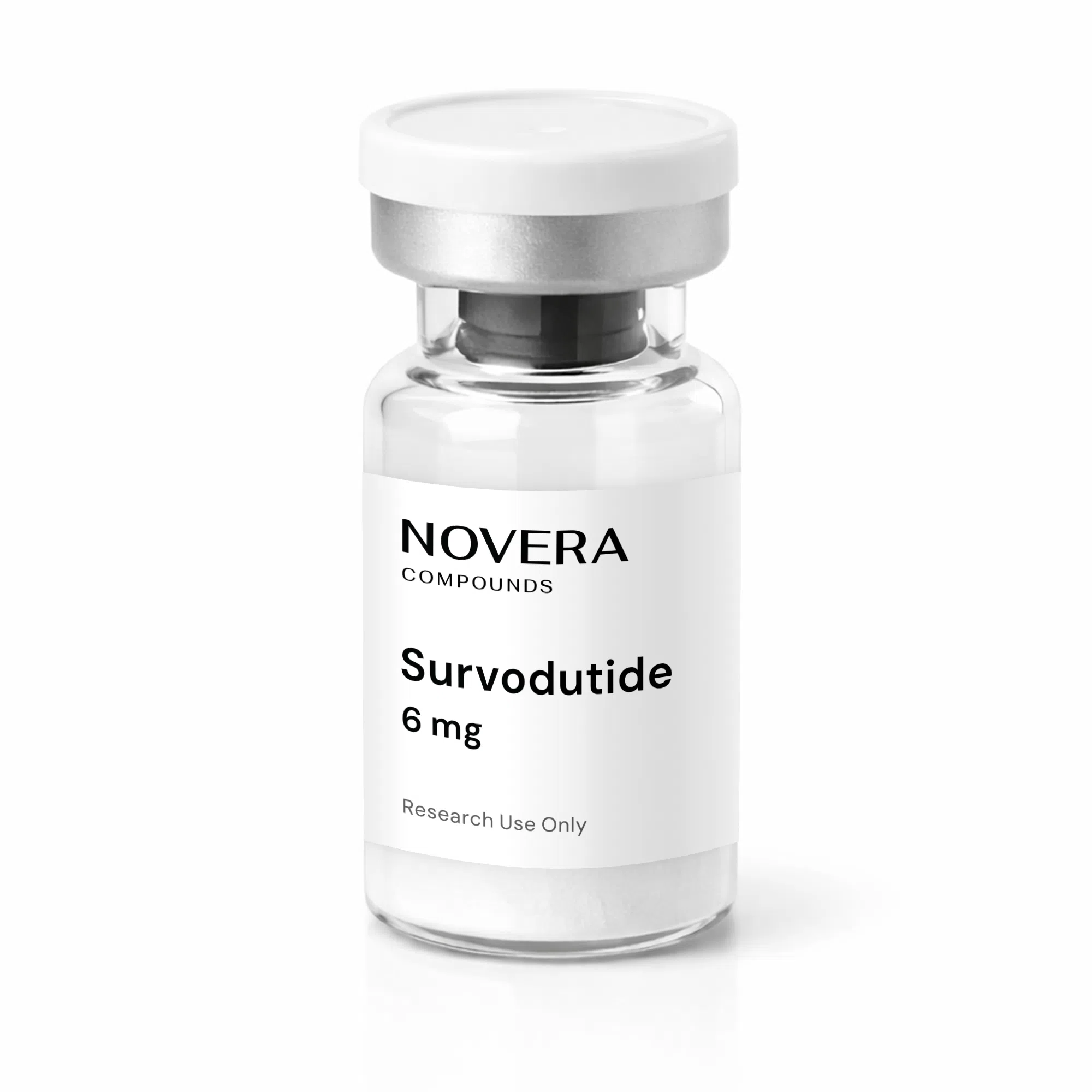
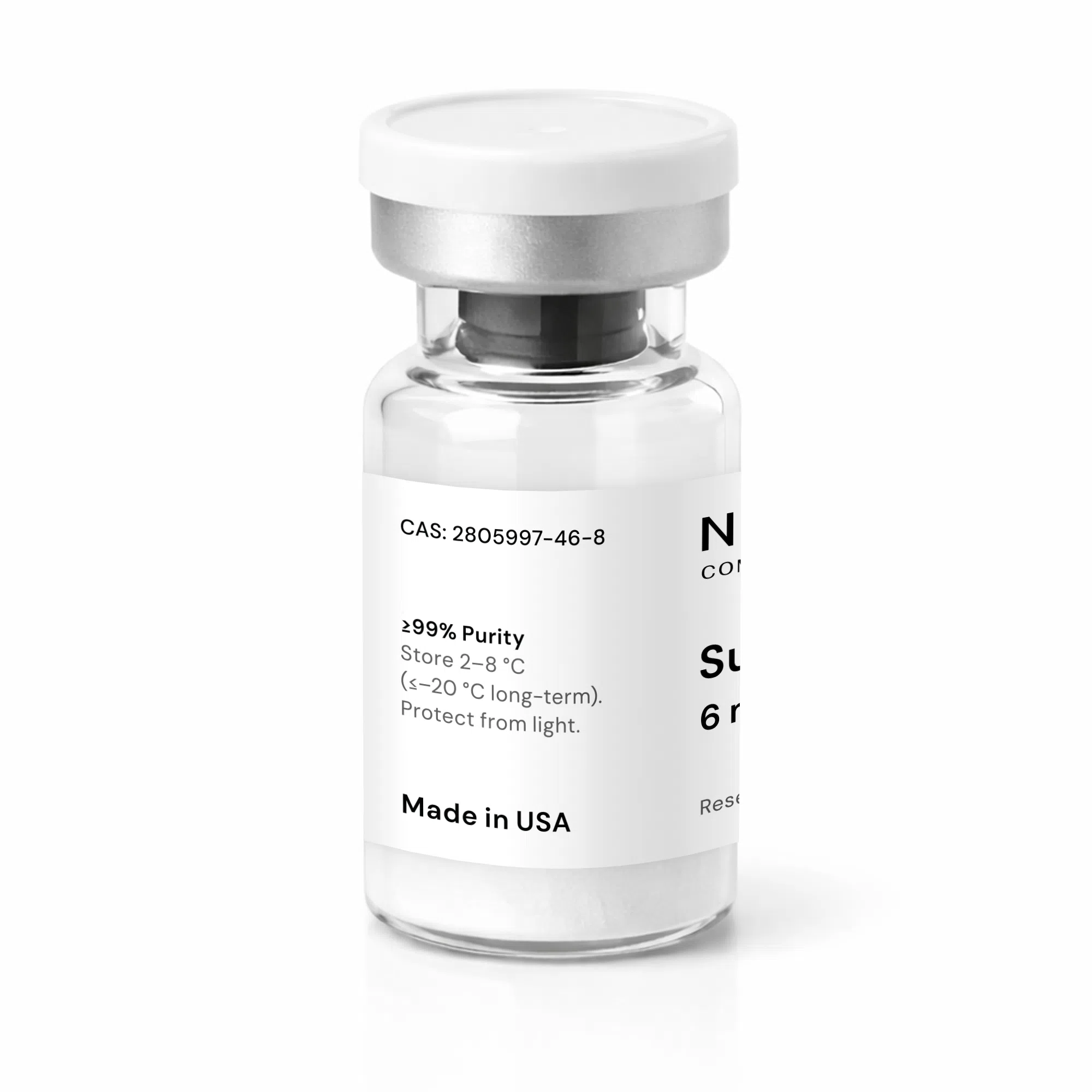
Survodutide 6mg
Strength: 6 mg
CAS: 2805997-46-8
Chemical Formula: C₁₉₂H₂₈₉N₄₇O₆₁
Molecular weight: 4231.63 g/mol
Peptide Sequence: His-{1-Aminocyclobutanecarboxylic acid}-Gln-Gly-Thr-Phe-Thr-Ser-Asp-Tyr-Ser-Lys-Tyr-Leu-Asp-Glu-Arg-Ala-Ala-Lys-Asp-Phe-Ile-{Lys(Gly-Ser-Gly-Ser-Gly-Gly-γGlu-C18 diacid)}-Trp-Leu-Glu-Ser-Ala-NH2
Synonyms: BI 456906
Storage: Store 2–8 °C (≤–20 °C long-term). RT exposure during transport acceptable. Protect from light.
Shelf life: 24 months from the manufacturing date.
Survodutide (BI 456906) is a synthetic, lipidated peptide analog modeled after glucagon, designed for laboratory research on dual receptor signaling, metabolic pathway dynamics, and hormone-mediated cellular communication.


Why Choose Medica Depot
Shop hundreds of medical products with no minimums and free shipping on large orders.
 400+ products
 No order minimums
 Free shipping
 Loyalty rewards
 Trusted since 2007
 Account manager
 Verified LOT numbers
INFORMATION
What is Survodutide (6 mg)?
Survodutide (6 mg) is a synthetic, research-grade peptide commonly studied in metabolic and endocrine research. It is a modified analog of glucagon-like peptide-1 (GLP-1), a naturally occurring hormone involved in glucose regulation and energy balance.
This peptide contains specific structural modifications, including amino acid substitutions and a lipidated side chain. These changes enhance its stability and enable prolonged receptor interaction, making it suitable for studying extended signaling responses compared to native GLP-1, which is rapidly degraded in the body.
In laboratory and preclinical settings, Survodutide is used to investigate complex metabolic signaling networks, particularly those related to glucose homeostasis, energy expenditure, and hormone-mediated cellular communication. The peptide’s extended structure and lipid conjugation enable researchers to study longer-duration signaling responses that would not be possible with shorter-acting peptide analogs.
Product Specifications
- Product Name: Survodutide (6 mg)
- Synonym: BI 456906
- CAS Number: 2805997-46-8
- Molecular Formula: C₁₉₂H₂₈₉N₄₇O₆₁
- Molecular Weight: 4231.63 g/mol
- Peptide Sequence:
His–{1-Aminocyclobutanecarboxylic acid}–Gln–Gly–Thr–Phe–Thr–Ser–Asp–Tyr–Ser–Lys–Tyr–Leu–Asp–Glu–Arg–Ala–Ala–Lys–Asp–Phe–Ile–{Lys(Gly–Ser–Gly–Ser–Gly–Gly–γGlu–C18 diacid)}–Trp–Leu–Glu–Ser–Ala–NH₂ - Purity: ≥95% (confirmed by HPLC and mass spectrometry)
- Packaging Format: 6 mg lyophilized powder in a sealed research-grade vial
- Storage Conditions: Store 2–8 °C (≤–20 °C long term). Protect from light.
- Intended Use: For Laboratory Research Use Only
Key Characteristics of Survodutide (6 mg)
- Synthetic peptide designed for metabolic pathway research
- Contains lipidated modification supporting prolonged receptor interaction in experimental systems
- Structurally optimized to support reproducibility in research models
- Supplied in lyophilized format to support reconstitution before use
- Analytical purity confirmed using HPLC and mass spectrometry
- Designed for controlled in vitro and preclinical research settings
- Suitable for comparative studies involving other metabolic signaling peptides
How Survodutide (6 mg) Supports Research
Survodutide is used in laboratory studies to investigate hormone-regulated metabolic pathways and receptor-mediated cellular signaling. Researchers employ this peptide to examine how long-acting analogs influence intracellular signaling cascades, energy metabolism, and endocrine communication networks.
Its structural design allows for investigation of receptor binding dynamics, downstream signal transduction, and coordinated metabolic responses in controlled systems. By studying Survodutide in cell-based assays and animal models, investigators can facilitate the investigation of multi-pathway signaling in metabolic models.
Research Applications & Usage Information
Survodutide (6 mg) is commonly utilized in laboratory research involving:
- Hormone receptor interaction studies
- Metabolic signaling pathway analysis
- Glucose homeostasis and insulin-regulation models
- Energy expenditure and adipose tissue research
- Preclinical metabolic disorder models
- Long-acting peptide analog comparison studies
- Cellular signal transduction and protein phosphorylation research
All applications are investigational and conducted within controlled research
Handling and Storage Recommendations
- Store 2–8 °C (≤–20 °C for long-term storage). Protect from light.
- Keep the vial tightly sealed and protected from moisture until reconstitution.
- Allow the vial to equilibrate to ambient laboratory temperature before opening to minimize exposure to condensation.
- After reconstitution, store prepared solutions at 2–8 °C according to laboratory protocols.
- Avoid repeated freeze-thaw cycles to support research applications.
- Follow sterile laboratory techniques during preparation and handling.
Research Use Only Notice
This product is intended for laboratory research use only and is not approved for human or veterinary use. It is not intended for diagnostic, therapeutic, or clinical applications. Any reference to biological activity or potential effects is based solely on preclinical or in-vitro findings and should not be interpreted as validated clinical outcomes. Researchers are responsible for ensuring proper handling, storage, and disposal in accordance with institutional, federal, and international guidelines.
References
- Zimmermann T, Thomas L, Baader-Pagler T, et al. BI 456906: Discovery and preclinical pharmacology of a novel GCGR/GLP-1R dual agonist with robust anti-obesity efficacy. Mol Metab. 2022;66:101633. doi:10.1016/j.molmet.2022.101633
- Augustin R, Thomas L, Zimmermann T, et al. 749-P: Selection of BI 456906 as a dual GCGR/GLP-1R agonist based on in vitro potency and in vivo target engagement biomarkers. Diabetes. 2023;72(Supplement_1). doi:10.2337/db23-749-p
- Zhang J, Xu H, Dong Y, Feng J, Li R. Design, synthesis, and structure-activity relationship study of novel GLP-1/GIP/GCG triple receptor agonists. Eur J Med Chem. 2025;298:118024. doi:10.1016/j.ejmech.2025.118024
- Palani A, Nawrocki AR, Orvieto F, et al. Discovery of MK-1462: GLP-1 and Glucagon Receptor Dual Agonist for the Treatment of Obesity and Diabetes. ACS Med Chem Lett. 2022;13(8):1248-1254. Published 2022 Jul 21. doi:10.1021/acsmedchemlett.2c00217
What is Survodutide (6 mg)?
Survodutide (6 mg) is a synthetic, research-grade peptide commonly studied in metabolic and endocrine research. It is a modified analog of glucagon-like peptide-1 (GLP-1), a naturally occurring hormone involved in glucose regulation and energy balance.
This peptide contains specific structural modifications, including amino acid substitutions and a lipidated side chain. These changes enhance its stability and enable prolonged receptor interaction, making it suitable for studying extended signaling responses compared to native GLP-1, which is rapidly degraded in the body.
In laboratory and preclinical settings, Survodutide is used to investigate complex metabolic signaling networks, particularly those related to glucose homeostasis, energy expenditure, and hormone-mediated cellular communication. The peptide’s extended structure and lipid conjugation enable researchers to study longer-duration signaling responses that would not be possible with shorter-acting peptide analogs.
Product Specifications
- Product Name: Survodutide (6 mg)
- Synonym: BI 456906
- CAS Number: 2805997-46-8
- Molecular Formula: C₁₉₂H₂₈₉N₄₇O₆₁
- Molecular Weight: 4231.63 g/mol
- Peptide Sequence:
His–{1-Aminocyclobutanecarboxylic acid}–Gln–Gly–Thr–Phe–Thr–Ser–Asp–Tyr–Ser–Lys–Tyr–Leu–Asp–Glu–Arg–Ala–Ala–Lys–Asp–Phe–Ile–{Lys(Gly–Ser–Gly–Ser–Gly–Gly–γGlu–C18 diacid)}–Trp–Leu–Glu–Ser–Ala–NH₂ - Purity: ≥95% (confirmed by HPLC and mass spectrometry)
- Packaging Format: 6 mg lyophilized powder in a sealed research-grade vial
- Storage Conditions: Store 2–8 °C (≤–20 °C long term). Protect from light.
- Intended Use: For Laboratory Research Use Only
Key Characteristics of Survodutide (6 mg)
- Synthetic peptide designed for metabolic pathway research
- Contains lipidated modification supporting prolonged receptor interaction in experimental systems
- Structurally optimized to support reproducibility in research models
- Supplied in lyophilized format to support reconstitution before use
- Analytical purity confirmed using HPLC and mass spectrometry
- Designed for controlled in vitro and preclinical research settings
- Suitable for comparative studies involving other metabolic signaling peptides
How Survodutide (6 mg) Supports Research
Survodutide is used in laboratory studies to investigate hormone-regulated metabolic pathways and receptor-mediated cellular signaling. Researchers employ this peptide to examine how long-acting analogs influence intracellular signaling cascades, energy metabolism, and endocrine communication networks.
Its structural design allows for investigation of receptor binding dynamics, downstream signal transduction, and coordinated metabolic responses in controlled systems. By studying Survodutide in cell-based assays and animal models, investigators can facilitate the investigation of multi-pathway signaling in metabolic models.
Research Applications & Usage Information
Survodutide (6 mg) is commonly utilized in laboratory research involving:
- Hormone receptor interaction studies
- Metabolic signaling pathway analysis
- Glucose homeostasis and insulin-regulation models
- Energy expenditure and adipose tissue research
- Preclinical metabolic disorder models
- Long-acting peptide analog comparison studies
- Cellular signal transduction and protein phosphorylation research
All applications are investigational and conducted within controlled research
Handling and Storage Recommendations
- Store 2–8 °C (≤–20 °C for long-term storage). Protect from light.
- Keep the vial tightly sealed and protected from moisture until reconstitution.
- Allow the vial to equilibrate to ambient laboratory temperature before opening to minimize exposure to condensation.
- After reconstitution, store prepared solutions at 2–8 °C according to laboratory protocols.
- Avoid repeated freeze-thaw cycles to support research applications.
- Follow sterile laboratory techniques during preparation and handling.
Research Use Only Notice
This product is intended for laboratory research use only and is not approved for human or veterinary use. It is not intended for diagnostic, therapeutic, or clinical applications. Any reference to biological activity or potential effects is based solely on preclinical or in-vitro findings and should not be interpreted as validated clinical outcomes. Researchers are responsible for ensuring proper handling, storage, and disposal in accordance with institutional, federal, and international guidelines.
References
- Zimmermann T, Thomas L, Baader-Pagler T, et al. BI 456906: Discovery and preclinical pharmacology of a novel GCGR/GLP-1R dual agonist with robust anti-obesity efficacy. Mol Metab. 2022;66:101633. doi:10.1016/j.molmet.2022.101633
- Augustin R, Thomas L, Zimmermann T, et al. 749-P: Selection of BI 456906 as a dual GCGR/GLP-1R agonist based on in vitro potency and in vivo target engagement biomarkers. Diabetes. 2023;72(Supplement_1). doi:10.2337/db23-749-p
- Zhang J, Xu H, Dong Y, Feng J, Li R. Design, synthesis, and structure-activity relationship study of novel GLP-1/GIP/GCG triple receptor agonists. Eur J Med Chem. 2025;298:118024. doi:10.1016/j.ejmech.2025.118024
- Palani A, Nawrocki AR, Orvieto F, et al. Discovery of MK-1462: GLP-1 and Glucagon Receptor Dual Agonist for the Treatment of Obesity and Diabetes. ACS Med Chem Lett. 2022;13(8):1248-1254. Published 2022 Jul 21. doi:10.1021/acsmedchemlett.2c00217
Related products