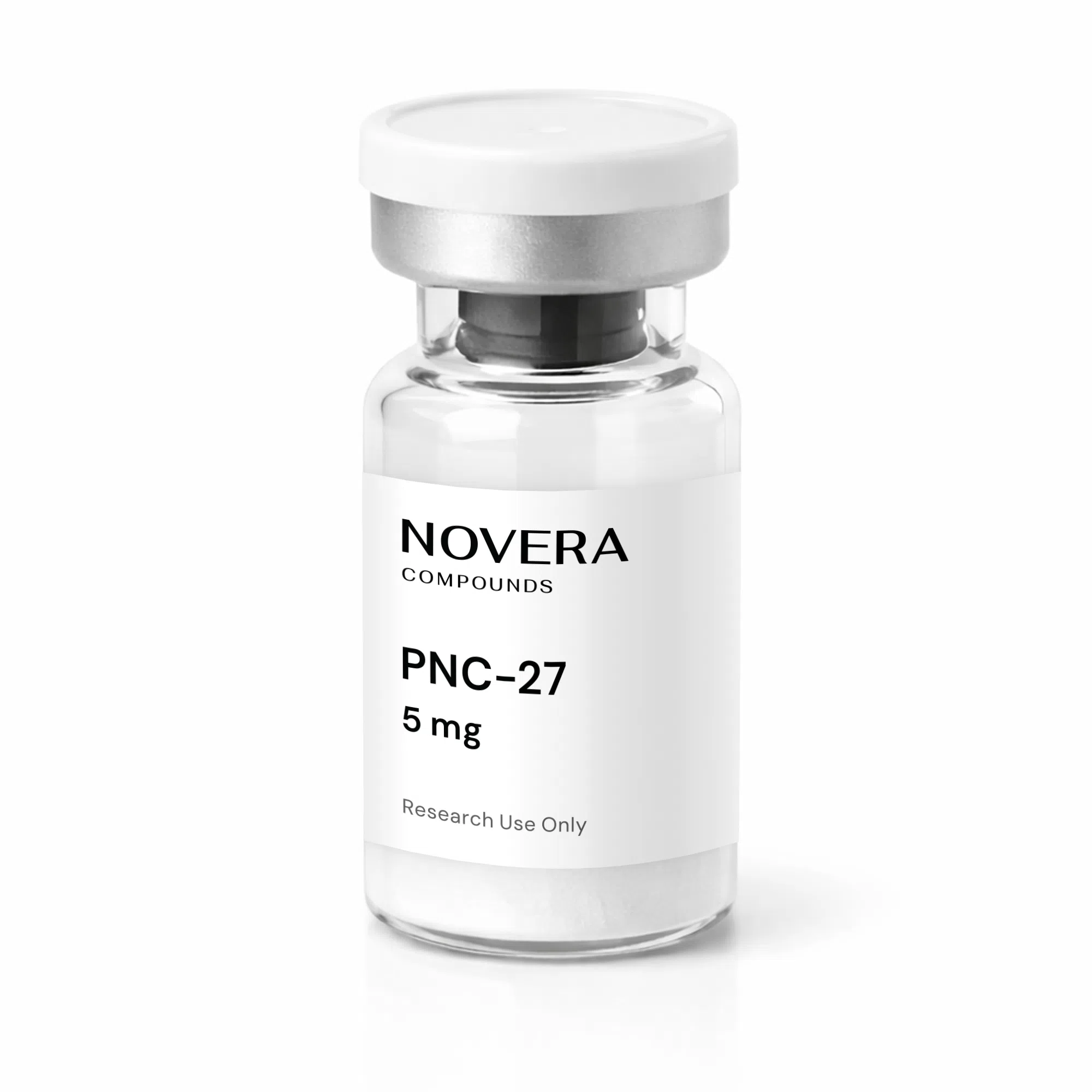
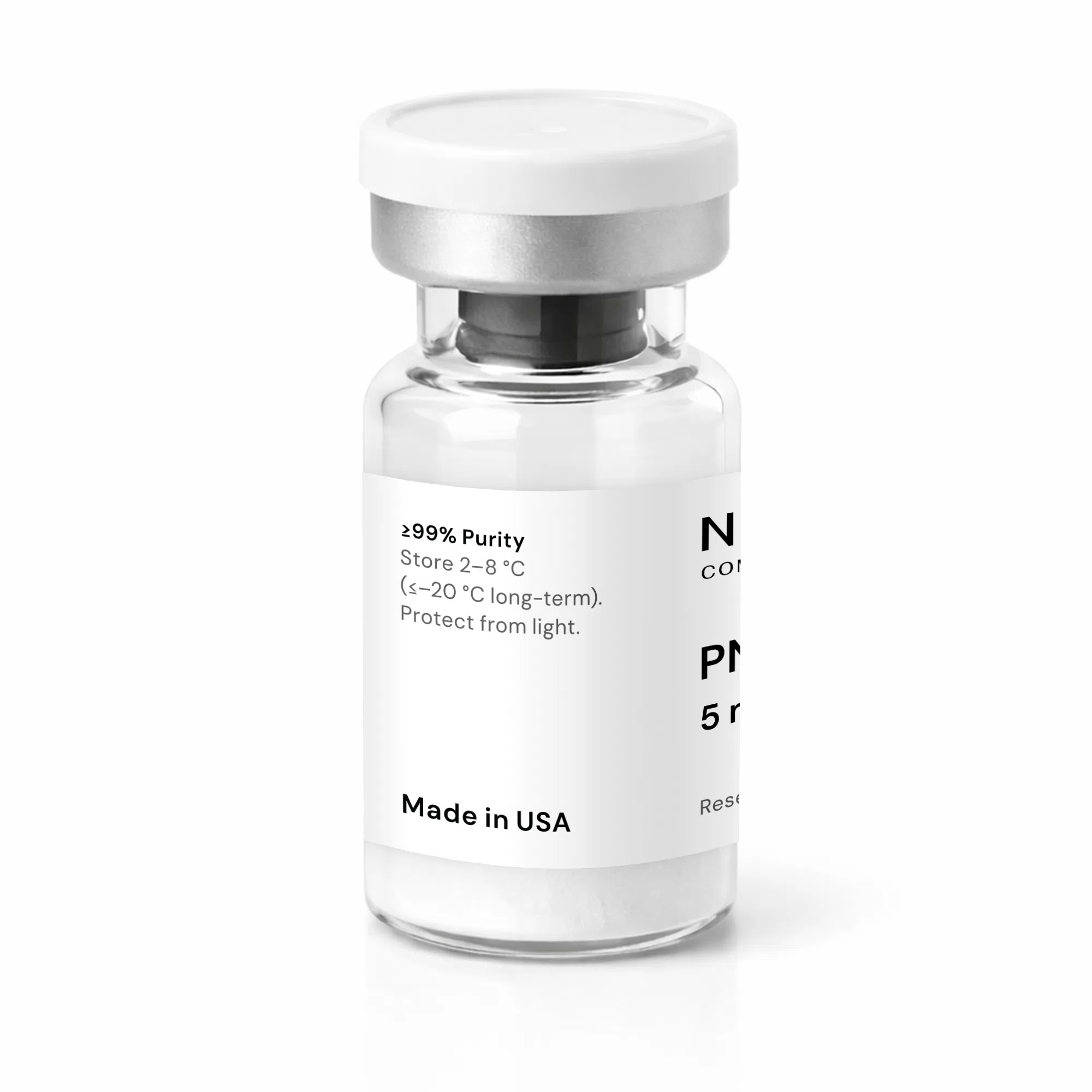
PNC-27 5mg
Strength: 5mg
CAS: N/A
Chemical Formula: C₁₈₈H₂₉₃N₅₃O₄₄S
Molecular weight: 4031.7 g/mol
Peptide Sequence: PPLSQETFSDLWKLLKKWKMRRNQFWVKVQRG
Synonyms: PNC‑27; p53(12–26)–penetratin/MRP chimera; HDM2‑targeted lytic peptide
Storage: Store 2–8 °C (≤–20 °C long-term). RT exposure during transport acceptable. Protect from light.
Shelf life: 24 months from the manufacturing date.
PNC-27 is a p53-referenced, penetratin-linked synthetic peptide used as a research tool in oncology-oriented experimental work. It is applied to evaluate peptide–cell interactions, membrane-associated effects, and response profiles in tumor-relevant cell lines or tissue models, often within comparative screening designs alongside controls and related sequences. For laboratory research use only; not for human use.


Why Choose Medica Depot
Shop hundreds of medical products with no minimums and free shipping on large orders.
 400+ products
 No order minimums
 Free shipping
 Loyalty rewards
 Trusted since 2007
 Account manager
 Verified LOT numbers
INFORMATION
What is PNC-27 (5mg)?
PNC-27 (5mg) is a synthetic research peptide used in laboratory settings, primarily in oncology-related experimental models. It is described in scientific literature as a p53(12–26)–penetratin (MRP) chimera, which combines a p53-derived segment with a cell-penetrating peptide sequence to facilitate controlled research.
In research workflows, PNC-27 serves as a sequence-defined tool to study peptide–cell interactions and cellular response patterns under controlled conditions. It is supplied strictly for laboratory research purposes and is not intended for diagnostic, therapeutic, or consumer use.
Product Specifications
- Category: Peptides
- Subcategory: Research & Oncology Peptides
- Peptide Sequence: PPLSQETFSDLWKLLKKWKMRRNQFWVKVQRG
- Chemical Formula: C₁₈₈H₂₉₃N₅₃O₄₄S
- Molecular Weight: 4031.7 g/mol
- Synonyms: PNC-27; p53(12–26)–penetratin/MRP chimera; HDM2-targeted lytic peptide
- Purity: ≥98%
- Packaging Format: 5mg
- Storage Conditions: Store at -20°C; avoid light exposure
Key Characteristics of PNC-27 (5mg)
- Oncology Research Focus: Commonly used as a peptide tool in cancer-related experimental workflows.
- Sequence-Defined Material: Supplied with a specific amino-acid sequence, supporting documentation, and reproducibility.
- Purity Standard: ≥98% purity to minimize variability from peptide-related impurities in assays.
- Small-Format Packaging: 5mg format suited for controlled research inventory use.
- Stability-Focused Storage: Stored frozen (-20°C) and protected from light to preserve integrity.
- Research-Only Compliance: Not intended for diagnostic, therapeutic, or consumer use.
How PNC-27 (5mg) Supports Research
PNC-27 is used as a research probe to investigate how a defined peptide sequence influences cellular responses in oncology-relevant models. It has been studied for its interaction with HDM2/MDM2-associated biology and for membrane-related effects in controlled experimental systems.
As a synthetic, sequence-specific material, PNC-27 can be used in comparative research designs (e.g., alongside controls or related sequences) to help interpret response patterns under standardized conditions.
Research Applications & Usage Information
PNC-27 (5mg) is typically used in laboratory research for:
- Cancer Cell Model Studies: Used in cell-based experiments to evaluate response patterns in tumor-relevant cell lines.
- Peptide–Cell Interaction Research: Included in studies examining peptide binding and interaction behavior in vitro.
- Membrane-Focused Investigations: Used in research exploring membrane-associated effects and cellular integrity in controlled systems.
- Mechanistic Screening: Supports exploratory assays that compare pathway or marker changes across conditions.
- Method Development: May be used to support assay setup, optimization, or comparison of detection methods in research workflows.
- Comparative Peptide Studies: Useful for evaluating sequence variants or peptide controls within the same experimental framework.
Handling and Storage Recommendations
- Store at -20°C when not in use.
- Protect from light exposure by keeping the vial in its original packaging or a light-protective container.
- Limit temperature cycling by avoiding repeated warming and refreezing to help maintain stability.
- Use standard lab precautions. Handle peptide materials with appropriate personal protective equipment (PPE) and follow your facility’s standard operating procedures (SOPs).
- Record lot details, dates, and storage location for internal quality control.
Research Use Only Notice
This product is intended for laboratory research use only and is not approved for human or veterinary use. It is not intended for diagnostic, therapeutic, or clinical applications. Any reference to biological activity or potential effects is based solely on preclinical or in-vitro findings and should not be interpreted as validated clinical outcomes. Researchers are responsible for ensuring proper handling, storage, and disposal in accordance with institutional, federal, and international guidelines.
References
- Sarafraz-Yazdi E, Bowne WB, Adler V, et al. Anticancer peptide PNC-27 adopts an HDM-2-binding conformation and kills cancer cells by binding to HDM-2 in their membranes. Proc Natl Acad Sci U S A. 2010;107(5):1918-1923. doi:10.1073/pnas.0909364107
- Sookraj KA, Bowne WB, Adler V, Sarafraz-Yazdi E, Michl J, Pincus MR. The anti-cancer peptide, PNC-27, induces tumor cell lysis as the intact peptide. Cancer Chemother Pharmacol. 2010;66(2):325-331. doi:10.1007/s00280-009-1166-7
- Davitt K, Babcock BD, Fenelus M, et al. The anti-cancer peptide, PNC-27, induces tumor cell necrosis of a poorly differentiated non-solid tissue human leukemia cell line that depends on expression of HDM-2 in the plasma membrane of these cells. Ann Clin Lab Sci. 2014;44(3):241-248.
- Sarafraz-Yazdi E, Gorelick C, Wagreich AR, et al. Ex vivo Efficacy of Anti-Cancer Drug PNC-27 in the Treatment of Patient-Derived Epithelial Ovarian Cancer. Ann Clin Lab Sci. 2015;45(6):650-658.
- Sarafraz-Yazdi E, Mumin S, Cheung D, et al. PNC-27, a Chimeric p53-Penetratin Peptide Binds to HDM-2 in a p53 Peptide-like Structure, Induces Selective Membrane-Pore Formation and Leads to Cancer Cell Lysis. Biomedicines. 2022;10(5):945. doi:10.3390/biomedicines10050945
What is PNC-27 (5mg)?
PNC-27 (5mg) is a synthetic research peptide used in laboratory settings, primarily in oncology-related experimental models. It is described in scientific literature as a p53(12–26)–penetratin (MRP) chimera, which combines a p53-derived segment with a cell-penetrating peptide sequence to facilitate controlled research.
In research workflows, PNC-27 serves as a sequence-defined tool to study peptide–cell interactions and cellular response patterns under controlled conditions. It is supplied strictly for laboratory research purposes and is not intended for diagnostic, therapeutic, or consumer use.
Product Specifications
- Category: Peptides
- Subcategory: Research & Oncology Peptides
- Peptide Sequence: PPLSQETFSDLWKLLKKWKMRRNQFWVKVQRG
- Chemical Formula: C₁₈₈H₂₉₃N₅₃O₄₄S
- Molecular Weight: 4031.7 g/mol
- Synonyms: PNC-27; p53(12–26)–penetratin/MRP chimera; HDM2-targeted lytic peptide
- Purity: ≥98%
- Packaging Format: 5mg
- Storage Conditions: Store at -20°C; avoid light exposure
Key Characteristics of PNC-27 (5mg)
- Oncology Research Focus: Commonly used as a peptide tool in cancer-related experimental workflows.
- Sequence-Defined Material: Supplied with a specific amino-acid sequence, supporting documentation, and reproducibility.
- Purity Standard: ≥98% purity to minimize variability from peptide-related impurities in assays.
- Small-Format Packaging: 5mg format suited for controlled research inventory use.
- Stability-Focused Storage: Stored frozen (-20°C) and protected from light to preserve integrity.
- Research-Only Compliance: Not intended for diagnostic, therapeutic, or consumer use.
How PNC-27 (5mg) Supports Research
PNC-27 is used as a research probe to investigate how a defined peptide sequence influences cellular responses in oncology-relevant models. It has been studied for its interaction with HDM2/MDM2-associated biology and for membrane-related effects in controlled experimental systems.
As a synthetic, sequence-specific material, PNC-27 can be used in comparative research designs (e.g., alongside controls or related sequences) to help interpret response patterns under standardized conditions.
Research Applications & Usage Information
PNC-27 (5mg) is typically used in laboratory research for:
- Cancer Cell Model Studies: Used in cell-based experiments to evaluate response patterns in tumor-relevant cell lines.
- Peptide–Cell Interaction Research: Included in studies examining peptide binding and interaction behavior in vitro.
- Membrane-Focused Investigations: Used in research exploring membrane-associated effects and cellular integrity in controlled systems.
- Mechanistic Screening: Supports exploratory assays that compare pathway or marker changes across conditions.
- Method Development: May be used to support assay setup, optimization, or comparison of detection methods in research workflows.
- Comparative Peptide Studies: Useful for evaluating sequence variants or peptide controls within the same experimental framework.
Handling and Storage Recommendations
- Store at -20°C when not in use.
- Protect from light exposure by keeping the vial in its original packaging or a light-protective container.
- Limit temperature cycling by avoiding repeated warming and refreezing to help maintain stability.
- Use standard lab precautions. Handle peptide materials with appropriate personal protective equipment (PPE) and follow your facility’s standard operating procedures (SOPs).
- Record lot details, dates, and storage location for internal quality control.
Research Use Only Notice
This product is intended for laboratory research use only and is not approved for human or veterinary use. It is not intended for diagnostic, therapeutic, or clinical applications. Any reference to biological activity or potential effects is based solely on preclinical or in-vitro findings and should not be interpreted as validated clinical outcomes. Researchers are responsible for ensuring proper handling, storage, and disposal in accordance with institutional, federal, and international guidelines.
References
- Sarafraz-Yazdi E, Bowne WB, Adler V, et al. Anticancer peptide PNC-27 adopts an HDM-2-binding conformation and kills cancer cells by binding to HDM-2 in their membranes. Proc Natl Acad Sci U S A. 2010;107(5):1918-1923. doi:10.1073/pnas.0909364107
- Sookraj KA, Bowne WB, Adler V, Sarafraz-Yazdi E, Michl J, Pincus MR. The anti-cancer peptide, PNC-27, induces tumor cell lysis as the intact peptide. Cancer Chemother Pharmacol. 2010;66(2):325-331. doi:10.1007/s00280-009-1166-7
- Davitt K, Babcock BD, Fenelus M, et al. The anti-cancer peptide, PNC-27, induces tumor cell necrosis of a poorly differentiated non-solid tissue human leukemia cell line that depends on expression of HDM-2 in the plasma membrane of these cells. Ann Clin Lab Sci. 2014;44(3):241-248.
- Sarafraz-Yazdi E, Gorelick C, Wagreich AR, et al. Ex vivo Efficacy of Anti-Cancer Drug PNC-27 in the Treatment of Patient-Derived Epithelial Ovarian Cancer. Ann Clin Lab Sci. 2015;45(6):650-658.
- Sarafraz-Yazdi E, Mumin S, Cheung D, et al. PNC-27, a Chimeric p53-Penetratin Peptide Binds to HDM-2 in a p53 Peptide-like Structure, Induces Selective Membrane-Pore Formation and Leads to Cancer Cell Lysis. Biomedicines. 2022;10(5):945. doi:10.3390/biomedicines10050945
Related products