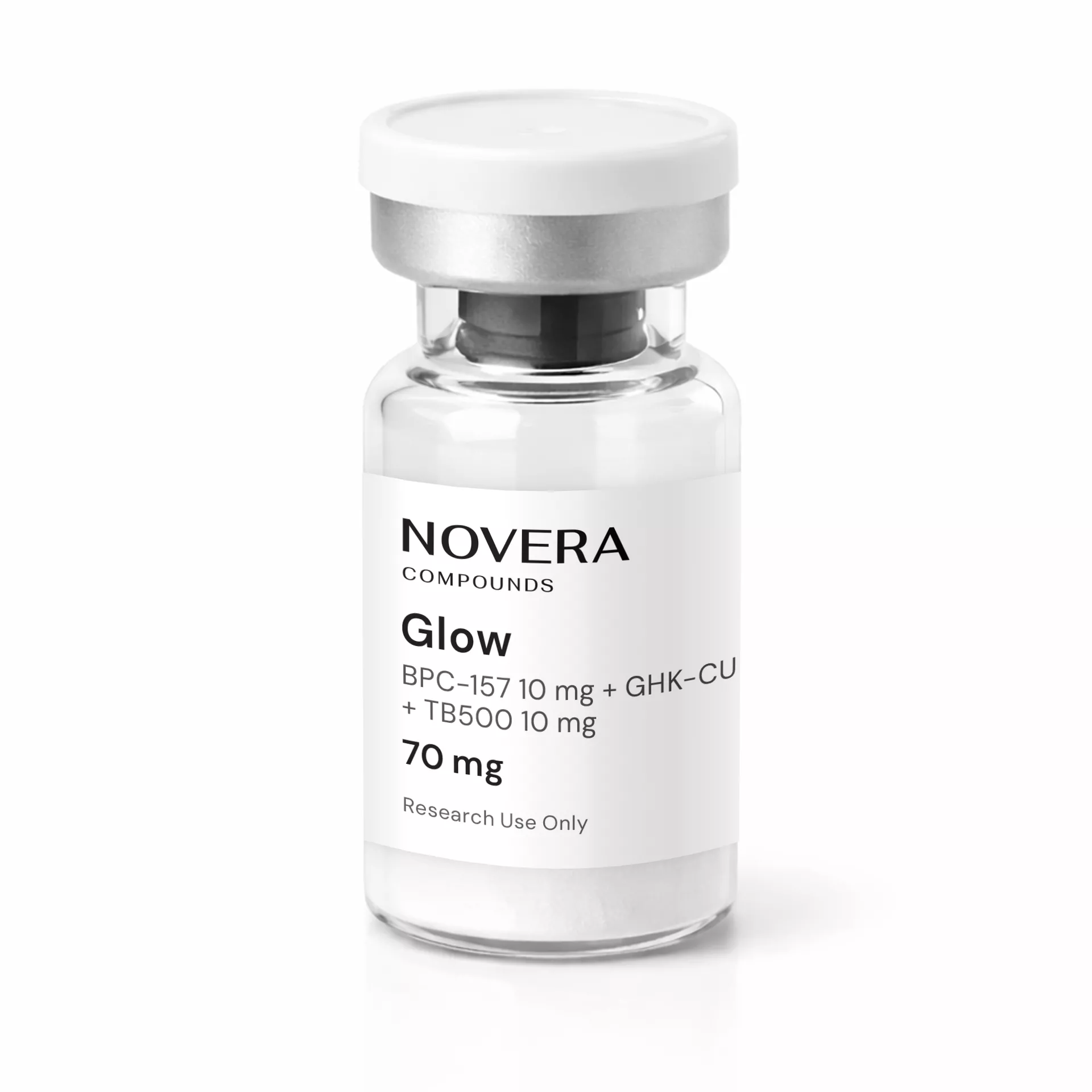
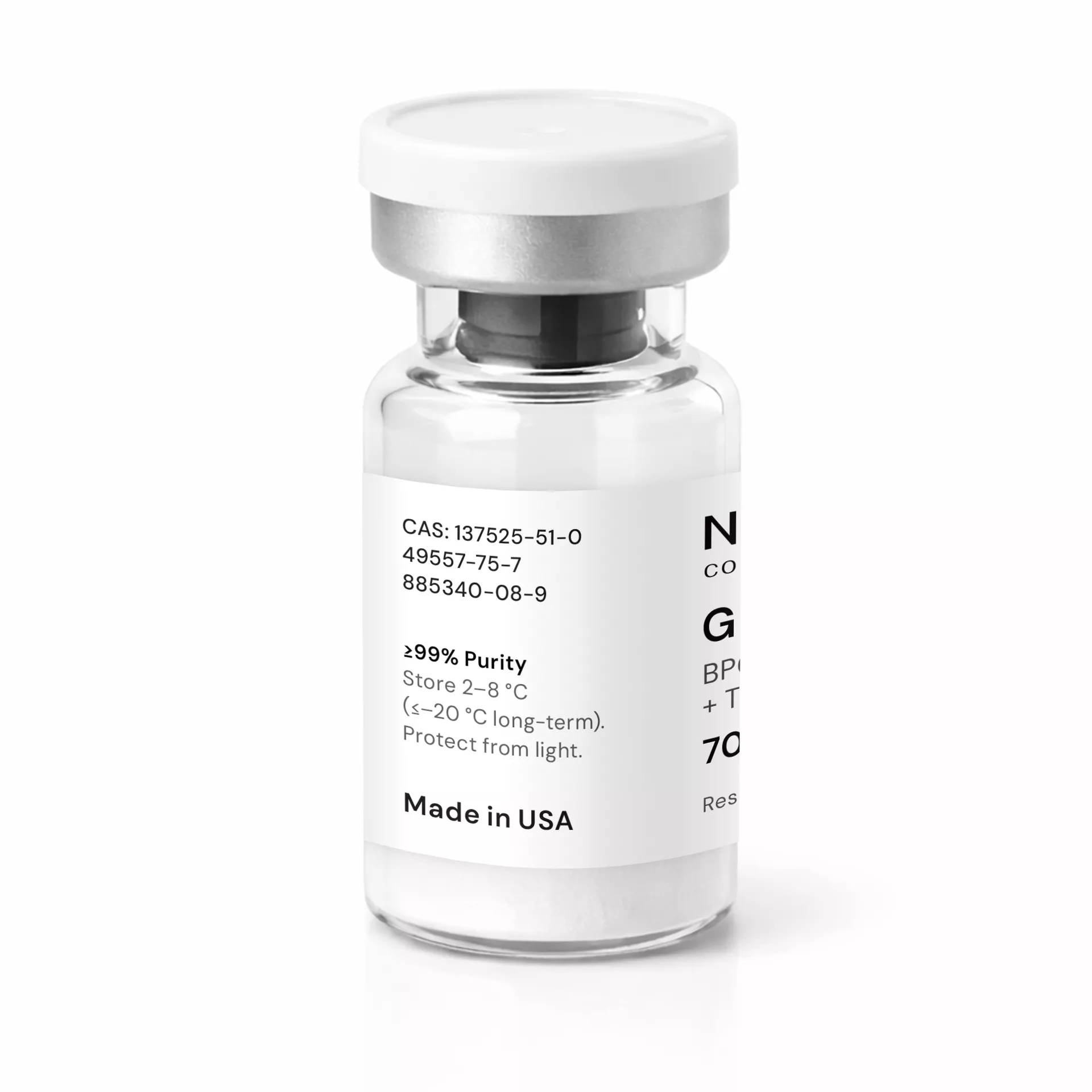
GLOW BPC 157 10mg + GHK-CU 50mg + TB500 10mg
Strength: 70 mg
CAS: BPC-157: 137525-51-0 GHK-Cu: 49557-75-7 TB500: 885340-08-9
Chemical Formula: GHK-Cu: C₁₄H₂4N₆O₄ BPC-₁₅₇: C₆₂H₉₈N₁₆O₂₂ TB₅₀₀: C₃₈H₆₈N₁₀O₁₄
Molecular weight: GHK-Cu: 340.38 g/mol BPC-157: 1419.535 g/mol TB-500(TB-4): 889.0 g/mol
Peptide Sequence: GHK-Cu: Gly-His-Lys (GHK) BPC-157: Gly-Glu-Pro-Pro-Pro-Gly-Lys-Pro-Ala-Asp-Asp-Ala-Gly-Leu-Val TB500: Ac-Ser-Asp-Lys-Pro-Asp-Met-Ala-Glu-Ile-Glu-Lys-Phe-Asp-Lys-Ser-Lys-Leu-Lys-Lys-Thr-Glu-Thr-Gln-Glu-Lys-Asn-Pro-Leu-Pro-Ser-Lys-Glu-Thr-Ile-Glu-Gln-Glu-Lys-Gln-Ala-Gly-Glu-Ser
Synonyms: glow, bpc157, tb500, thymosin beta 4, tb4, ghkcu, BPC-157, TB-500(TB-4)
Storage: Store 2–8 °C (≤–20 °C long-term). RT exposure during transport acceptable. Protect from light.
Shelf life: 24 months from the manufacturing date.
GLOW is a multi peptide research blend containing GHK Cu, BPC 157, and TB 500, formulated for studies of regenerative and cellular signaling biology in controlled in vitro and preclinical models. Research uses this combination to investigate peptide driven effects on extracellular matrix remodeling, cell migration, cytoskeletal organization, and gene expression patterns related to tissue structure and repair, with all applications restricted to laboratory research use only.


Why Choose Medica Depot
Shop hundreds of medical products with no minimums and free shipping on large orders.
 400+ products
 No order minimums
 Free shipping
 Loyalty rewards
 Trusted since 2007
 Account manager
 Verified LOT numbers
INFORMATION
What is GLOW – GHK-CU (50mg) / BPC-157 (10mg) / TB500 (10mg)?
GLOW is a multi-peptide research formulation classified within regenerative and cellular signaling research peptides. It combines three well-studied peptides—GHK-Cu, BPC-157, and TB500—into a single laboratory-grade blend designed for controlled experimental applications.
Each component is commonly examined in studies of extracellular matrix dynamics, cellular migration, protein signaling, and tissue modeling. By combining these peptides, researchers can evaluate multi-pathway interactions within structured laboratory environments.
This formulation is intended solely for laboratory research and is not for human or veterinary administration.
Product Specifications
- CAS Numbers:
- GHK-Cu: 89030-95-5
- BPC-157: 49557-75-7
- TB500: 885340-08-9
- Peptide Sequences:
- GHK-Cu: Gly–His–Lys (copper-bound tripeptide)
- BPC-157: Gly–Glu–Pro–Pro–Pro–Gly–Lys–Pro–Ala–Asp–Asp–Ala–Gly–Leu–Val
- TB500: Synthetic fragment derived from Thymosin Beta-4
- Molecular Formulas:
- GHK-Cu: C₁₄H₂4N₆O₄
- BPC-157: C₆₂H₉₈N₁₆O₂₂
- TB500: C₃₈H₆₈N₁₀O₁₄
- Purity: ≥99% (all components)
- Storage Conditions: Store at –20 °C; short‑term storage at 2–8 °C is acceptable. Protect from light.
- Intended Use: For laboratory research use only
Key Characteristics of GLOW – GHK-CU / BPC-157 / TB500
- Multi-peptide research blend combining three structurally distinct peptides.
- High purity (≥99%) suitable for controlled laboratory studies.
- Frequently examined in cellular signaling and structural protein research models.
- Designed for in vitro and preclinical experimental environments.
- Supplied in a sealed research-grade vial format.
- Requires low-temperature storage to maintain structural stability.
- Not intended for diagnostic, therapeutic, or clinical use.
How GLOW – GHK-CU / BPC-157 / TB500 Supports Research
This multi-peptide formulation is used in laboratory research to explore interactions between signaling peptides and cellular pathways involved in matrix remodeling, protein regulation, and cellular movement.
By combining peptides that are studied individually in regenerative and structural biology, researchers can assess potential synergistic or comparative effects in controlled experimental systems.
Its defined composition allows researchers to design structured studies examining peptide-driven biochemical responses and cellular behavior. Typical experimental endpoints include measures of collagen and extracellular matrix protein expression, cell migration rates, cytoskeletal organization, and transcriptional changes in genes related to tissue structure and repair, depending on the model.
Research Applications & Usage Information
GLOW – GHK-Cu / BPC-157 / TB500 is commonly utilized in research involving:
- Cellular migration and adhesion studies
- Extracellular matrix and collagen signaling models
- Peptide-receptor interaction analysis
- Cytoskeletal and actin-related protein research
- Tissue culture and in vitro repair pathway investigations
- Comparative studies evaluating single-peptide vs. multi-peptide activity
- Gene expression research related to structural protein regulation
- Multi-pathway exploratory studies in regenerative biology, where combined peptide exposure is used to compare single- vs multi-peptide effects on matrix markers, cell motility, and gene-expression profiles in vitro.
This product is supplied exclusively for research purposes and must be used in accordance with laboratory safety and compliance standards.
Handling and Storage Recommendations
- Store at -20°C immediately upon receipt.
- Protect from direct light exposure.
- Keep the vial tightly sealed when not in use.
- Avoid repeated freeze–thaw cycles.
- Handle using appropriate laboratory protective equipment.
- Use aseptic technique during preparation and reconstitution (if applicable).
Proper storage and careful handling help preserve peptide integrity and support consistent experimental outcomes.
Research Use Only Notice
This product is intended for laboratory research use only and is not approved for human or veterinary use. It is not intended for diagnostic, therapeutic, or clinical applications. Any reference to biological activity or potential effects is based solely on preclinical or in-vitro findings and should not be interpreted as validated clinical outcomes. Researchers are responsible for ensuring proper handling, storage, and disposal in accordance with institutional, federal, and international guidelines.
References
- Bajramagic S, Sever M, Rasic F, et al. Stable gastric pentadecapeptide BPC 157 and intestinal anastomoses therapy in rats—A review. Pharmaceuticals (Basel). 2024;17(8):1081. Published 2024 Aug 17. doi:10.3390/ph17081081.
- Sikiric P, Seiwerth S, Rucman R, et al. Stable gastric pentadecapeptide BPC 157: novel therapy in gastrointestinal tract and wound healing. Curr Pharm Des. 2011;17(16):1612-1632. doi:10.2174/138161211796197179.
- Adnan SB, Maarof M, Fauzi MB, Fadilah NIM. Exploring the role of tripeptides in wound healing and skin regeneration: a comprehensive review. Int J Med Sci. 2025;22(16):4175-4200. Published 2025 Oct 1. doi:10.7150/ijms.11811.
- Pickart L, Margolina A. Regenerative and protective actions of the GHK-Cu peptide in the light of the new gene data. Int J Mol Sci. 2018;19(7):1987. doi:10.3390/ijms19071987.
- Sosne G, Qiu P, Goldstein AL, Wheater M. Biological activities of thymosin beta4 defined by active sites in short peptide sequences. FASEB J. 2010;24(7):2144-2151. doi:10.1096/fj.09-142307
- Malinda KM, Goldstein AL, Kleinman HK. Thymosin beta 4 stimulates directional migration of human umbilical vein endothelial cells. FASEB J. 1997;11(6):474-481. doi:10.1096/fasebj.11.6.9194528
What is GLOW – GHK-CU (50mg) / BPC-157 (10mg) / TB500 (10mg)?
GLOW is a multi-peptide research formulation classified within regenerative and cellular signaling research peptides. It combines three well-studied peptides—GHK-Cu, BPC-157, and TB500—into a single laboratory-grade blend designed for controlled experimental applications.
Each component is commonly examined in studies of extracellular matrix dynamics, cellular migration, protein signaling, and tissue modeling. By combining these peptides, researchers can evaluate multi-pathway interactions within structured laboratory environments.
This formulation is intended solely for laboratory research and is not for human or veterinary administration.
Product Specifications
- CAS Numbers:
- GHK-Cu: 89030-95-5
- BPC-157: 49557-75-7
- TB500: 885340-08-9
- Peptide Sequences:
- GHK-Cu: Gly–His–Lys (copper-bound tripeptide)
- BPC-157: Gly–Glu–Pro–Pro–Pro–Gly–Lys–Pro–Ala–Asp–Asp–Ala–Gly–Leu–Val
- TB500: Synthetic fragment derived from Thymosin Beta-4
- Molecular Formulas:
- GHK-Cu: C₁₄H₂4N₆O₄
- BPC-157: C₆₂H₉₈N₁₆O₂₂
- TB500: C₃₈H₆₈N₁₀O₁₄
- Purity: ≥99% (all components)
- Storage Conditions: Store at –20 °C; short‑term storage at 2–8 °C is acceptable. Protect from light.
- Intended Use: For laboratory research use only
Key Characteristics of GLOW – GHK-CU / BPC-157 / TB500
- Multi-peptide research blend combining three structurally distinct peptides.
- High purity (≥99%) suitable for controlled laboratory studies.
- Frequently examined in cellular signaling and structural protein research models.
- Designed for in vitro and preclinical experimental environments.
- Supplied in a sealed research-grade vial format.
- Requires low-temperature storage to maintain structural stability.
- Not intended for diagnostic, therapeutic, or clinical use.
How GLOW – GHK-CU / BPC-157 / TB500 Supports Research
This multi-peptide formulation is used in laboratory research to explore interactions between signaling peptides and cellular pathways involved in matrix remodeling, protein regulation, and cellular movement.
By combining peptides that are studied individually in regenerative and structural biology, researchers can assess potential synergistic or comparative effects in controlled experimental systems.
Its defined composition allows researchers to design structured studies examining peptide-driven biochemical responses and cellular behavior. Typical experimental endpoints include measures of collagen and extracellular matrix protein expression, cell migration rates, cytoskeletal organization, and transcriptional changes in genes related to tissue structure and repair, depending on the model.
Research Applications & Usage Information
GLOW – GHK-Cu / BPC-157 / TB500 is commonly utilized in research involving:
- Cellular migration and adhesion studies
- Extracellular matrix and collagen signaling models
- Peptide-receptor interaction analysis
- Cytoskeletal and actin-related protein research
- Tissue culture and in vitro repair pathway investigations
- Comparative studies evaluating single-peptide vs. multi-peptide activity
- Gene expression research related to structural protein regulation
- Multi-pathway exploratory studies in regenerative biology, where combined peptide exposure is used to compare single- vs multi-peptide effects on matrix markers, cell motility, and gene-expression profiles in vitro.
This product is supplied exclusively for research purposes and must be used in accordance with laboratory safety and compliance standards.
Handling and Storage Recommendations
- Store at -20°C immediately upon receipt.
- Protect from direct light exposure.
- Keep the vial tightly sealed when not in use.
- Avoid repeated freeze–thaw cycles.
- Handle using appropriate laboratory protective equipment.
- Use aseptic technique during preparation and reconstitution (if applicable).
Proper storage and careful handling help preserve peptide integrity and support consistent experimental outcomes.
Research Use Only Notice
This product is intended for laboratory research use only and is not approved for human or veterinary use. It is not intended for diagnostic, therapeutic, or clinical applications. Any reference to biological activity or potential effects is based solely on preclinical or in-vitro findings and should not be interpreted as validated clinical outcomes. Researchers are responsible for ensuring proper handling, storage, and disposal in accordance with institutional, federal, and international guidelines.
References
- Bajramagic S, Sever M, Rasic F, et al. Stable gastric pentadecapeptide BPC 157 and intestinal anastomoses therapy in rats—A review. Pharmaceuticals (Basel). 2024;17(8):1081. Published 2024 Aug 17. doi:10.3390/ph17081081.
- Sikiric P, Seiwerth S, Rucman R, et al. Stable gastric pentadecapeptide BPC 157: novel therapy in gastrointestinal tract and wound healing. Curr Pharm Des. 2011;17(16):1612-1632. doi:10.2174/138161211796197179.
- Adnan SB, Maarof M, Fauzi MB, Fadilah NIM. Exploring the role of tripeptides in wound healing and skin regeneration: a comprehensive review. Int J Med Sci. 2025;22(16):4175-4200. Published 2025 Oct 1. doi:10.7150/ijms.11811.
- Pickart L, Margolina A. Regenerative and protective actions of the GHK-Cu peptide in the light of the new gene data. Int J Mol Sci. 2018;19(7):1987. doi:10.3390/ijms19071987.
- Sosne G, Qiu P, Goldstein AL, Wheater M. Biological activities of thymosin beta4 defined by active sites in short peptide sequences. FASEB J. 2010;24(7):2144-2151. doi:10.1096/fj.09-142307
- Malinda KM, Goldstein AL, Kleinman HK. Thymosin beta 4 stimulates directional migration of human umbilical vein endothelial cells. FASEB J. 1997;11(6):474-481. doi:10.1096/fasebj.11.6.9194528
Related products