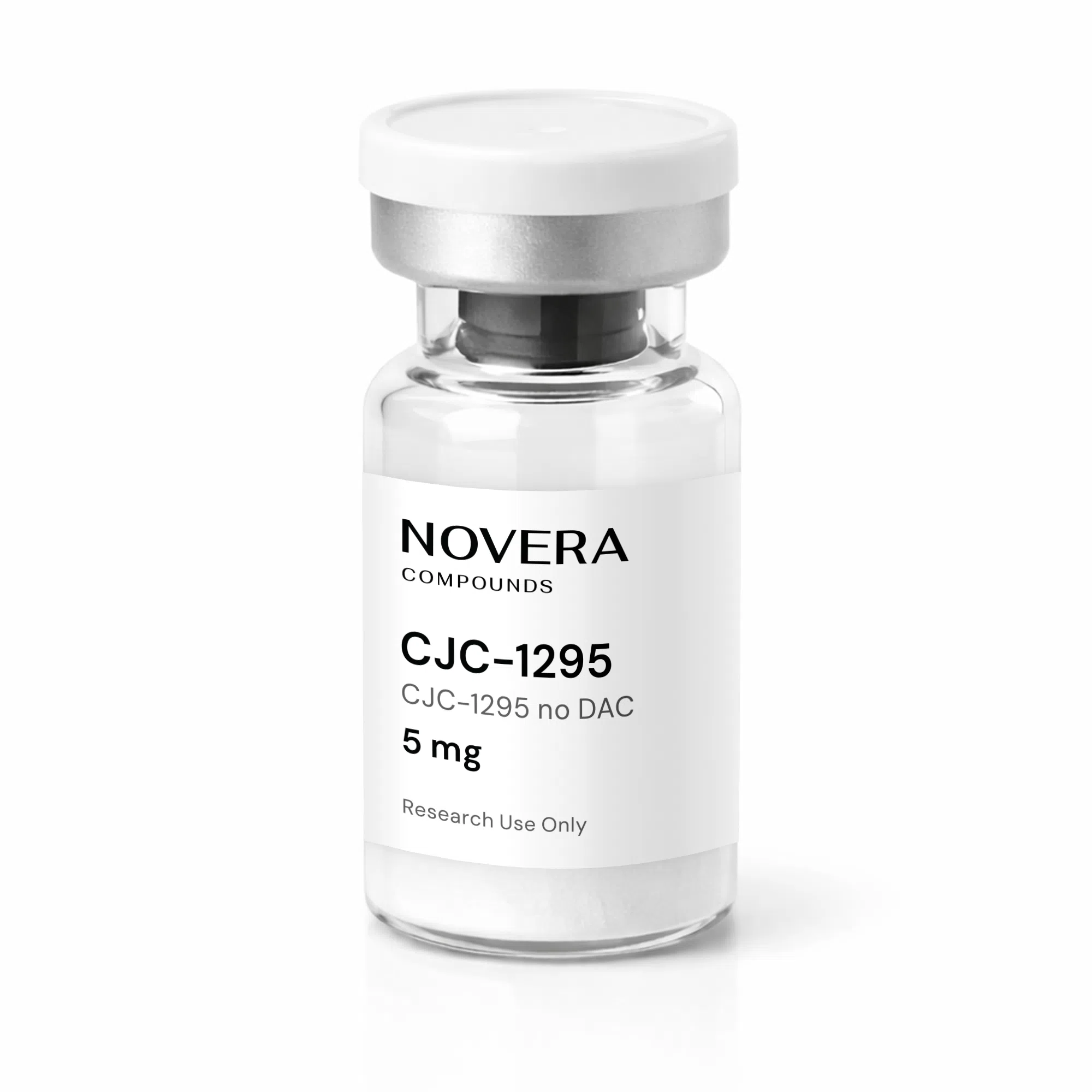
CJC-1295 Without DAC 5mg
Strength: 5 mg
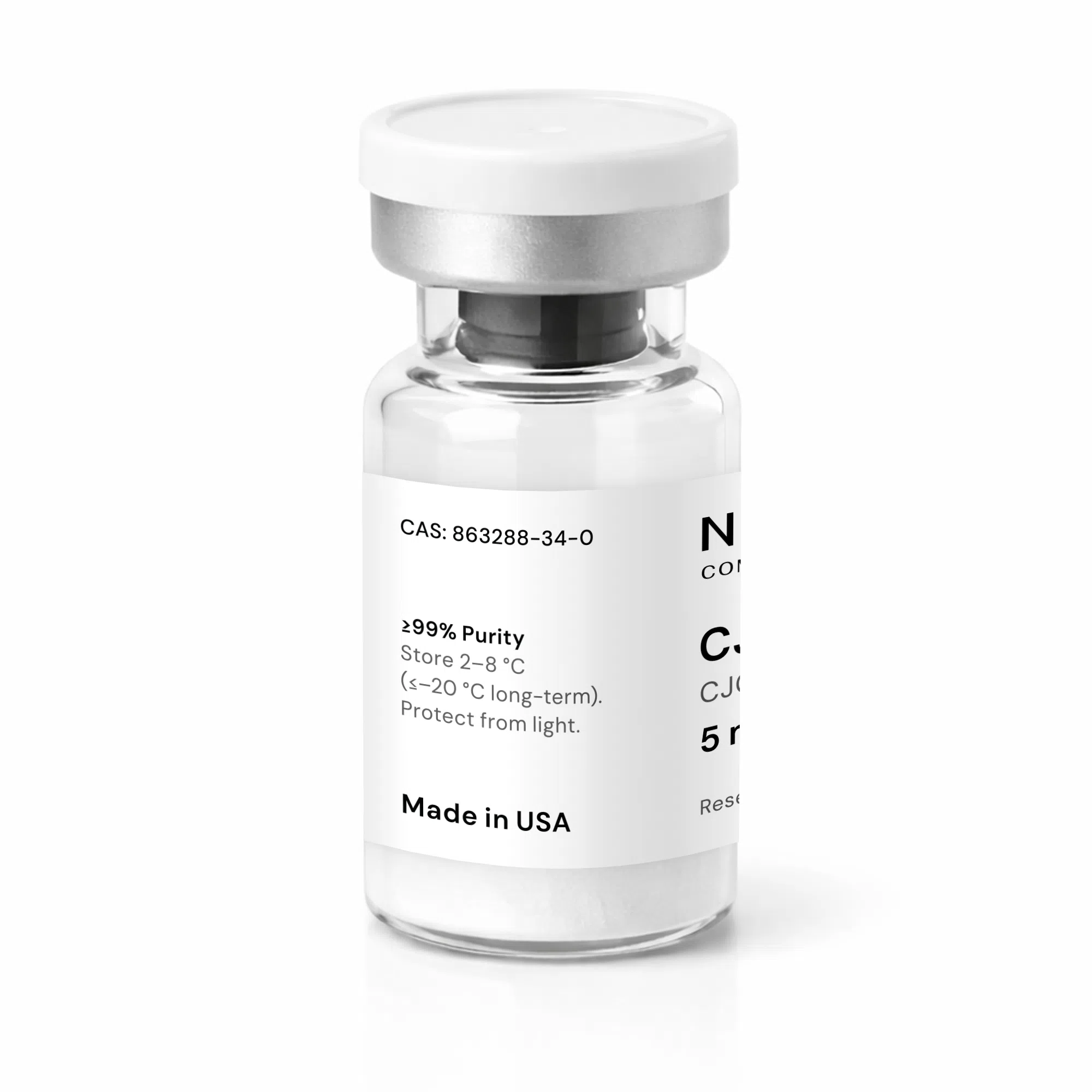
CAS: 863288-34-0
Chemical Formula: C₁₅₂H₂₅₂N₄₄O₄₂
Molecular weight: 3367.9 g/mol
Peptide Sequence: Tyr-D-Ala-Asp-Ala-Ile-Phe-Thr-Gln-Ser-Tyr-Arg-Lys-Val-Leu-Ala-Gln-Leu-Ser-Ala-Arg-Lys-Leu-Leu-Gln-Asp-Ile-Leu-Ser-Arg
Synonyms: MOD-GRF(1-29), CJC-1295 without DAC, modgrf, tetrasubstituted grf, modified grf
Storage: Store 2–8 °C (≤–20 °C long-term). RT exposure during transport acceptable. Protect from light.
Shelf life: 24 months from the manufacturing date.
CJC-1295 – No DAC, also called Modified GRF (1-29), is a synthetic GHRH analog used in research on GH/IGF 1 axis–related signaling and endocrine pathway biology. “No DAC” indicates it lacks the albumin-binding drug-affinity complex found in long-acting CJC-1295 variants, making it a short-acting research peptide. It is primarily used for time-course and signaling studies in experimental designs that require shorter-duration exposures.


Why Choose Medica Depot
Shop hundreds of medical products with no minimums and free shipping on large orders.
 400+ products
 No order minimums
 Free shipping
 Loyalty rewards
 Trusted since 2007
 Account manager
 Verified LOT numbers
INFORMATION
What is CJC-1295 – No DAC (5mg)?
CJC-1295 – No DAC (5mg) is a synthetic growth hormone–releasing hormone (GHRH) analog used in laboratory research to study endocrine signaling and growth hormone–axis biology. It belongs to the endocrine/metabolic peptide category, specifically the GHRH-analog subcategory.
“No DAC” means it lacks the Drug Affinity Complex (DAC) found in long-acting CJC-1295 designs, making it suitable for experiments that focus on capturing cleaner time-course relationships between exposure and measured markers. This version of CJC-1295 allows researchers to examine receptor-linked signaling and downstream biomarker patterns over time, making it ideal for controlled models that require short-duration peptide signaling.
Product Specifications
- CAS Number: 863288-34-0
- Peptide Sequence: Tyr-D-Ala-Asp-Ala-Ile-Phe-Thr-Gln-Ser-Tyr-Arg-Lys-Val-Leu-Ala-Gln-Leu-Ser-Ala-Arg-Lys-Leu-Leu-Gln-Asp-Ile-Leu-Ser-Arg
- Chemical Formula: C₁₅₂H₂₅₂N₄₄O₄₂
- Molecular Weight: 3367.9 g/mol
- Purity: ≥99% (or >99%)
- Packaging Format: 5 mg
- Storage Conditions: Store at -20°C, avoid light exposure
- For Laboratory Research Use Only
Key Characteristics of CJC-1295 – No DAC (5mg)
- Synthetic peptide designed for controlled research applications to study growth hormone–related signaling.
- No DAC version: A truncated GHRH-related analog lacking the DAC extension used in long-acting constructs, enabling short-duration signaling studies.
- High purity (≥99%): Intended to reduce confounding from impurities in analytical or cell-based workflows.
- Convenient 5 mg format: Often selected for pilot assays, replicate runs, and controlled comparative studies (study-dependent).
- Cold storage + light protection: Basic storage expectations to help preserve integrity before use in assays.
- Compatible with standard peptide handling and cold-chain storage protocols.
How CJC-1295 – No DAC (5mg) Supports Research
CJC-1295 – No DAC is used in laboratory studies as a GHRH-analog research reagent in endocrine pathway studies. In controlled models, it helps researchers investigate how GHRH receptor–linked signaling interacts with cellular responses and how to track downstream biomarkers or transcriptional readouts, depending on the assay design.
Because it lacks the DAC modification seen in long-acting constructs, CJC-1295 – No DAC is suitable for time-course experiments requiring clearer separation between peptide exposure and measurement, offering greater flexibility in experimental timelines. It also serves as a reference compound in analytical workflows, enabling peptide identification and assay validation for GHRH-related compounds.
Research Applications & Usage Information
CJC-1295 – No DAC (5mg) is commonly incorporated into laboratory research involving:
- Endocrine signaling research: Used in research programs examining GHRH-linked signaling behavior and GH-axis pathway responses in controlled in-vitro and preclinical systems.
- Time-course assay designs: Selected when experiments benefit from clearer separation of exposure windows and readouts versus long-acting constructs (design-dependent).
- Comparative peptide screening: Used to compare assay responses to related GHRH analogs, depending on the research model and experimental endpoints.
- Analytical identification workflows: Used as a target/reference compound in mass-spectrometry–based peptide detection and characterization contexts.
- Stability and handling studies: Can support research where peptide integrity and measurement consistency are central variables (protocol-dependent).
All uses are investigational and are restricted to controlled laboratory research environments.
Handling and Storage Recommendations
- Store unreconstituted vials at -20°C in a dry, light-protected environment.
- Allow vials to equilibrate to room temperature before opening to prevent condensation.
- Reconstitute using sterile laboratory technique in accordance with institutional protocols.
- After reconstitution, store solutions at 2–8°C and use within protocol-defined timeframes.
- Avoid repeated freeze–thaw cycles to preserve peptide structure and analytical integrity.
Research Use Only Notice
This product is intended for laboratory research use only and is not approved for human or veterinary use. It is not intended for diagnostic, therapeutic, or clinical applications. Any reference to biological activity or potential effects is based solely on preclinical or in-vitro findings and should not be interpreted as validated clinical outcomes. Researchers are responsible for ensuring proper handling, storage, and disposal in accordance with institutional, federal, and international guidelines.
References
- Hartvig RA, Holm NB, Dalsgaard PW, Reitzel LA, Müller IB, Linnet K. Identification of peptide and protein doping related drug compounds confiscated in Denmark between 2007-2013. Scandinavian Journal of Forensic Science. 2014;20(2):42-49. doi:10.2478/sjfs-2014-0003
- Knoop A, Thomas A, Fichant E, Delahaut P, Schänzer W, Thevis M. Qualitative identification of growth hormone-releasing hormones in human plasma by means of immunoaffinity purification and LC-HRMS/MS. Anal Bioanal Chem. 2016;408(12):3145-3153. doi:10.1007/s00216-016-9377-3
- Memdouh S, Gavrilović I, Ng K, Cowan D, Abbate V. Advances in the detection of growth hormone-releasing hormone synthetic analogs. Drug Test Anal. 2021;13(11-12):1871-1887. doi:10.1002/dta.3183
- Thomas A, Walpurgis K, Thevis M. Chromatographic-mass spectrometric analysis of peptidic analytes (2-10 kDa) in doping control urine samples. J Mass Spectrom. 2024;59(1):e4996. doi:10.1002/jms.4996
What is CJC-1295 – No DAC (5mg)?
CJC-1295 – No DAC (5mg) is a synthetic growth hormone–releasing hormone (GHRH) analog used in laboratory research to study endocrine signaling and growth hormone–axis biology. It belongs to the endocrine/metabolic peptide category, specifically the GHRH-analog subcategory.
“No DAC” means it lacks the Drug Affinity Complex (DAC) found in long-acting CJC-1295 designs, making it suitable for experiments that focus on capturing cleaner time-course relationships between exposure and measured markers. This version of CJC-1295 allows researchers to examine receptor-linked signaling and downstream biomarker patterns over time, making it ideal for controlled models that require short-duration peptide signaling.
Product Specifications
- CAS Number: 863288-34-0
- Peptide Sequence: Tyr-D-Ala-Asp-Ala-Ile-Phe-Thr-Gln-Ser-Tyr-Arg-Lys-Val-Leu-Ala-Gln-Leu-Ser-Ala-Arg-Lys-Leu-Leu-Gln-Asp-Ile-Leu-Ser-Arg
- Chemical Formula: C₁₅₂H₂₅₂N₄₄O₄₂
- Molecular Weight: 3367.9 g/mol
- Purity: ≥99% (or >99%)
- Packaging Format: 5 mg
- Storage Conditions: Store at -20°C, avoid light exposure
- For Laboratory Research Use Only
Key Characteristics of CJC-1295 – No DAC (5mg)
- Synthetic peptide designed for controlled research applications to study growth hormone–related signaling.
- No DAC version: A truncated GHRH-related analog lacking the DAC extension used in long-acting constructs, enabling short-duration signaling studies.
- High purity (≥99%): Intended to reduce confounding from impurities in analytical or cell-based workflows.
- Convenient 5 mg format: Often selected for pilot assays, replicate runs, and controlled comparative studies (study-dependent).
- Cold storage + light protection: Basic storage expectations to help preserve integrity before use in assays.
- Compatible with standard peptide handling and cold-chain storage protocols.
How CJC-1295 – No DAC (5mg) Supports Research
CJC-1295 – No DAC is used in laboratory studies as a GHRH-analog research reagent in endocrine pathway studies. In controlled models, it helps researchers investigate how GHRH receptor–linked signaling interacts with cellular responses and how to track downstream biomarkers or transcriptional readouts, depending on the assay design.
Because it lacks the DAC modification seen in long-acting constructs, CJC-1295 – No DAC is suitable for time-course experiments requiring clearer separation between peptide exposure and measurement, offering greater flexibility in experimental timelines. It also serves as a reference compound in analytical workflows, enabling peptide identification and assay validation for GHRH-related compounds.
Research Applications & Usage Information
CJC-1295 – No DAC (5mg) is commonly incorporated into laboratory research involving:
- Endocrine signaling research: Used in research programs examining GHRH-linked signaling behavior and GH-axis pathway responses in controlled in-vitro and preclinical systems.
- Time-course assay designs: Selected when experiments benefit from clearer separation of exposure windows and readouts versus long-acting constructs (design-dependent).
- Comparative peptide screening: Used to compare assay responses to related GHRH analogs, depending on the research model and experimental endpoints.
- Analytical identification workflows: Used as a target/reference compound in mass-spectrometry–based peptide detection and characterization contexts.
- Stability and handling studies: Can support research where peptide integrity and measurement consistency are central variables (protocol-dependent).
All uses are investigational and are restricted to controlled laboratory research environments.
Handling and Storage Recommendations
- Store unreconstituted vials at -20°C in a dry, light-protected environment.
- Allow vials to equilibrate to room temperature before opening to prevent condensation.
- Reconstitute using sterile laboratory technique in accordance with institutional protocols.
- After reconstitution, store solutions at 2–8°C and use within protocol-defined timeframes.
- Avoid repeated freeze–thaw cycles to preserve peptide structure and analytical integrity.
Research Use Only Notice
This product is intended for laboratory research use only and is not approved for human or veterinary use. It is not intended for diagnostic, therapeutic, or clinical applications. Any reference to biological activity or potential effects is based solely on preclinical or in-vitro findings and should not be interpreted as validated clinical outcomes. Researchers are responsible for ensuring proper handling, storage, and disposal in accordance with institutional, federal, and international guidelines.
References
- Hartvig RA, Holm NB, Dalsgaard PW, Reitzel LA, Müller IB, Linnet K. Identification of peptide and protein doping related drug compounds confiscated in Denmark between 2007-2013. Scandinavian Journal of Forensic Science. 2014;20(2):42-49. doi:10.2478/sjfs-2014-0003
- Knoop A, Thomas A, Fichant E, Delahaut P, Schänzer W, Thevis M. Qualitative identification of growth hormone-releasing hormones in human plasma by means of immunoaffinity purification and LC-HRMS/MS. Anal Bioanal Chem. 2016;408(12):3145-3153. doi:10.1007/s00216-016-9377-3
- Memdouh S, Gavrilović I, Ng K, Cowan D, Abbate V. Advances in the detection of growth hormone-releasing hormone synthetic analogs. Drug Test Anal. 2021;13(11-12):1871-1887. doi:10.1002/dta.3183
- Thomas A, Walpurgis K, Thevis M. Chromatographic-mass spectrometric analysis of peptidic analytes (2-10 kDa) in doping control urine samples. J Mass Spectrom. 2024;59(1):e4996. doi:10.1002/jms.4996
Related products