Choosing the right dermal filler is one of the most important decisions in aesthetic treatment—for both patients and practitioners. With a growing number of options on the market, understanding the differences between leading products helps ensure natural, long-lasting results that align with each patient’s unique goals. At Medica Depot, we support clinicians with trusted, evidence-based insights to guide treatment planning and product selection.
The landscape of injectables continues to evolve, with new formulations and technologies expanding what’s possible in facial rejuvenation. Today’s patients are more informed than ever and often research options before their consultation. That’s why providers must stay current on product mechanisms, indications, longevity, and safety profiles. So they can confidently recommend the best solution for each case.
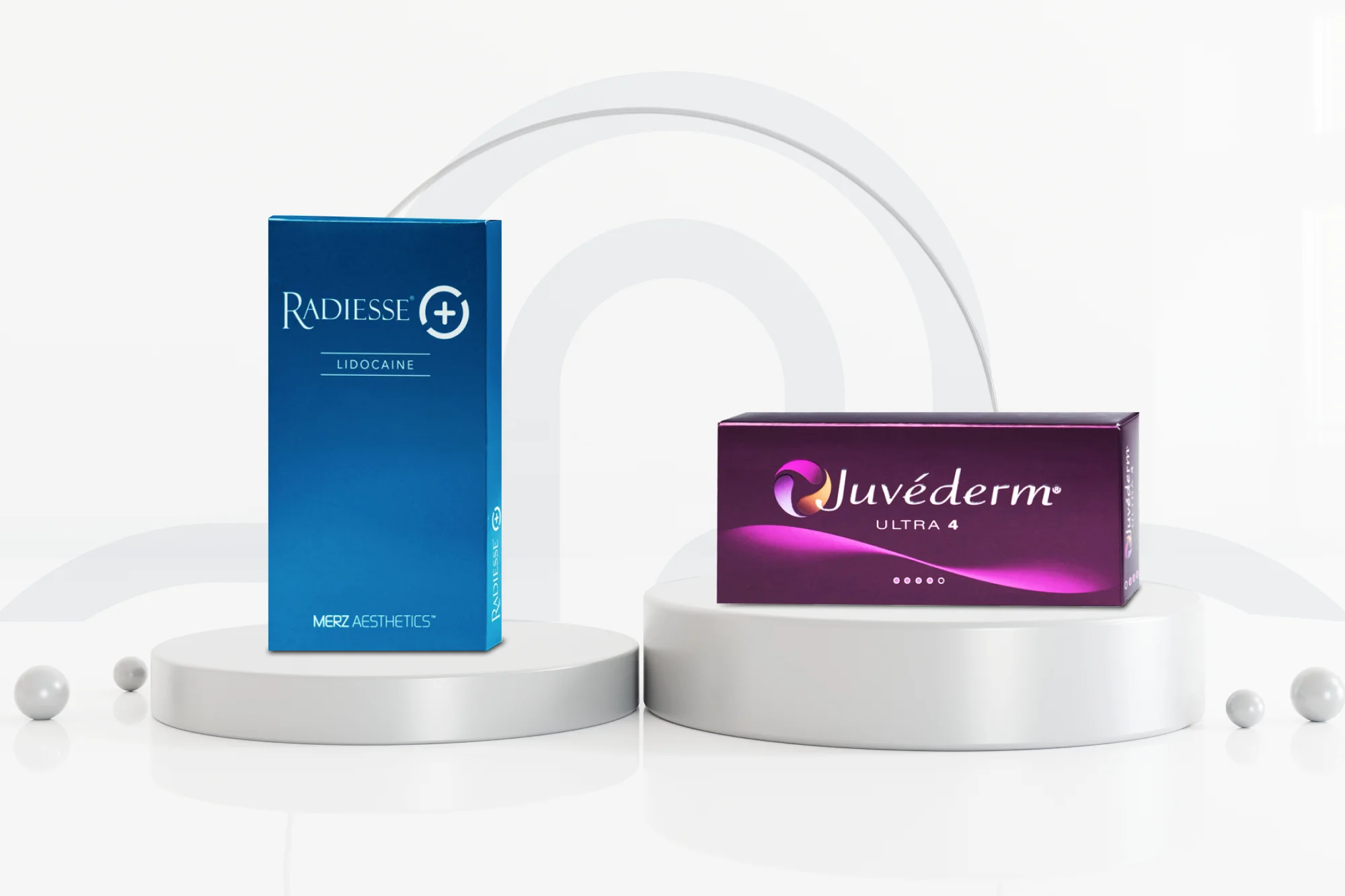
In this article, we take an in-depth look at two of the most widely used dermal fillers: Juvederm and Radiesse. We compare their composition, how they work, ideal treatment areas, how long the results last, and key considerations like reversibility and safety. Whether you’re treating fine lines, restoring volume, or enhancing contours, this guide will help you and your patients make informed decisions with confidence.
Key Takeaways
- This article compares Juvederm (a hyaluronic acid filler) and Radiesse (a calcium hydroxylapatite biostimulator) across composition, mechanism, treatment areas, longevity, and reversibility.
- Juvederm is highlighted for its smooth, cohesive gels, reversibility with hyaluronidase, and suitability for delicate areas like lips and tear troughs.
- Radiesse is emphasized for its dual-action (immediate volume + collagen stimulation), stronger lift, longer durability, and non-reversibility.
- The content guides readers to consult a board-certified injector to match product properties to anatomy and aesthetic goals for safe, natural outcomes.
Why Doctors Choose Juvederm Fillers
Juvederm is a family of hyaluronic acid (HA) dermal fillers designed for natural-looking volume, smoothing, and contouring. The products use either HYLACROSS or VYCROSS technology. These proprietary cross-linking methods create smooth, cohesive gels with predictable lift and integration.
- Composition: Juvederm fillers are made from non-animal, chemically stabilized hyaluronic acid. This makes them biocompatible, resorbable, and generally well tolerated.
- Indications: Different Juvederm formulations target specific concerns—such as nasolabial folds, lip augmentation, midface volume loss, chin and jawline definition, and even hand rejuvenation.
- Longevity: Depending on the product and area treated, results typically last 6–18 months, with some midface and jawline treatments lasting up to about 2 years.
- Reversibility: A key advantage is that Juvederm can be dissolved with hyaluronidase if needed—useful for adjusting results or managing rare complications.
Because of its versatility and reversibility, Juvederm is often recommended for first-time filler patients and for areas requiring finesse, such as lips and tear troughs.
Why Doctors Choose Radiesse Dermal Fillers
Radiesse is an injectable biostimulator composed of calcium hydroxylapatite (CaHA) microspheres suspended in a carboxymethylcellulose (CMC) gel. It received FDA approval for facial wrinkles and folds in 2006 and for hand rejuvenation in 2015; certain formulations also carry approvals for jawline contouring.
- Dual-action mechanism: The CMC gel provides immediate volume, while CaHA microspheres stimulate fibroblasts to produce new collagen (types I and III) and elastin over time.
- Physical properties: Radiesse has high viscosity and elasticity, giving it strong lifting capacity—ideal for deeper structural support in the midface, jawline, and nasolabial folds.
- Longevity: Results can last 12–18 months or longer, with some patients reporting durability up to 2–3 years in certain areas due to ongoing collagen remodeling.
- Not reversible: Unlike HA fillers, Radiesse cannot be dissolved with hyaluronidase. If results are unsatisfactory, patients must wait for the product to metabolize naturally.
Radiesse is particularly valued for patients seeking both immediate correction and longer-term skin quality improvement through collagen biostimulation.
Selecting Between Juvederm vs Radiesse Dermal Fillers
Neither is universally “better.” The right choice depends on anatomy, treatment goals, and risk tolerance.
- Treatment area: Juvederm is preferred for lips, tear troughs, and superficial lines due to its smooth integration and reversibility. Radiesse excels in deeper planes—cheeks, jawline, and nasolabial folds—where lift and biostimulation are priorities.
- Longevity vs. flexibility: Radiesse generally lasts longer and improves skin quality over time, but it cannot be reversed. Juvederm offers more flexibility to adjust or dissolve if needed.
- Safety considerations: Radiesse is not recommended for thin-skin areas like the tear troughs or lips because it carries a higher risk of nodules or irregularities. Juvederm’s HA gel is better suited to these delicate zones.
For first-time patients or those prioritizing reversibility, Juvederm is often the starting point. For patients seeking structural lift and collagen remodeling and accepting non-reversibility, Radiesse may be a better fit.
Citations
[1] Yang, Hsi-An, et al. “A Comparative Study of the Efficacy of Different Tissue Fillers for Nasolabial Fold Correction.” Aesthetic Plastic Surgery, vol. 50, no. 3, Nov. 2025, pp. 1309–19. https://doi.org/10.1007/s00266-025-05423-5.
[2] Sadeghzadeh, Aida. “Efficacy of Calcium Hydroxylapatite and Hyaluronic Acid in Midface Volumization: A Systematic Review and Meta-analysis.” www.mphrj.com, Feb. 2026, https://doi.org/10.22034/mphrj.2026.574225.1060.
[3] Durairaj, Kalpna Kay, et al. “Sculpting the Midface and Lower Face: A Novel Biostimulatory Technique Using Hyperdilute Calcium Hydroxylapatite.” Aesthetic Surgery Journal Open Forum, vol. 7, Jan. 2025, p. ojaf104. https://doi.org/10.1093/asjof/ojaf104.
[4] Merz Aesthetics. “New Research Shows RADIESSE® Supports Substantial Regeneration of Collagen and Key Extracellular Matrix Proteins – Merz Aesthetics.” Merz Aesthetics, 27 May 2026, merzaesthetics.com/news/new-research-shows-radiesse-supports-substantial-regeneration-of-collagen-and-key-extracellular-matrix-proteins.
This content was prepared and reviewed under our editorial guidelines , which govern how we source, verify, and update clinical and product information. Every claim is checked against peer-reviewed research, manufacturer documentation, or regulatory guidance before publication.