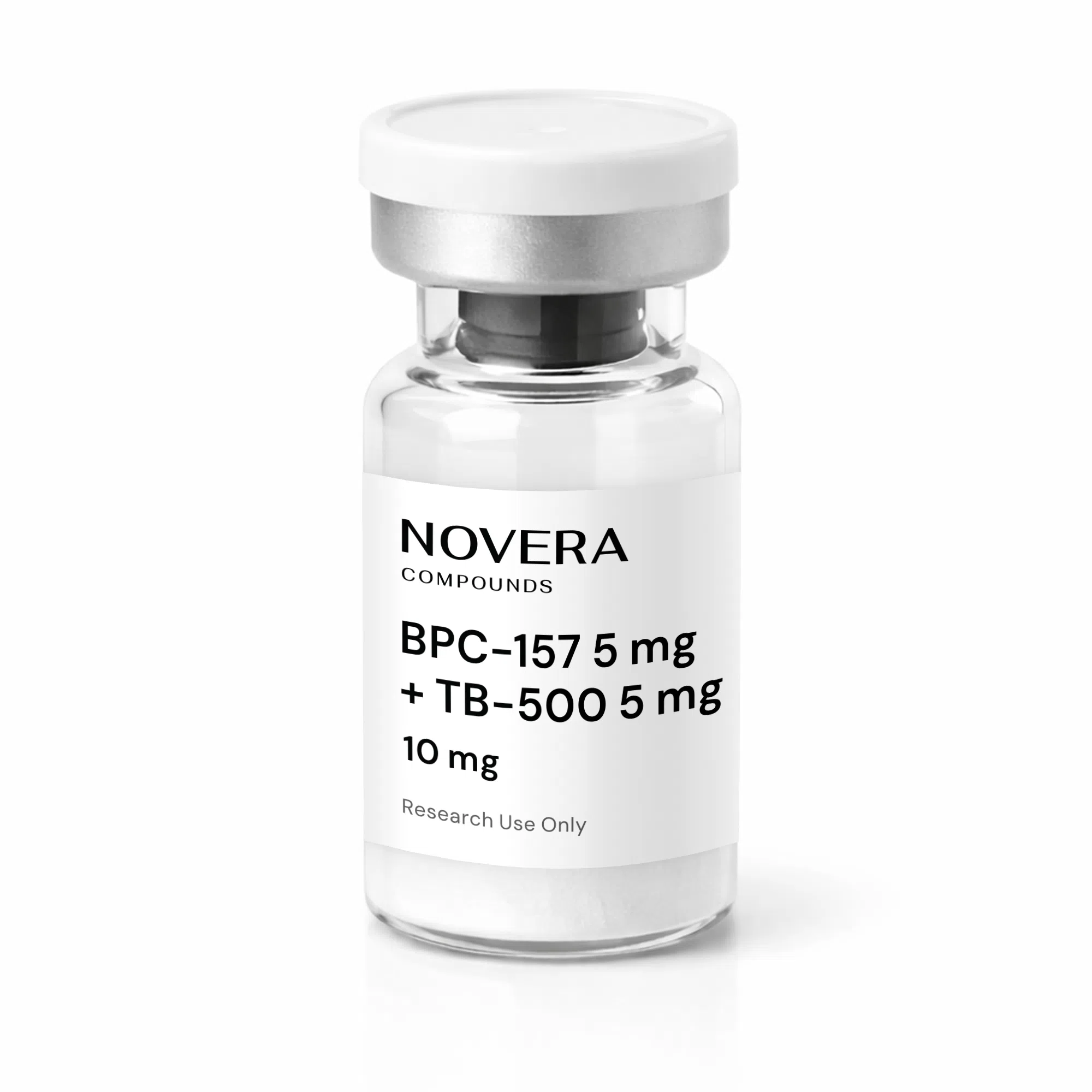
Wolverine Blend BPC-157 5mg + TB500 5mg
Strength: 10mg
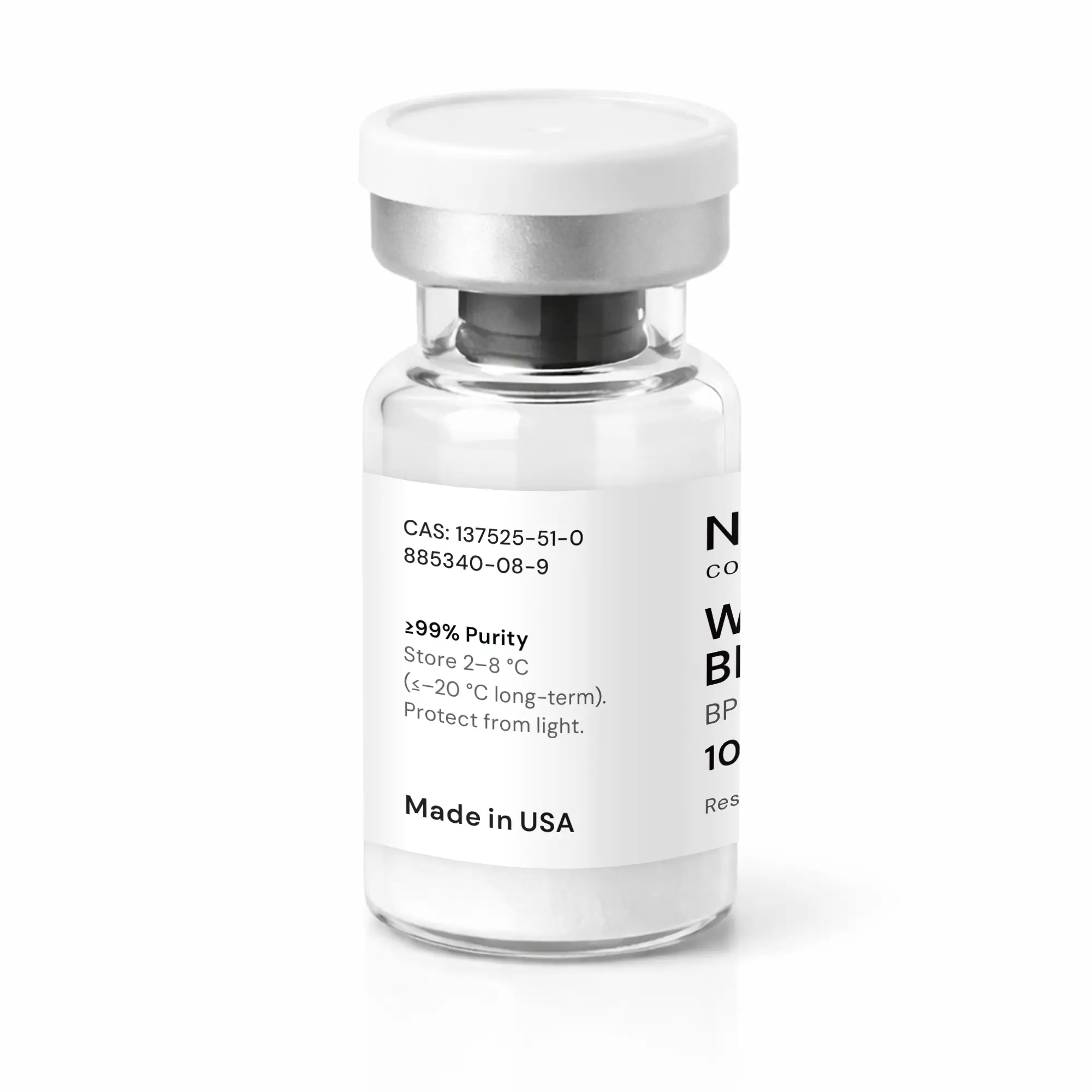
CAS: BPC-157: 137525-51-0 TB500: 885340-08-9
Chemical Formula: BPC-157: C₆₂H₉₈N₁₆O₂₂ TB500: C₃₈H₆₈N₁₀O₁₄
Molecular weight: BPC-157: 1419.535 g/mol TB-500(TB-4): 889.0 g/mol
Peptide Sequence: BPC157: Gly-Glu-Pro-Pro-Pro-Gly-Lys-Pro-Ala-Asp-Asp-Ala-Gly-Leu-Val TB-500(TB4): Ac-Ser-Asp-Lys-Pro-Asp-Met-Ala-Glu-Ile-Glu-Lys-Phe-Asp-Lys-Ser-Lys-Leu-Lys-Lys-Thr-Glu-Thr-Gln-Glu-Lys-Asn-Pro-Leu-Pro-Ser-Lys-Glu-Thr-Ile-Glu-Gln-Glu-Lys-Gln-Ala-Gly-Glu-Ser
Synonyms: BPC157, TB500, TB-4, tb4, bpc
Storage: Store 2–8 °C (≤–20 °C long-term). RT exposure during transport acceptable. Protect from light.
Shelf life: 24 months from the manufacturing date.
BPC 157 5 mg + TB 500 5 mg is a paired research peptide set often used in healing and regenerative research. It supports studies of tissue response signaling, cell behavior, and cytoskeleton associated pathways in controlled in vitro and preclinical model systems. Provided as two separate vials of defined, high purity lyophilized peptides for parallel or comparative assays, this combination is intended solely for laboratory research use.


Why Choose Medica Depot
Shop hundreds of medical products with no minimums and free shipping on large orders.
 400+ products
 No order minimums
 Free shipping
 Loyalty rewards
 Trusted since 2007
 Account manager
 Verified LOT numbers
INFORMATION
What is BPC-157 5mg + TB-500 5mg?
BPC-157 5mg + TB-500 5mg is a research peptide combination commonly grouped within healing & regenerative research peptides. In laboratory settings, these peptides are primarily used as tools to explore biological signaling and tissue-response models, such as how cells respond to stress, how proteins interact during repair processes, and how signaling pathways change during regeneration-focused experiments.
BPC-157 is a synthetic pentadecapeptide that appears in the research literature primarily in preclinical and in vitro studies investigating tissue responses and related signaling pathways.
TB-500 is a research designation commonly used for thymosin beta-4–related peptide sequences. Thymosin beta-4 has been widely studied in preclinical models for its role in actin dynamics, cell structure and movement, and cellular behavior in repair-oriented contexts.
Product Specifications
- Category: Peptides
- Subcategory: Healing & Regenerative Peptides
- CAS Numbers:
- BPC-157: 137525-51-0
- TB-500: 885340-08-9
- Peptide Sequences:
- BPC-157: Gly-Glu-Pro-Pro-Pro-Gly-Lys-Pro-Ala-Asp-Asp-Ala-Gly-Leu-Val
- TB-500 (TB4): Ac-Ser-Asp-Lys-Pro-Asp-Met-Ala-Glu-Ile-Glu-Lys-Phe-Asp-Lys-Ser-Lys-Leu-Lys-Lys-Thr-Glu-Thr-Gln-Glu-Lys-Asn-Pro-Leu-Pro-Ser-Lys-Glu-Thr-Ile-Glu-Gln-Glu-Lys-Gln-Ala-Gly-Glu-Ser
- Chemical Formula:
- BPC-157: C₆₂H₉₈N₁₆O₂₂
- TB-500(TB-4): C₂₁₂H₃₅₀N₅₆O₇₈S
- Molecular Weight:
- BPC-157: 1419.535 g/mol
- TB-500(TB-4): 889.0 g/mol
- Purity: ≥99% (HPLC‑verified; identity confirmed by standard analytical methods)
- Storage Conditions: Store at -20°C, avoid light exposure
- For Laboratory Research Use Only
Key Characteristics of BPC-157 5mg + TB-500 5mg
- Research-grade identity markers: CAS numbers and defined sequences support documentation and inventory control.
- High stated purity: ≥99% (HPLC‑verified) to support reproducibility in controlled research workflows.
- Used in preclinical research contexts: Discussed in literature mainly in in-vitro and animal models, not as validated clinical outcomes.
- Light/temperature sensitivity considerations: Commonly stored frozen and protected from light to help maintain integrity.
- Combination format: Convenient for labs running parallel assays that compare pathways associated with tissue response, cell migration, and protein signaling models.
How BPC-157 5mg + TB-500 5mg Supports Research
In research settings, this peptide combination is generally used as a set of experimental tools to help investigators observe how biological systems behave under controlled conditions. Rather than being “outcomes” themselves, the peptides may be used to probe:
- How cells move and organize (often discussed with TB4-related actin dynamics).
- How tissue response signaling changes under stress or injury models (often discussed in the BPC-157 preclinical literature).
In combination, the paired vials allow investigators to run parallel or comparative experiments that distinguish actin/cytoskeleton-focused responses (often linked to the TB‑500/TB4 literature) from broader tissue-response and barrier-related signaling patterns discussed in the BPC-157 preclinical literature.
Research Applications & Usage Information
BPC-157 5mg + TB-500 5mg is commonly referenced in research contexts such as:
- Tissue-response and regeneration models (preclinical/in-vitro): Used to evaluate changes in healing‑associated endpoints, extracellular matrix behavior, or repair signaling, with BPC-157 and TB-500 run singly or in combination in preclinical designs.
- Cell migration and cytoskeleton studies (often linked to TB4 discussions of actin binding and cell movement).
- Angiogenesis-associated assays in controlled model systems (reported for TB4 in preclinical studies).
- Inflammation- and stress-response signaling research: Investigators track pathway markers, mediator expression, or tissue-response profiles in model systems that may include BPC-157 as a probe.
- Method development/assay validation: Standardized peptides used as controls or probes to confirm detection methods (e.g., identity-linked sequences in documentation).
Note: Published findings for these peptides are predominantly preclinical and should be interpreted within the limits of the model system used.
Handling and Storage Recommendations
- Store frozen at -20°C and protect from light to help maintain peptide integrity.
- Keep containers tightly sealed when not in use to minimize moisture exposure.
Safe Handling
- Handle using standard laboratory PPE (e.g., gloves, eye protection) and work in accordance with your facility’s safety procedures (SOPs).
- Dispose of materials according to institutional biosafety/chemical waste guidance.
Research Use Only Notice
This product is intended for laboratory research use only and is not approved for human or veterinary use. It is not intended for diagnostic, therapeutic, or clinical applications. Any reference to biological activity or potential effects is based solely on preclinical or in-vitro findings and should not be interpreted as validated clinical outcomes. Researchers are responsible for ensuring proper handling, storage, and disposal in accordance with institutional, federal, and international guidelines.
References
- Chang CH, Tsai WC, Lin MS, Hsu YH, Pang JH. The promoting effect of pentadecapeptide BPC 157 on tendon healing involves tendon outgrowth, cell survival, and cell migration. J Appl Physiol (1985). 2011;110(3):774-780. doi:10.1152/japplphysiol.00945.2010
- Staresinic M, Sebecic B, Patrlj L, et al. Gastric pentadecapeptide BPC 157 accelerates healing of transected rat Achilles tendon and in vitro stimulates tendocytes growth. J Orthop Res. 2003;21(6):976-983. doi:10.1016/S0736-0266(03)00110-4
- Goldstein AL, Hannappel E, Sosne G, Kleinman HK. Thymosin β4: a multi-functional regenerative peptide. Basic properties and clinical applications. Expert Opin Biol Ther. 2012;12(1):37-51. doi:10.1517/14712598.2012.634793
- Esposito S, Deventer K, Goeman J, Van der Eycken J, Van Eenoo P. Synthesis and characterization of the N-terminal acetylated 17-23 fragment of thymosin beta 4 identified in TB-500, a product suspected to possess doping potential. Drug Test Anal. 2012;4(9):733-738. doi:10.1002/dta.1402
What is BPC-157 5mg + TB-500 5mg?
BPC-157 5mg + TB-500 5mg is a research peptide combination commonly grouped within healing & regenerative research peptides. In laboratory settings, these peptides are primarily used as tools to explore biological signaling and tissue-response models, such as how cells respond to stress, how proteins interact during repair processes, and how signaling pathways change during regeneration-focused experiments.
BPC-157 is a synthetic pentadecapeptide that appears in the research literature primarily in preclinical and in vitro studies investigating tissue responses and related signaling pathways.
TB-500 is a research designation commonly used for thymosin beta-4–related peptide sequences. Thymosin beta-4 has been widely studied in preclinical models for its role in actin dynamics, cell structure and movement, and cellular behavior in repair-oriented contexts.
Product Specifications
- Category: Peptides
- Subcategory: Healing & Regenerative Peptides
- CAS Numbers:
- BPC-157: 137525-51-0
- TB-500: 885340-08-9
- Peptide Sequences:
- BPC-157: Gly-Glu-Pro-Pro-Pro-Gly-Lys-Pro-Ala-Asp-Asp-Ala-Gly-Leu-Val
- TB-500 (TB4): Ac-Ser-Asp-Lys-Pro-Asp-Met-Ala-Glu-Ile-Glu-Lys-Phe-Asp-Lys-Ser-Lys-Leu-Lys-Lys-Thr-Glu-Thr-Gln-Glu-Lys-Asn-Pro-Leu-Pro-Ser-Lys-Glu-Thr-Ile-Glu-Gln-Glu-Lys-Gln-Ala-Gly-Glu-Ser
- Chemical Formula:
- BPC-157: C₆₂H₉₈N₁₆O₂₂
- TB-500(TB-4): C₂₁₂H₃₅₀N₅₆O₇₈S
- Molecular Weight:
- BPC-157: 1419.535 g/mol
- TB-500(TB-4): 889.0 g/mol
- Purity: ≥99% (HPLC‑verified; identity confirmed by standard analytical methods)
- Storage Conditions: Store at -20°C, avoid light exposure
- For Laboratory Research Use Only
Key Characteristics of BPC-157 5mg + TB-500 5mg
- Research-grade identity markers: CAS numbers and defined sequences support documentation and inventory control.
- High stated purity: ≥99% (HPLC‑verified) to support reproducibility in controlled research workflows.
- Used in preclinical research contexts: Discussed in literature mainly in in-vitro and animal models, not as validated clinical outcomes.
- Light/temperature sensitivity considerations: Commonly stored frozen and protected from light to help maintain integrity.
- Combination format: Convenient for labs running parallel assays that compare pathways associated with tissue response, cell migration, and protein signaling models.
How BPC-157 5mg + TB-500 5mg Supports Research
In research settings, this peptide combination is generally used as a set of experimental tools to help investigators observe how biological systems behave under controlled conditions. Rather than being “outcomes” themselves, the peptides may be used to probe:
- How cells move and organize (often discussed with TB4-related actin dynamics).
- How tissue response signaling changes under stress or injury models (often discussed in the BPC-157 preclinical literature).
In combination, the paired vials allow investigators to run parallel or comparative experiments that distinguish actin/cytoskeleton-focused responses (often linked to the TB‑500/TB4 literature) from broader tissue-response and barrier-related signaling patterns discussed in the BPC-157 preclinical literature.
Research Applications & Usage Information
BPC-157 5mg + TB-500 5mg is commonly referenced in research contexts such as:
- Tissue-response and regeneration models (preclinical/in-vitro): Used to evaluate changes in healing‑associated endpoints, extracellular matrix behavior, or repair signaling, with BPC-157 and TB-500 run singly or in combination in preclinical designs.
- Cell migration and cytoskeleton studies (often linked to TB4 discussions of actin binding and cell movement).
- Angiogenesis-associated assays in controlled model systems (reported for TB4 in preclinical studies).
- Inflammation- and stress-response signaling research: Investigators track pathway markers, mediator expression, or tissue-response profiles in model systems that may include BPC-157 as a probe.
- Method development/assay validation: Standardized peptides used as controls or probes to confirm detection methods (e.g., identity-linked sequences in documentation).
Note: Published findings for these peptides are predominantly preclinical and should be interpreted within the limits of the model system used.
Handling and Storage Recommendations
- Store frozen at -20°C and protect from light to help maintain peptide integrity.
- Keep containers tightly sealed when not in use to minimize moisture exposure.
Safe Handling
- Handle using standard laboratory PPE (e.g., gloves, eye protection) and work in accordance with your facility’s safety procedures (SOPs).
- Dispose of materials according to institutional biosafety/chemical waste guidance.
Research Use Only Notice
This product is intended for laboratory research use only and is not approved for human or veterinary use. It is not intended for diagnostic, therapeutic, or clinical applications. Any reference to biological activity or potential effects is based solely on preclinical or in-vitro findings and should not be interpreted as validated clinical outcomes. Researchers are responsible for ensuring proper handling, storage, and disposal in accordance with institutional, federal, and international guidelines.
References
- Chang CH, Tsai WC, Lin MS, Hsu YH, Pang JH. The promoting effect of pentadecapeptide BPC 157 on tendon healing involves tendon outgrowth, cell survival, and cell migration. J Appl Physiol (1985). 2011;110(3):774-780. doi:10.1152/japplphysiol.00945.2010
- Staresinic M, Sebecic B, Patrlj L, et al. Gastric pentadecapeptide BPC 157 accelerates healing of transected rat Achilles tendon and in vitro stimulates tendocytes growth. J Orthop Res. 2003;21(6):976-983. doi:10.1016/S0736-0266(03)00110-4
- Goldstein AL, Hannappel E, Sosne G, Kleinman HK. Thymosin β4: a multi-functional regenerative peptide. Basic properties and clinical applications. Expert Opin Biol Ther. 2012;12(1):37-51. doi:10.1517/14712598.2012.634793
- Esposito S, Deventer K, Goeman J, Van der Eycken J, Van Eenoo P. Synthesis and characterization of the N-terminal acetylated 17-23 fragment of thymosin beta 4 identified in TB-500, a product suspected to possess doping potential. Drug Test Anal. 2012;4(9):733-738. doi:10.1002/dta.1402
This content was prepared and reviewed under our editorial guidelines , which govern how we source, verify, and update clinical and product information. Every claim is checked against peer-reviewed research, manufacturer documentation, or regulatory guidance before publication.
Product authenticity is an important part of making informed decisions in medical aesthetics and pharmaceuticals. Medica Depot provides information for clinics and practitioners on how to check authenticity claims. Learn more about how we recognize authentic products.
Related products