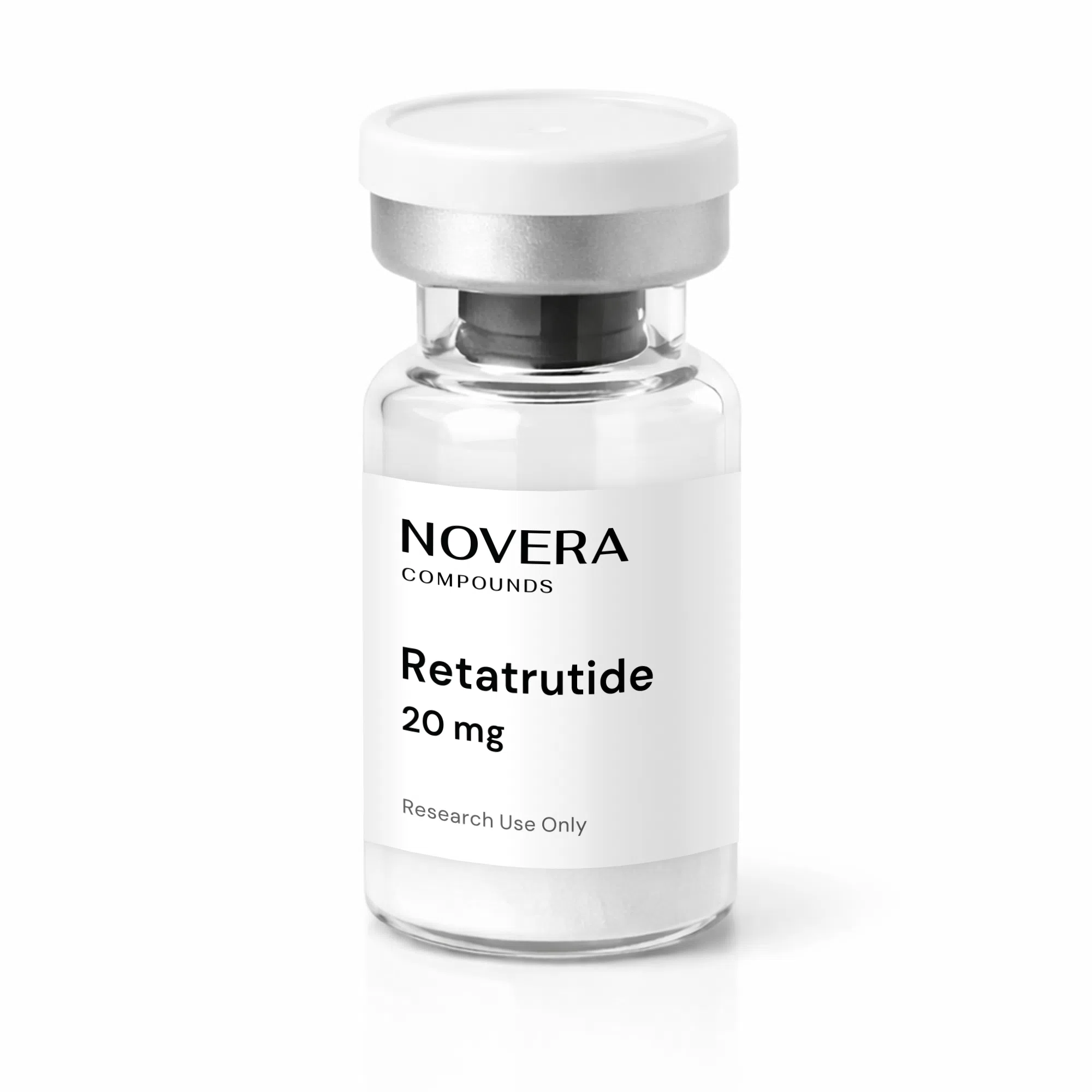
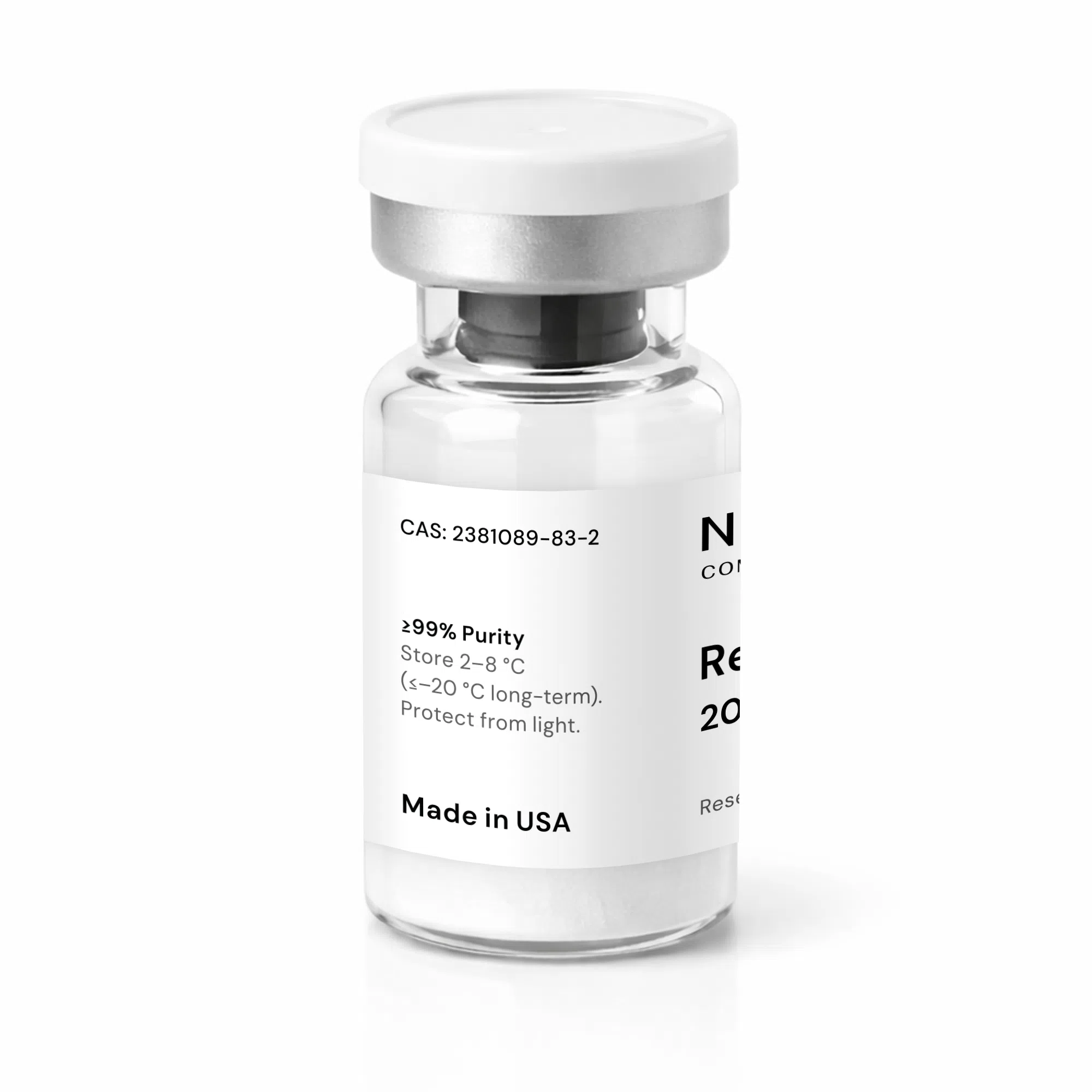
Retatrutide 20mg
Strength: 20mg
CAS: 2381089-83-2
Chemical Formula: C₂₂₁H₃₄₂N₄₆O₆₈
Molecular weight: 4845.444 g/mol
Peptide Sequence: Tyr-{Aib}-Gln-Gly-Thr-Phe-Thr-Ser-Asp-Tyr-Ser-Ile-{α-Me-Leu}-Leu-Asp-Lys-{diacid-C20-gamma-Glu-(AEEA)-Lys}-Ala-Gln-{Aib}-Ala-Phe-Ile-Glu-Tyr-Leu-Leu-Glu-Gly-Gly-Pro-Ser-Ser-Gly-Ala-Pro-Pro-Pro-Ser-NH2 (Sodium salt)
Synonyms: Retatrutide acetate, LY3437943
Storage: Store 2–8 °C (≤–20 °C long-term). RT exposure during transport acceptable. Protect from light.
Shelf life: 24 months from the manufacturing date.
Retatrutide is a synthetic triple-receptor agonist peptide designed to engage GLP-1, GIP, and glucagon receptors in experimental systems. Supplied as high-purity lyophilized powder, it is used in laboratory and preclinical research models to investigate multi-pathway metabolic signaling, energy homeostasis, and coordinated endocrine receptor activation. Intended strictly for controlled in vitro and in vivo research applications.


Why Choose Medica Depot
Shop hundreds of medical products with no minimums and free shipping on large orders.
 400+ products
 No order minimums
 Free shipping
 Loyalty rewards
 Trusted since 2007
 Account manager
 Verified LOT numbers
INFORMATION
What is Retatrutide (20 mg)?
Retatrutide (20 mg) is a synthetic peptide designed for metabolic and endocrine research. It functions as a triple receptor agonist at the GIP, GLP-1, and glucagon receptors. Researchers commonly use it in studies of weight loss and metabolic peptides. Researchers investigate how the simultaneous activation of these pathways influences metabolic outcomes, glucose control, and overall energy balance in metabolic dysregulation and energy balance models.
Retatrutide is used in preclinical models to explore how coordinated receptor activation can impact glucose metabolism, lipid accumulation, appetite regulation, and systemic energy regulation. All applications are strictly for laboratory studies and preclinical research use only.
Product Specifications
- CAS Number: 2381089-83-2
- Synonyms: Retatrutide acetate, LY3437943
- Peptide Sequence: Tyr-{Aib}-Gln-Gly-Thr-Phe-Thr-Ser-Asp-Tyr-Ser-Ile-{α-Me-Leu}-Leu-Asp-Lys-{diacid-C20-gamma-Glu-(AEEA)-Lys}-Ala-Gln-{Aib}-Ala-Phe-Ile-Glu-Tyr-Leu-Leu-Glu-Gly-Gly-Pro-Ser-Ser-Gly-Ala-Pro-Pro-Pro-Ser-NH2 (Sodium salt)
- Molecular Formula: C₂₂₁H₃₄₂N₄₆O₆₈
- Molecular Weight: 4845.444 g/mol
- Purity: Supplied as a high-purity research peptide (typically ≥98–99% by HPLC). Identity and purity are confirmed using chromatographic methods and mass spectrometry. Lot-specific results are available in the certificate of analysis (COA).
- Packaging Format: 20 mg of lyophilized (freeze-dried) Retatrutide acetate in a sealed vial, suitable for preparing controlled stocks for in vitro assays and other qualified research workflows.
- Storage Conditions: Store refrigerated at 2–8 °C. For periods of non-use, maintain at ≤–20 °C. Protect from light.
- Intended Use: For laboratory research use only; not for human or veterinary use.
Key Characteristics of Retatrutide (20 mg)
- Triple-Receptor Agonist Design: Retatrutide activates GIP, GLP-1, and glucagon receptors in experimental systems. In vitro assays show relatively balanced GLP-1 and glucagon receptor activity, with stronger GIP receptor potency reported in some assay systems.
- Engagement of Incretin and Glucagon Pathways: GLP-1 and GIP signaling are commonly associated with appetite regulation and glucose control. At the same time, glucagon receptor activity is being explored for its role in energy expenditure, lipid oxidation, and thermogenesis.
- Metabolic and Weight-Regulation Focus: In metabolic dysregulation models, Retatrutide is connected with modulating body mass and regulating glucose pathways. Early studies have compared its effects with single- and dual-agonist approaches to evaluate the magnitude and durability of metabolic effects.
- Sustained Signaling Kinetics: Pharmacokinetic data suggest prolonged receptor interaction, supporting ongoing signaling effects in preclinical models.
- Research-Grade Analytical Documentation: Each batch is supported by standard characterization (e.g., COA, HPLC data, and MS confirmation), ensuring consistency across experiments and study sites.
How Retatrutide (20 mg) Supports Research
Retatrutide (20 mg) is a versatile tool for studying multi-receptor incretin/glucagon agonism. It allows researchers to investigate receptor cross-talk, hormonal signaling cascades, and downstream effects on metabolic outcomes in preclinical models. The peptide is useful in comparisons between single-, dual-, and triple-agonist strategies across various endpoints:
- Food Intake and Appetite Regulation
- Energy Expenditure and Substrate Utilization
- Glucose Pathway Regulation and Insulin Secretion Dynamics
- Lipid Handling and Metabolic Flexibility
Retatrutide also provides a structured context for research into dose-response relationships, safety monitoring, and the durability of metabolic changes.
Research Applications & Usage Information
Researchers use Retatrutide (20 mg) in:
- Metabolic Studies: Studied in rodent models to evaluate body mass modulation, energy expenditure, and diet-induced metabolic responses.
- Glucose Regulation Studies: Investigated for its effects on glucose pathways, including insulin secretion and regulation in metabolic dysregulation models.
- Mechanistic Incretin/Glucagon Research: Used to isolate the contributions of each receptor in appetite regulation, insulin sensitivity, lipid handling, and whole-body energy regulation.
- Cardiometabolic Endpoints in Research: Explored in studies measuring metabolic markers and energy balance in preclinical models.
- Oncology Metabolism Research: In some preclinical cancer studies, researchers have observed retatrutide-associated weight changes alongside shifts in tumor-related metabolic outcomes.
Handling and Storage Recommendations
- Store the sealed vial refrigerated at 2–8 °C. For periods of non-use, maintain at ≤–20 °C. Protect from light.
- Avoid repeated temperature cycling.
- Handle using standard laboratory PPE (gloves, lab coat, eye protection) and follow good laboratory practices for bioactive peptides.
- Label all prepared research materials clearly and adhere to institutional stability controls and disposal protocols for unused or contaminated materials.
Research Use Only Notice
This product is intended for laboratory research use only and is not approved for human or veterinary use. It is not intended for diagnostic, therapeutic, or clinical applications. Any reference to biological activity or potential effects is based solely on preclinical or in‑vitro findings and should not be interpreted as validated clinical outcomes. Researchers are responsible for ensuring proper handling, storage, and disposal in accordance with institutional, federal, and international guidelines.
References
- Coskun T, Urva S, Roell WC, et al. LY3437943, a novel triple glucagon, GIP, and GLP-1 receptor agonist for glycemic control and weight loss: From discovery to clinical proof of concept. Cell Metab. 2022;34(9):1234-1247.e9. doi:10.1016/j.cmet.2022.07.013
- Jastreboff AM, Kaplan LM, Frías JP, et al. Triple-Hormone-Receptor Agonist Retatrutide for Obesity – A Phase 2 Trial. N Engl J Med. 2023;389(6):514-526. doi:10.1056/NEJMoa2301972
- Sanyal AJ, Kaplan LM, Frias JP, et al. Triple hormone receptor agonist retatrutide for metabolic dysfunction-associated steatotic liver disease: a randomized phase 2a trial. Nat Med. 2024;30(7):2037-2048. doi:10.1038/s41591-024-03018-2
- Ma J, Hu X, Zhang W, Tao M, Wang M, Lu W. Comparison of the effects of Liraglutide, Tirzepatide, and Retatrutide on diabetic kidney disease in db/db mice. Endocrine. 2025;87(1):159-169. doi:10.1007/s12020-024-03998-8
What is Retatrutide (20 mg)?
Retatrutide (20 mg) is a synthetic peptide designed for metabolic and endocrine research. It functions as a triple receptor agonist at the GIP, GLP-1, and glucagon receptors. Researchers commonly use it in studies of weight loss and metabolic peptides. Researchers investigate how the simultaneous activation of these pathways influences metabolic outcomes, glucose control, and overall energy balance in metabolic dysregulation and energy balance models.
Retatrutide is used in preclinical models to explore how coordinated receptor activation can impact glucose metabolism, lipid accumulation, appetite regulation, and systemic energy regulation. All applications are strictly for laboratory studies and preclinical research use only.
Product Specifications
- CAS Number: 2381089-83-2
- Synonyms: Retatrutide acetate, LY3437943
- Peptide Sequence: Tyr-{Aib}-Gln-Gly-Thr-Phe-Thr-Ser-Asp-Tyr-Ser-Ile-{α-Me-Leu}-Leu-Asp-Lys-{diacid-C20-gamma-Glu-(AEEA)-Lys}-Ala-Gln-{Aib}-Ala-Phe-Ile-Glu-Tyr-Leu-Leu-Glu-Gly-Gly-Pro-Ser-Ser-Gly-Ala-Pro-Pro-Pro-Ser-NH2 (Sodium salt)
- Molecular Formula: C₂₂₁H₃₄₂N₄₆O₆₈
- Molecular Weight: 4845.444 g/mol
- Purity: Supplied as a high-purity research peptide (typically ≥98–99% by HPLC). Identity and purity are confirmed using chromatographic methods and mass spectrometry. Lot-specific results are available in the certificate of analysis (COA).
- Packaging Format: 20 mg of lyophilized (freeze-dried) Retatrutide acetate in a sealed vial, suitable for preparing controlled stocks for in vitro assays and other qualified research workflows.
- Storage Conditions: Store refrigerated at 2–8 °C. For periods of non-use, maintain at ≤–20 °C. Protect from light.
- Intended Use: For laboratory research use only; not for human or veterinary use.
Key Characteristics of Retatrutide (20 mg)
- Triple-Receptor Agonist Design: Retatrutide activates GIP, GLP-1, and glucagon receptors in experimental systems. In vitro assays show relatively balanced GLP-1 and glucagon receptor activity, with stronger GIP receptor potency reported in some assay systems.
- Engagement of Incretin and Glucagon Pathways: GLP-1 and GIP signaling are commonly associated with appetite regulation and glucose control. At the same time, glucagon receptor activity is being explored for its role in energy expenditure, lipid oxidation, and thermogenesis.
- Metabolic and Weight-Regulation Focus: In metabolic dysregulation models, Retatrutide is connected with modulating body mass and regulating glucose pathways. Early studies have compared its effects with single- and dual-agonist approaches to evaluate the magnitude and durability of metabolic effects.
- Sustained Signaling Kinetics: Pharmacokinetic data suggest prolonged receptor interaction, supporting ongoing signaling effects in preclinical models.
- Research-Grade Analytical Documentation: Each batch is supported by standard characterization (e.g., COA, HPLC data, and MS confirmation), ensuring consistency across experiments and study sites.
How Retatrutide (20 mg) Supports Research
Retatrutide (20 mg) is a versatile tool for studying multi-receptor incretin/glucagon agonism. It allows researchers to investigate receptor cross-talk, hormonal signaling cascades, and downstream effects on metabolic outcomes in preclinical models. The peptide is useful in comparisons between single-, dual-, and triple-agonist strategies across various endpoints:
- Food Intake and Appetite Regulation
- Energy Expenditure and Substrate Utilization
- Glucose Pathway Regulation and Insulin Secretion Dynamics
- Lipid Handling and Metabolic Flexibility
Retatrutide also provides a structured context for research into dose-response relationships, safety monitoring, and the durability of metabolic changes.
Research Applications & Usage Information
Researchers use Retatrutide (20 mg) in:
- Metabolic Studies: Studied in rodent models to evaluate body mass modulation, energy expenditure, and diet-induced metabolic responses.
- Glucose Regulation Studies: Investigated for its effects on glucose pathways, including insulin secretion and regulation in metabolic dysregulation models.
- Mechanistic Incretin/Glucagon Research: Used to isolate the contributions of each receptor in appetite regulation, insulin sensitivity, lipid handling, and whole-body energy regulation.
- Cardiometabolic Endpoints in Research: Explored in studies measuring metabolic markers and energy balance in preclinical models.
- Oncology Metabolism Research: In some preclinical cancer studies, researchers have observed retatrutide-associated weight changes alongside shifts in tumor-related metabolic outcomes.
Handling and Storage Recommendations
- Store the sealed vial refrigerated at 2–8 °C. For periods of non-use, maintain at ≤–20 °C. Protect from light.
- Avoid repeated temperature cycling.
- Handle using standard laboratory PPE (gloves, lab coat, eye protection) and follow good laboratory practices for bioactive peptides.
- Label all prepared research materials clearly and adhere to institutional stability controls and disposal protocols for unused or contaminated materials.
Research Use Only Notice
This product is intended for laboratory research use only and is not approved for human or veterinary use. It is not intended for diagnostic, therapeutic, or clinical applications. Any reference to biological activity or potential effects is based solely on preclinical or in‑vitro findings and should not be interpreted as validated clinical outcomes. Researchers are responsible for ensuring proper handling, storage, and disposal in accordance with institutional, federal, and international guidelines.
References
- Coskun T, Urva S, Roell WC, et al. LY3437943, a novel triple glucagon, GIP, and GLP-1 receptor agonist for glycemic control and weight loss: From discovery to clinical proof of concept. Cell Metab. 2022;34(9):1234-1247.e9. doi:10.1016/j.cmet.2022.07.013
- Jastreboff AM, Kaplan LM, Frías JP, et al. Triple-Hormone-Receptor Agonist Retatrutide for Obesity – A Phase 2 Trial. N Engl J Med. 2023;389(6):514-526. doi:10.1056/NEJMoa2301972
- Sanyal AJ, Kaplan LM, Frias JP, et al. Triple hormone receptor agonist retatrutide for metabolic dysfunction-associated steatotic liver disease: a randomized phase 2a trial. Nat Med. 2024;30(7):2037-2048. doi:10.1038/s41591-024-03018-2
- Ma J, Hu X, Zhang W, Tao M, Wang M, Lu W. Comparison of the effects of Liraglutide, Tirzepatide, and Retatrutide on diabetic kidney disease in db/db mice. Endocrine. 2025;87(1):159-169. doi:10.1007/s12020-024-03998-8
This content was prepared and reviewed under our editorial guidelines , which govern how we source, verify, and update clinical and product information. Every claim is checked against peer-reviewed research, manufacturer documentation, or regulatory guidance before publication.
Related products